
F.Q. Story Dining Rooms: Keep, Combine, or Remove in a Small Historic Home?
Dining rooms in the F.Q. Story Historic District occupy an awkward position in many homes. They are often too small to feel generous, yet too important architecturally to ignore. Homeowners frequently look at these rooms and ask a reasonable question: should we keep the dining room as-is, combine it with adjacent spaces, or remove it entirely?
In compact historic homes, this decision has consequences that reach far beyond one room. What feels like a simple layout change can reshape how the entire house functions on a daily basis.
Why Dining Rooms Feel Redundant in F.Q. Story Homes
Most F.Q. Story homes were built in the 1940s, when formal dining was still a daily expectation. Dining rooms were proportioned for modest furniture and predictable circulation.
Today, eating habits have shifted. Casual dining, kitchen seating, and flexible living spaces reduce reliance on a dedicated dining room. As a result, these rooms often feel underused.
The core decision tension is flexibility versus definition. In small homes, definition still matters.
Furniture Dictates Success More Than Walls
In small dining rooms, furniture fit determines usability. Removing walls without accounting for table size, chair clearance, and circulation often results in spaces that look open but function poorly.
When dining rooms are combined with living spaces, furniture zones must be carefully planned or the room becomes visually and physically congested.
Before removing boundaries, realistic furniture layouts should guide decisions.
Partial Combination Often Outperforms Full Removal
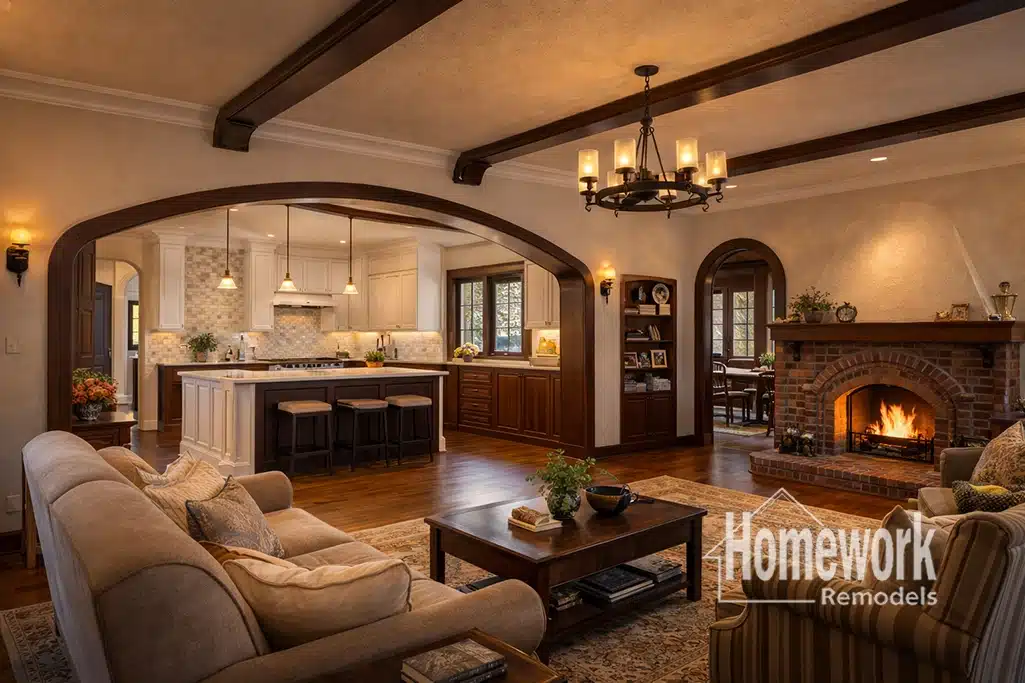
Many F.Q. Story homes benefit from partial combinations rather than full demolition. Widened openings, cased transitions, or half-height separations preserve room identity while improving flow.
These solutions maintain visual order and support furniture placement, while allowing flexibility for entertaining and daily use.
The decision tension is openness versus control. Control often creates better everyday living.
Lighting and Ceiling Cues Replace Walls
When walls are reduced or removed, lighting and ceiling treatments become critical. Without cues, combined spaces can feel flat and undefined.
Strategic lighting zones and subtle ceiling changes help maintain function without reintroducing barriers. These details matter more in small homes than in large ones.
Storage Is Often the Hidden Casualty
Dining rooms frequently provide wall space for storage, buffets, or cabinetry. Removing the room eliminates these opportunities.
In small homes, lost storage quickly creates clutter elsewhere. Successful combinations plan replacement storage intentionally.
Circulation Patterns Should Remain Predictable
Dining rooms often act as buffers between living and kitchen spaces. Removing them entirely can force traffic through seating areas or disrupt quiet zones.
Preserving clear circulation paths keeps small homes comfortable even when spaces are shared.
The decision tension is convenience versus calm. Calm sustains livability.
Resale Expectations Still Exist
While personal use drives remodeling, resale perception matters. Buyers in historic neighborhoods often expect some degree of room definition.
Homes that eliminate dining rooms entirely may feel less balanced to future buyers than those that adapt them thoughtfully.
Understanding how whole-home remodeling in Phoenix evaluates room relationships helps homeowners make decisions that age well.
Structural Considerations Are Not Always Obvious
Walls between dining and living rooms may carry structural loads, especially in older construction. Removing them can introduce beams or posts that affect aesthetics.
Homeowners should understand what is involved in removing load-bearing walls in Phoenix’s older homes before committing to full openness.
Structural compromises are difficult to undo.
When Keeping the Dining Room Makes Sense
In some F.Q. Story homes, keeping the dining room intact—while updating finishes, lighting, and furniture—delivers the best balance.
A defined dining space can provide rhythm and function without feeling outdated when designed intentionally.
The decision tension is change for change’s sake versus purposeful improvement.
Why Design-Build Helps Avoid Regret
Design-build remodeling allows dining room decisions to be evaluated within the context of structure, furniture, circulation, and future plans.
This integrated approach prevents impulsive wall removal and supports solutions that improve daily life rather than complicate it.
Learning how the design-build remodeling process works helps homeowners navigate these nuanced decisions confidently.
The Core Decision Tension: Open Space or Organized Space
In F.Q. Story homes, space is precious—but organization is priceless. Dining rooms that are adapted thoughtfully continue to serve a purpose, even if that purpose evolves.
The best solutions respect scale, furniture, and flow rather than chasing openness alone.
A Note for Homeowners…
Many of the questions raised in this article—around planning, cost, timing, and long-term outcomes—are part of a broader remodeling system that most homeowners aren’t shown upfront.
Our Core Guides were created to explain why remodeling often feels unpredictable and what actually brings clarity and stability before construction begins.
Let’s Decide What Role Your Dining Room Should Play
If you are reconsidering a dining room in an F.Q. Story Historic District home, careful planning can prevent common pitfalls. With neighborhood-specific experience and an integrated design-build approach, it is possible to adapt the space without sacrificing function or balance.
We invite you to schedule a free remodeling consultation to explore options tailored to how your home is actually used.