
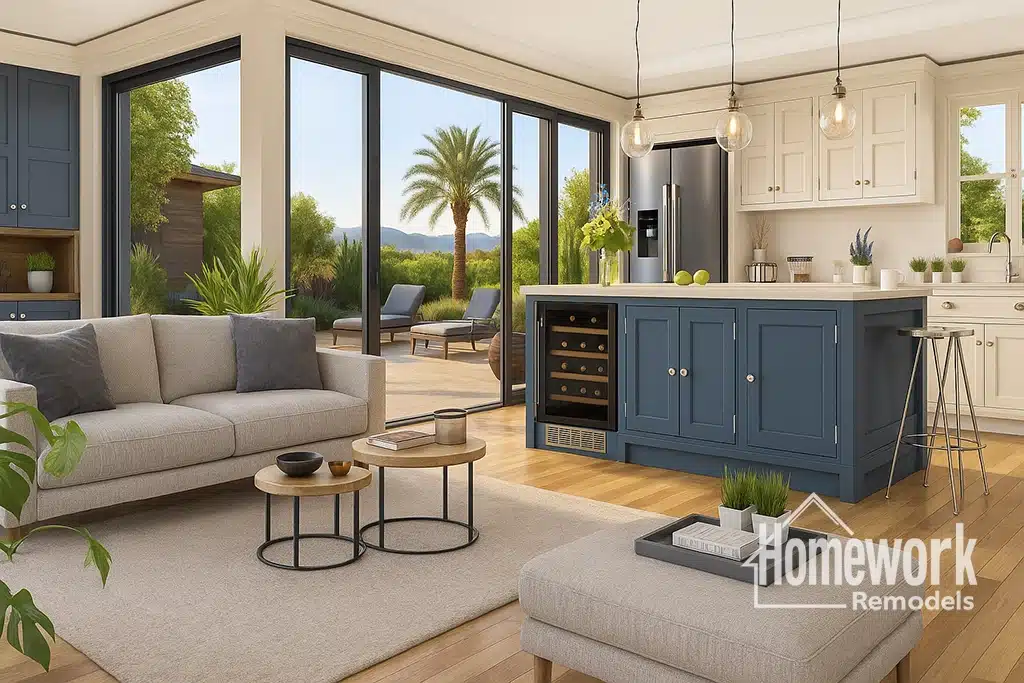
The Benefits of Combining Living and Kitchen Spaces
For many Scottsdale homeowners, the kitchen and living room no longer feel like separate destinations. Cooking, entertaining, working, and relaxing often happen simultaneously, and the walls that once divided these spaces can feel more restrictive than helpful. It’s no surprise that combining kitchen and living areas has become one of the most requested changes in whole-home remodeling.
But this decision is not simply about removing walls. It’s about understanding how shared spaces actually function—and whether combining them improves daily life or introduces new compromises.
Why the Kitchen Became the Center of the Home
Older Scottsdale homes were designed around separation. Kitchens were utilitarian spaces, often tucked away from formal living and dining rooms. Entertaining happened elsewhere. Cooking was largely unseen.
Today, kitchens serve as gathering places. Family members linger. Guests congregate. Meals blend into conversation. This shift is one of the primary drivers behind open layouts, especially in homes where square footage exists but flow does not.
In many whole-home remodeling in Scottsdale projects, combining living and kitchen spaces allows homeowners to fully use the footprint they already have—without adding square footage.
The Decision Tension: Togetherness vs. Functional Separation
While openness encourages connection, it also removes boundaries that once served practical purposes. Noise travels farther. Cooking messes become visible. Lighting requirements multiply.
The key question is not whether openness is desirable, but how much integration supports your lifestyle. For some households, a fully combined space enhances daily interaction. For others, partial separation provides balance.
Understanding this tension early prevents disappointment later.
How Combined Spaces Change Daily Use Patterns
When kitchens and living areas merge, movement patterns change. Circulation paths often shift through the kitchen. Furniture placement must accommodate both traffic and function. Storage becomes more critical because clutter has nowhere to hide.
Successful combined spaces are designed around behavior, not aesthetics alone. Appliance placement, island orientation, and seating zones all influence whether the space feels fluid or chaotic.
This is why layout planning often matters more than finish selection when evaluating open concepts.
Structural Considerations That Influence Openness
Combining living and kitchen spaces frequently involves structural changes. Load-bearing walls may need to be removed or reconfigured, and ceiling structures must be evaluated carefully.
In Scottsdale homes, especially ranch-style layouts, roof loads are often carried through interior walls. Understanding these conditions early helps homeowners avoid surprises during construction. Exploring options through removing load-bearing walls safely clarifies what level of openness is realistic.
In some cases, partial openings or wide cased transitions deliver many of the benefits of openness without requiring extensive structural intervention.
Lighting Becomes More Complex—And More Important
Lighting requirements increase significantly when spaces are combined. A single fixture type rarely serves both cooking tasks and relaxation needs.
Layered lighting—task, ambient, and accent—is essential in open layouts. Kitchens require focused illumination, while living areas benefit from softer, adjustable light. Without thoughtful planning, combined spaces can feel either too bright or not functional enough.
This complexity reinforces the importance of addressing lighting early in the design process rather than treating it as a finishing detail.
Ventilation, Acoustics, and Comfort
Open kitchens introduce smells, heat, and sound into adjacent living spaces. Effective ventilation becomes more important—not just for comfort, but for maintaining indoor air quality.
Similarly, acoustics matter. Hard surfaces common in kitchens can amplify sound, making living areas feel louder than expected. Area rugs, ceiling treatments, and soft furnishings play a larger role in open layouts.
In Scottsdale’s climate, HVAC zoning and airflow also deserve attention. Combined spaces often require adjustments to ensure even cooling across larger volumes.
Furniture and Zoning Define Success
One of the most overlooked aspects of combining living and kitchen spaces is furniture planning. Without walls, furniture becomes the primary tool for defining zones.
Thoughtful furniture layouts help maintain a sense of order. Seating orientation, rug placement, and scale all contribute to whether the space feels cohesive or undefined.
Open layouts work best when zones are clearly implied—even if they aren’t physically separated.
When Partial Integration Works Better
Full openness isn’t always the answer. In some homes, maintaining a degree of separation—through half walls, columns, or ceiling changes—supports both connection and functionality.
Partial integration can preserve kitchen containment while improving sightlines and movement. It also provides flexibility for future changes, a valuable consideration for homeowners planning to stay long term.
This approach aligns well with a design-build remodeling process, where multiple layout scenarios are explored before committing to a final direction.
Designing for Long-Term Satisfaction
Combining living and kitchen spaces is less about following trends and more about supporting how you live every day. The most successful remodels reflect realistic use patterns, not idealized images.
By weighing togetherness against functionality—and by planning for structure, systems, and daily habits—Scottsdale homeowners can create shared spaces that feel intentional, comfortable, and lasting.
Let’s Explore What Integration Makes Sense for Your Home
Combining kitchen and living spaces works best when it’s tailored to how you actually live—not just how spaces look in photos. If you’re weighing openness against function and comfort, an early planning conversation can help clarify what level of integration fits your home. You can begin by scheduling a free consultation with our design-build team to explore your options.