How Homeowners Accidentally Give Up Control
Most homeowners enter a remodel wanting one thing above all else: control. Not control in the sense of micromanaging every detail, but confidence that decisions are intentional, outcomes are understandable, and surprises are minimized.
What many homeowners don’t realize is that control doesn’t disappear suddenly. It’s something that erodes quietly—often through reasonable, well-intentioned choices made early in the process. By the time homeowners feel like they’ve “lost control,” the shift has already happened.
Understanding how this loss occurs is the first step to preventing it.
Control Is About Understanding, Not Authority
A common misconception is that control comes from making every decision personally or staying deeply involved in day-to-day activities. In reality, control comes from understanding how decisions are made, when they matter, and what their consequences are.
When homeowners feel informed and oriented, they feel in control—even if they’re not handling every detail. When they don’t understand what’s happening or why, anxiety sets in, regardless of how many choices they’re given.
Loss of control is rarely about delegation. It’s about disconnection.
The First Place Control Slips: Deferring Decisions
One of the most common ways homeowners unintentionally give up control is by deferring decisions too long.
Early in a remodel, it feels reasonable to keep options open. Homeowners may say, “We’ll decide that later,” assuming flexibility is being preserved. In reality, deferring decisions often transfers control forward—into a phase where options are fewer, costs are higher, and time pressure is greater.
When decisions are postponed without a clear plan for resolution, they don’t remain neutral. They become liabilities that resurface at the least convenient moment.
This idea sits at the heart of The Remodeling Decision System™, which explains why the timing and sequence of decisions often determine whether homeowners experience confidence or confusion during a remodel.
How Estimates Replace Understanding
Another subtle shift happens when homeowners rely too heavily on early estimates to feel grounded.
Estimates can be useful, but they’re not substitutes for understanding. When homeowners anchor their confidence to numbers rather than to process, they may feel secure early—and destabilized later when numbers change.
At that point, control feels lost because expectations were built on assumptions rather than on resolved information. The issue isn’t that estimates changed. It’s that they were asked to do a job they weren’t designed to do.
When Speed Feels Like Progress
Homeowners often equate momentum with progress. Fast decisions feel productive. Moving quickly feels reassuring. But speed without clarity can quietly undermine control.
Rushed decisions are more likely to be revisited. Revisions introduce friction, cost, and doubt. Over time, homeowners may feel as though they’re reacting rather than directing—responding to circumstances instead of shaping them.
True progress isn’t measured by how fast decisions are made. It’s measured by how well they hold up.
The Hidden Cost of Too Many Choices
Ironically, offering homeowners unlimited choice can reduce their sense of control.
When every option is presented at once, decision-making becomes overwhelming. Homeowners may struggle to prioritize, compare, or even understand what matters most. Instead of feeling empowered, they feel exposed.
Without a framework to guide decisions, choice becomes noise. Control fades not because homeowners lack authority, but because they lack orientation.
How Control Slips During Construction
By the time construction begins, the conditions for control have already been set. If major questions remain unresolved, construction becomes the forcing function.
Decisions that could have been made calmly are now urgent. Costs feel imposed rather than chosen. Timelines feel rigid. Homeowners may feel as though the project is driving them instead of the other way around.
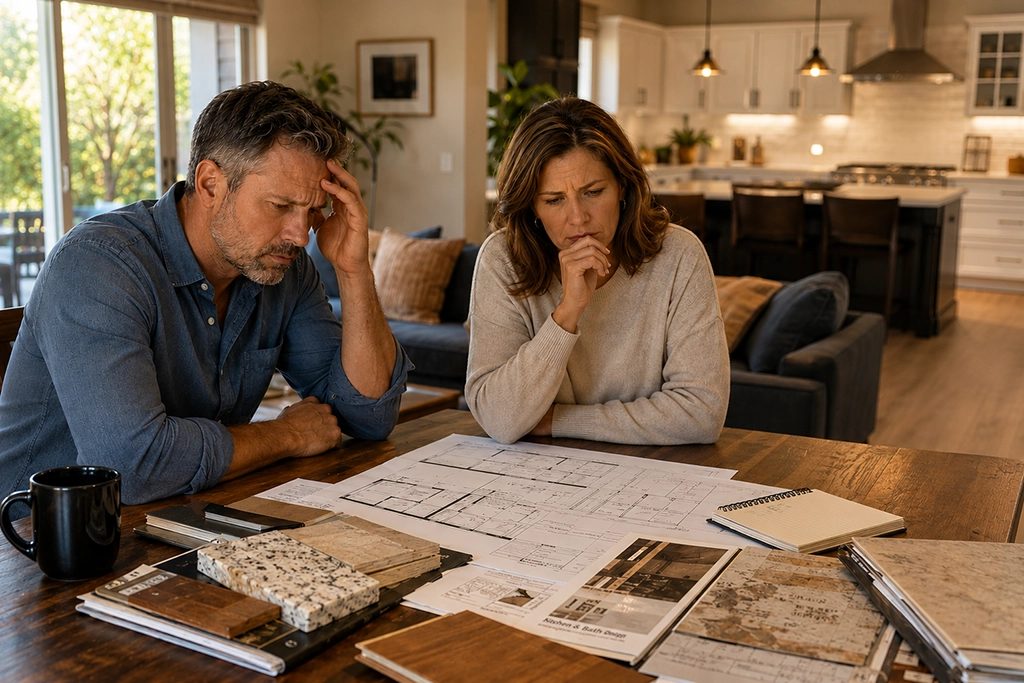
This is often the moment when homeowners say, “I feel like I’ve lost control.” In reality, the loss occurred earlier—when decisions were deferred, assumptions went untested, or clarity was replaced with speed.
Homeowners who want to understand this pattern more deeply may benefit from the Hidden Cost of Remodeling Without a Plan Journey, which explores how unresolved decisions often become construction problems later.
Control Isn’t Reclaimed by Micromanaging
When homeowners sense control slipping, the instinctive response is often to step in more aggressively—questioning every detail, revisiting decisions, or inserting themselves into daily coordination.
While understandable, this rarely restores confidence. It can increase tension, slow progress, and strain relationships without addressing the root cause.
Control isn’t regained through micromanagement. It’s regained through understanding.
How Process Preserves Control
A clear remodeling process acts as a stabilizer. It defines when decisions are made, how they’re evaluated, and what information is required before moving forward.
When homeowners understand the sequence—what’s being decided now, what comes later, and why—they feel oriented. Even when challenges arise, they’re not disorienting because they occur within an understood framework.
The Core Guide How Remodeling Decisions Create (or Destroy) Peace of Mind explains how decision structure, timing, and clarity directly influence whether homeowners feel grounded or overwhelmed during a remodel.
Confidence Comes From Anticipation
One of the strongest indicators of control is anticipation. When homeowners know what decisions are coming and why, they’re mentally prepared.
Surprises feel smaller. Tradeoffs feel intentional. Conversations feel collaborative rather than confrontational. Control is maintained not by eliminating uncertainty, but by expecting it and addressing it deliberately.
Staying Oriented Through the Entire Remodel
Homeowners don’t need perfect foresight to stay in control. They need visibility into the process and support in navigating it.
When clarity replaces guesswork, and preparation replaces reaction, control becomes durable. It doesn’t disappear when the project becomes complex—it holds.
At Homework Remodels, control is treated as an outcome of understanding, not authority. By thoughtfully guiding decisions and intentionally sequencing them, homeowners remain confident participants in their remodel from start to finish.
Remodeling doesn’t have to feel uncertain. Each Core Guide explains one part of the remodeling process clearly—so you can understand what’s happening, why it matters, and how informed decisions shape calmer outcomes over time.
If you’re exploring how planning, decision-making, budgeting, design, and construction work together, the Remodeling Knowledge Center provides a structured collection of homeowner resources organized around the most important remodeling topics and decisions.
Explore the Homeowner Core Guides to see the full homeowner framework.