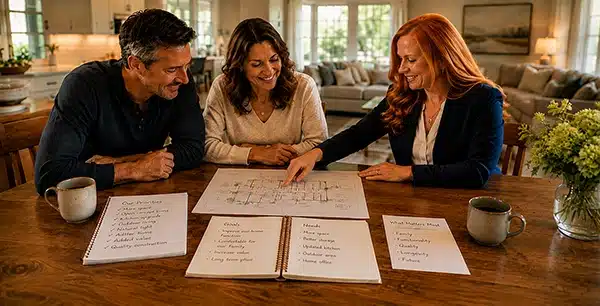
The Remodeling Decision System
The Remodeling Decision System organizes homeowner education into four connected phases, helping you move from life decisions and planning to construction, completion, and a better understanding of how successful remodeling projects actually work.

Understanding the Decisions That Shape Every Remodeling Project
Most homeowners begin remodeling the same way they begin any major undertaking: they start searching for answers. Some want to understand costs. Others want to know how long a project will take. Many are trying to decide whether to remodel their current home, build an addition, remove walls, create a guest house, or move altogether. As questions multiply, homeowners gather information from websites, videos, magazines, social media, neighbors, contractors, architects, designers, and anyone else who seems to have experience they don’t yet have. The search feels productive because remodeling seems like an information problem. If you gather enough information, the path forward should become clear.
Yet many homeowners discover the opposite. The more information they gather, the more complicated remodeling begins to feel. A conversation about costs becomes a conversation about scope. Scope leads to discussions about priorities. Priorities reveal disagreements about goals. Goals expose assumptions about the future. Future plans influence budgets, schedules, design decisions, and countless other choices that seemed unrelated only moments before. What initially seemed like a straightforward remodeling project begins to behave like a system in which every decision influences multiple others.
This experience leads many homeowners to believe that remodeling itself is inherently complicated. In reality, what they are experiencing is the complexity of decision-making. The challenge isn’t that remodeling has too many moving parts. The challenge is that those moving parts are connected. Decisions that appear unrelated often depend deeply on one another. A discussion about entertaining influences space planning. Space planning influences structural requirements. Structural requirements influence investment planning. Investment planning influences priorities. Priorities influence every subsequent decision. The project begins to reveal itself not as a collection of construction activities but as a network of interconnected decisions.
Understanding this distinction changes the way remodeling is viewed. Most homeowners naturally focus on construction because construction is the visible part of the process. They see walls being removed, cabinets being installed, flooring being replaced, and additions taking shape. What they do not see as easily are the hundreds of decisions that made those outcomes possible. Every layout, investment, compromise, priority, and completed space began as a decision. Construction simply gives those decisions physical form. Remodeling is therefore not primarily a construction process. It is a decision-making process that ultimately takes physical form as construction.
Recognizing remodeling as a decision-making process helps explain why so many intelligent, capable homeowners feel uncertain when planning a project. The challenge is rarely a lack of information. The challenge is understanding how information fits together. Homeowners often possess answers before they understand the decisions those answers are intended to support. They may know what kitchens cost before they understand the goals driving the kitchen remodel. They may compare contractors before they understand the project delivery methods being compared. They may evaluate solutions before fully defining the problems they hope to solve. What appears to be a lack of information is frequently a lack of context.
The Remodeling Decision System provides that context. Rather than focusing on individual remodeling topics, it focuses on the decision structure underlying every remodeling project. Its purpose is not to tell homeowners what decisions to make. Its purpose is to help homeowners understand the decisions they make, why those decisions matter, and how they influence every outcome that follows.
The Laws of Remodeling
Over the years, we have observed a recurring pattern among successful remodeling projects. While homes differ, budgets vary, and goals are often unique to each family, the underlying decision challenges remain remarkably consistent. Homeowners may be remodeling a kitchen, planning a whole-home renovation, building a guest house, preserving a historic property, or adapting a home for future accessibility needs, yet the same principles still influence their projects.
These principles are not design trends. They are not construction techniques. They are not rules invented by contractors, architects, or designers. Instead, they are observations about how remodeling actually works. They describe the relationship between decisions, priorities, planning, and outcomes. Whether homeowners recognize them or not, these principles influence every remodeling project because they govern the decision-making process that ultimately shapes construction.
Much like the laws of physics explain the physical world, the Laws of Remodeling explain why remodeling projects succeed, why they become difficult, why uncertainty appears, and why clarity so profoundly influences outcomes. Homeowners who understand these laws often navigate remodeling with greater confidence because they can see the relationships between decisions that otherwise appear disconnected. They begin to understand not only what decisions they must make, but why those decisions matter and how they influence every stage of the journey.
The Laws of Remodeling form the intellectual foundation of The Remodeling Decision System. Together, they provide a framework for understanding the decisions that shape every project, helping homeowners move beyond isolated questions toward a deeper understanding of how remodeling actually works.
Phase 1 — Understanding Remodeling
The First Law of Remodeling
Every Remodeling Project Begins as a Life Decision
Most homeowners describe remodeling in physical terms. They talk about kitchens that feel crowded, bathrooms that no longer meet their needs, living spaces that seem disconnected, or homes that have become increasingly difficult to navigate as life changes around them. They discuss removing walls, building additions, creating guest houses, or reconfiguring rooms to improve functionality. These conversations naturally focus on the visible aspects of remodeling because physical changes are the most obvious expressions of the project.
Yet the physical project is rarely where remodeling truly begins.
Long before homeowners explore floor plans, collect inspiration photos, set budgets, or meet with design professionals, they respond to something deeper than a construction challenge. They are responding to a growing awareness that their home no longer supports their life as effectively as it once did. Sometimes this realization emerges gradually over many years as family routines evolve, children grow older, careers change, entertaining becomes more important, or future plans begin to take shape. In other cases, the realization arrives suddenly through a significant life event such as the arrival of a new child, the need to care for aging parents, a transition to working from home, or a decision to remain in a home for decades longer than originally anticipated.
Regardless of how the realization occurs, the underlying challenge is rarely about walls, cabinets, or square footage. The challenge involves the relationship between the people living in the home and the environment intended to support them. A kitchen that once worked well may now feel disconnected from how family members gather and interact. A home that comfortably accommodated a young family may no longer support teenagers, adult children, or multi-generational living arrangements. Rooms that once felt spacious may begin to feel constrained as lifestyles, priorities, and responsibilities evolve.
These experiences reveal an important truth about remodeling. Homeowners do not pursue remodeling projects simply because they want different rooms. They pursue remodeling projects because they want a home that better supports the life they are trying to live.
This distinction influences every decision that follows. A homeowner who believes the problem is a small kitchen may initially focus on adding square footage, but a deeper look at daily routines may reveal that the real issue lies in the relationship between the kitchen and the surrounding living spaces. Another homeowner may assume an addition is necessary, only to discover that reorganizing existing space can accomplish the same goals more effectively. A family may start by discussing finishes and aesthetics, only to realize that functionality, flexibility, and long-term planning deserve far more attention than decorative selections.
When homeowners focus exclusively on physical solutions, they risk addressing symptoms rather than causes. Remodeling becomes far more effective when you understand the underlying life goals before evaluating physical solutions. A clear understanding of purpose creates a framework for evaluating every design option, planning decision, investment consideration, and construction choice. Decisions become easier because they are measured against a larger objective rather than judged in isolation.
This is one reason thoughtful planning consistently produces better outcomes. Planning is not merely about determining what will be built. The purpose of planning is to understand why it should be built and how the proposed solution will support the goals that inspired the project. Without this understanding, homeowners often evaluate alternatives without a clear standard for comparison. With this understanding, trade-offs become easier to navigate because priorities have already been established.
The remodeling industry naturally focuses on projects because projects are visible. Kitchens can be photographed, additions can be measured, and completed spaces can be showcased as examples of craftsmanship and design. Homeowners, however, rarely begin their remodeling journey by imagining construction details. They imagine family gatherings that feel more comfortable. They imagine welcoming friends into a home designed for hospitality. They imagine aging in place with confidence, creating space for changing family dynamics, or building an environment that supports the routines and experiences they value most. Construction becomes important because it serves those goals, not because it is the goal itself.
This reality explains why two homeowners standing in nearly identical homes can pursue entirely different remodeling solutions. The structure may be similar, but the lives lived within it are not. One family may prioritize connection and entertaining. Another may prioritize privacy and flexibility. One homeowner may be planning for retirement while another is preparing for a growing family. One may value preserving historic character, while another may focus on adapting the home for future accessibility needs. The physical solutions differ because the underlying life decisions differ.
Understanding this principle underpins every other remodeling decision. Before homeowners can make wise decisions about budgets, layouts, schedules, project delivery methods, materials, or construction strategies, they must first understand the life those decisions are intended to support. Every successful remodeling project can ultimately be traced back to a decision about how homeowners want to live, and every physical change that follows expresses that decision.
For this reason, the first and most important remodeling decision is not a design decision, a budget decision, or a contractor decision. It is a decision about the future life the homeowner hopes to create. Once that vision becomes clear, the remaining decisions can align around a common purpose, allowing the project to move forward with greater confidence, greater clarity, and a far greater likelihood of lasting satisfaction.
Learn more about The First Law of Remodeling
The Second Law of Remodeling
Remodeling Is a System of Interconnected Decisions
One reason remodeling feels more complicated than homeowners expect is that most people naturally view it as a series of individual decisions. They decide whether to remodel or move. They decide whether to update a kitchen, renovate a bathroom, remove walls, build an addition, or create a guest house. As planning progresses, they evaluate layouts, compare contractors, establish budgets, select materials, and determine construction priorities. Viewed one decision at a time, the process appears relatively straightforward because each choice seems evaluable on its own.
As homeowners move deeper into planning, however, they begin to discover that remodeling decisions rarely operate in isolation. A homeowner may start by exploring removing a wall between the kitchen and living room. What initially seems like a simple design decision quickly leads to structural questions. Structural questions influence construction methods. Construction methods influence investment requirements. Investment requirements influence project scope. Project scope influences priorities. Priorities influence scheduling. Scheduling influences how the family experiences the remodeling process. A single decision gradually reveals itself as part of a larger network of relationships, where each choice influences many others.
This pattern appears throughout remodeling because remodeling does not function as a collection of isolated choices. It functions as a system. Every decision becomes part of a larger structure that creates opportunities, introduces constraints, clarifies priorities, and exposes trade-offs that may not have been visible at the beginning of the project. Regardless of their nature, decisions shape the environment in which future decisions are made. As the project evolves, each choice adds to a growing web of relationships that ultimately shapes the remodel’s outcome.
Many homeowners become frustrated when they attempt to evaluate individual decisions without fully understanding the larger system in which those decisions are made. They focus on budget before clarifying scope. They evaluate scope before establishing priorities. They compare solutions before clearly defining the problem they hope to solve. They seek certainty about outcomes before understanding the decisions that shape them. The resulting confusion is understandable because individual decisions often appear disconnected when viewed in isolation, even though they are deeply interconnected beneath the surface.
A remodeling project behaves much like any complex system. Changes in one area create consequences in other areas. Adjusting priorities influences investment decisions. Investment decisions influence design options. Design options influence construction requirements. Construction requirements influence schedules, logistics, and homeowner experience. Every component affects multiple others, creating a structure of relationships that becomes increasingly difficult to understand without a framework that reveals how the pieces fit together.
This helps explain why homeowners often feel overwhelmed even when they have gathered significant amounts of information. The challenge is rarely a lack of information. Homeowners may have accurate information about remodeling costs, project schedules, construction methods, and contractor qualifications yet still feel uncertain about the path forward. Information answers individual questions, but understanding emerges when the relationships between those answers become visible. The more clearly homeowners see how one decision influences another, the more confident they become in evaluating options and anticipating consequences.
Consider a homeowner who believes additional square footage solves the problem. The conclusion appears reasonable at first. As planning progresses, however, new questions begin to emerge. Is the problem truly a lack of space, or is the existing space simply organized inefficiently? If additional space is necessary, should it come from an addition, a guest house, or a reconfiguration of the current floor plan? How will each option affect investment levels, property use, long-term plans, and daily life? What began as a single decision gradually reveals an interconnected system of considerations that must be understood together, not separately.
The same pattern appears throughout remodeling. Kitchen remodels influence adjacent living spaces. Additions influence site planning and neighborhood relationships. Historic renovations influence material selections and construction methods. Aging-in-place decisions influence layouts, circulation patterns, and long-term planning. Every decision has consequences that extend beyond the immediate choice, often reaching areas homeowners did not initially anticipate.
Understanding these relationships changes the way homeowners approach remodeling. Rather than solving isolated problems one at a time, they begin to recognize the value of understanding the larger system. Questions become more productive because they are connected to broader objectives. Decisions become clearer because their consequences are easier to anticipate. Trade-offs become easier to evaluate because homeowners can see how one choice influences another and how individual decisions contribute to larger outcomes.
This understanding also explains why planning plays such an important role in successful remodeling. Planning is not merely preparation for construction. It is the process of understanding how things relate. It allows homeowners to see how lifestyle goals influence design decisions, how design decisions influence investments, how investments influence priorities, and how priorities influence every stage of the project. Planning isn’t simply about generating answers. Planning reveals the structure that connects those answers into a coherent whole.
Once homeowners begin to see remodeling as a system of interconnected decisions, many aspects of the process become easier to understand. They recognize why seemingly simple questions often require complex answers. They understand why experienced professionals spend significant time exploring goals before discussing solutions. They appreciate why clarity in one area often produces clarity in many others. Most importantly, they recognize that successful remodeling is not achieved by making a series of isolated decisions. It comes from understanding how those decisions interact to create an outcome.
This principle sits near the heart of The Remodeling Decision System because it explains why the system exists in the first place. If remodeling were simply a collection of independent choices, homeowners would only need information. Because remodeling functions as an interconnected system, homeowners need understanding. The Remodeling Decision System provides a framework for developing that understanding so homeowners can navigate complexity with greater confidence, clarity, and awareness of how each decision influences those that follow.
Learn more about The Second Law of Remodeling
The Third Law of Remodeling
Most Remodeling Problems Begin Long Before Construction
One of the most common remodeling misconceptions is that problems start during construction. Homeowners often associate remodeling challenges with demolition, delays, budget increases, unexpected discoveries, communication breakdowns, and countless variables that become apparent once work begins. Because these challenges appear during construction, it is natural to assume that construction itself is responsible for creating them.
The reality is often far more complex.
While construction certainly introduces its own uncertainties, many of the frustrations homeowners experience can be traced to decisions made—or left unresolved—long before the first wall was opened. Construction frequently reveals problems that already existed within the planning process. What appears to be a construction problem is often a planning problem that has finally become visible.
This distinction is important because it shifts homeowners’ focus. When remodeling challenges are viewed exclusively as construction issues, the natural response is to concentrate on managing construction more effectively. While good project management remains essential, many of the biggest improvements happen much earlier. They occur when homeowners gain clarity regarding goals, priorities, scope, expectations, and the decisions that will eventually guide the project.
Consider a homeowner who asks for an estimate before fully defining the project. At first glance, the request seems reasonable. Most people want to understand costs before making major financial commitments. Yet costs are not created independently. Costs emerge from scope, priorities, materials, design decisions, construction methods, and countless other variables that may still be undefined. When those variables remain unclear, pricing uncertainty is unavoidable. The challenge eventually becomes a budget problem, but the real source often lies in decisions that were never fully developed.
The same pattern appears repeatedly throughout remodeling. Homeowners sometimes struggle with changing priorities during construction, only to discover that those priorities were never clearly established during planning. Design revisions emerge because the team did not fully explore project goals. Frustration develops around schedules because expectations were never aligned with project realities. Communication challenges arise because roles, responsibilities, and decision-making processes were not clearly understood from the beginning.
In each case, the visible problem appears during construction while the underlying cause originated much earlier.
This principle does not mean construction is unimportant or that planning can eliminate all remodeling challenges. Every home contains unknown conditions hidden behind walls, beneath floors, and within existing systems. Unexpected discoveries will always be part of remodeling, as homeowners work with existing structures. Planning doesn’t eliminate uncertainty entirely. Planning reduces unnecessary uncertainty by addressing known decisions before they become expensive problems.
Experienced remodeling professionals understand this reality because they encounter it repeatedly. They recognize that conversations about lifestyle goals influence design decisions. Design decisions influence scope. Scope influences investment planning. Investment planning influences priorities. Priorities influence scheduling, construction sequencing, and homeowner expectations. The earlier you understand these relationships, the more effectively a project can move forward.
This is one reason homeowners sometimes underestimate the value of preconstruction planning. Planning can feel slow because physical progress is not immediately visible. No walls are being removed. No cabinets are being installed. No dramatic transformation is taking place. Yet some of the most important work in the remodeling process happens during this stage. Questions are being explored. Assumptions are being tested. Priorities are being clarified. Trade-offs are being evaluated. Decisions that might otherwise become future problems are addressed while they are still relatively easy to manage.
Viewed from this perspective, planning is not a delay before remodeling begins. Planning is remodeling. It is the stage during which the majority of the project’s most influential decisions are made. Construction eventually implements those decisions, but the project’s direction is largely established long before construction crews arrive.
Understanding this law changes the way homeowners interpret remodeling challenges. Rather than viewing every issue as evidence that something has gone wrong, they begin to recognize that visible problems often have invisible origins. A budget concern may reveal an earlier scope-definition issue. A schedule challenge may expose unrealistic expectations established during planning. A design revision may uncover goals that were never fully articulated. The visible problem is real, but the source often lies further upstream.
This perspective also explains why experienced professionals frequently spend so much time asking questions that seem unrelated to construction. Homeowners may wonder why conversations focus on lifestyle, priorities, future plans, entertaining habits, family dynamics, or long-term goals when the project appears to be about a kitchen, bathroom, or addition. The answer is simple. The earlier you understand important decisions, the less likely they are to create confusion later. Questions asked during planning often prevent problems that would otherwise emerge during construction.
The Third Law of Remodeling ultimately reminds homeowners that successful projects are rarely the result of construction alone. They result from decisions thoughtfully examined before construction begins. The clearer goals, priorities, expectations, and scope are during planning, the more confidently construction can move forward. While no remodeling project will ever be entirely free of surprises, homeowners can reduce many of the most frustrating ones when they recognize that remodeling challenges often begin long before construction and choose to address them at the source.
For this reason, the Third Law of Remodeling is not merely a lesson about planning. It is a lesson about cause and effect. Construction often reveals what planning failed to resolve. Homeowners who understand this principle begin to see planning not as a preliminary step before the real work, but as one of the most important investments they can make in the project’s success.
Learn more about The Third Law of Remodeling
Phase 2 — Making Decisions
The Fourth Law of Remodeling
The Order of Decisions Matters
Most homeowners assume that remodeling success depends upon making good decisions. While this is certainly true, another reality often receives far less attention. Successful remodeling depends not only on making good decisions but also on making them in the proper order.
This distinction may seem subtle at first, yet it explains many of the frustrations homeowners experience during planning. Remodeling projects involve hundreds of decisions, and each decision depends on information created by earlier decisions. When homeowners try to answer later-stage questions before earlier-stage decisions are resolved, uncertainty naturally increases. The challenge is not that the homeowner is making poor decisions. The challenge is that they’re making decisions without the foundation to support them.
Consider one of the most common remodeling questions: “How much will it cost?” It is a reasonable question and one that nearly every homeowner asks. The difficulty is that cost does not exist independently. Scope, priorities, design decisions, materials, construction methods, existing conditions, and countless other variables influence cost. Until those variables become clearer, any discussion of cost remains tied to assumptions that may later change. The question itself is appropriate, but the answer depends upon decisions that have not yet been made.
The same pattern appears throughout remodeling. Homeowners often compare contractors before fully defining the project they want to build. They evaluate materials before understanding how those materials fit within their priorities. They focus on individual design solutions before clearly defining the problems those solutions are intended to solve. Each step seems logical on its own, yet the sequence creates confusion because downstream decisions are explored before upstream decisions have set direction.
This principle helps explain why remodeling can sometimes feel unpredictable. Homeowners often try to create certainty about outcomes before they have clarity on the decisions that shape those outcomes. The resulting frustration is understandable because the information they seek depends upon choices that remain unresolved. Until those foundational decisions become clearer, many later-stage questions will continue to produce incomplete answers.
Experienced remodeling professionals recognize this reality because they see it repeatedly. Before discussing construction details, they explore goals. Before establishing scope, they seek to understand priorities. Before developing pricing, they clarify the design direction. Before discussing schedules, they examine the decisions that will influence the project’s pace and complexity. This approach is not intended to slow the process. It exists because decisions made in the proper sequence tend to create better outcomes than decisions made in isolation.
The value of planning becomes especially clear through this lens. Planning is not simply a collection of tasks that must be completed before construction begins. Planning establishes the decision framework on which the entire project will rest. It allows homeowners to move from broad goals to increasingly specific solutions, ensuring that each decision is informed by those that came before. As clarity develops, uncertainty diminishes because the project is built on a more stable foundation.
This progression often follows a predictable pattern. Homeowners begin by defining how they want their home to support their life. Those goals influence priorities. Priorities influence scope. Scope influences design decisions. Design decisions influence investment planning. Investment planning influences project implementation. Each step builds on the last, creating a chain of decisions that gradually transforms abstract ideas into a realistic construction plan.
When this sequence is disrupted, confusion frequently follows. A homeowner may focus on pricing before defining priorities. They may become attached to a design solution before understanding its implications. They may set schedule expectations before the scope is fully developed. None of these actions are unreasonable. They simply pressure decisions that depend on information not yet available. The result is often a cycle of revisions, shifting expectations, and uncertainty that a more deliberate decision-making process could have reduced.
Understanding the Fourth Law of Remodeling helps homeowners recognize that clarity is rarely achieved all at once. Clarity emerges through a sequence of decisions that gradually build upon one another. Each decision provides information that supports the next. Each step strengthens the project’s foundation. Each layer of understanding creates greater confidence in the decisions that follow.
This principle also explains why successful remodeling projects often feel more predictable than unsuccessful ones. Predictability is not created by luck. It is created by clarity. Clarity develops when decisions are made in an order that allows each choice to benefit from the information generated by previous choices. As that process unfolds, uncertainty decreases and confidence grows because homeowners are no longer making decisions in the dark. They are making decisions within a framework designed to support understanding.
The Fourth Law of Remodeling reminds homeowners that the path to a successful project is not simply about reaching the right destination. It also depends on following the right sequence. Good decisions remain important, but their effectiveness depends heavily upon the foundation beneath them. When decisions are made in a thoughtful order, they reinforce one another and create momentum toward a clear outcome. When made out of sequence, even good decisions can create confusion because the context needed to support them has not yet been established.
For this reason, decision order matters, as every remodeling project is built on layers of understanding. Each layer supports the next, creating a framework that turns uncertainty into clarity and lets construction emerge from a thoughtfully developed plan rather than a series of disconnected choices.
Learn more about The Fourth Law of Remodeling
The Fifth Law of Remodeling
Clarity Creates Predictability
One of the most common desires homeowners bring to a remodeling project is certainty. They want to know what the project will cost, how long it will take, what challenges may arise, and whether the outcome will justify the investment. These questions are understandable because remodeling often represents one of the largest investments a homeowner will make in their property. Few people feel comfortable making major decisions without a clear sense of what lies ahead.
Yet certainty is often difficult to achieve in remodeling because every home has its own variables. Existing structures conceal conditions that cannot always be fully understood until work begins. Homeowners refine priorities as they learn more about possibilities. Design solutions evolve as challenges and opportunities emerge. Even the most carefully planned project must navigate realities that are impossible to predict with complete precision.
Because certainty can never be guaranteed, many homeowners assume predictability is equally impossible.
The reality is quite different.
While certainty may remain elusive, predictability often increases dramatically as clarity improves. This relationship is one of the most important principles in remodeling because it explains why some projects feel chaotic while others feel organized, why some homeowners experience constant uncertainty while others move forward with confidence, and why thoughtful planning consistently produces better outcomes.
The connection begins with understanding that most remodeling uncertainty doesn’t originate in construction. It originates from decisions that have not yet been fully clarified. When goals remain undefined, priorities remain uncertain. When priorities remain uncertain, scope becomes difficult to establish. When scope is unclear, budgets become difficult to predict. When budgets remain uncertain, expectations become unstable. What homeowners experience as unpredictability is often the natural consequence of insufficient clarity.
Consider a family exploring a kitchen remodel. If their goals are loosely defined, countless possibilities remain available. They may expand the kitchen, remove walls, relocate appliances, alter adjacent rooms, or pursue many design solutions. Without clear direction, every discussion creates more options and more uncertainty. Costs fluctuate because scope fluctuates. Timelines shift because priorities shift. Expectations change because objectives have not yet been fully defined.
The situation changes when clarity emerges.
Once homeowners understand how they want the space to function, priorities become easier to establish. Once priorities are established, unnecessary options begin to fall away. As options narrow, scope becomes clearer. As scope becomes clearer, investment expectations become more reliable. As investment expectations become more reliable, planning becomes more effective. Predictability increases not because uncertainty has been eliminated, but because clarity has reduced the number of unknowns influencing the project.
This principle applies far beyond budgets and schedules. Clarity improves communication because participants are working toward shared objectives. Clarity improves design because you can evaluate solutions against clearly defined goals. Clarity improves decision-making because trade-offs become easier to understand. Clarity improves homeowner confidence because decisions are being made within a framework of understanding rather than guesswork.
Experienced remodeling professionals recognize this relationship because they see it repeatedly. Homeowners often arrive seeking answers about cost, timeline, and construction. While these questions matter, experienced professionals know meaningful answers depend on clarity that hasn’t been developed yet. Before discussing outcomes, they focus on understanding goals. Before discussing solutions, they explore priorities. Before discussing budgets, they seek to understand scope. This process can feel slower than homeowners expect, but it ultimately yields a more predictable experience by replacing assumptions with understanding.
This reality helps explain why planning is one of the most valuable investments homeowners can make. Planning is not simply preparation for construction. Planning is the process through which clarity is created. Every conversation about goals, every exploration of priorities, every design discussion, and every evaluation of alternatives contributes to a deeper understanding of the project. As that understanding grows, uncertainty shrinks because decisions are supported by increasingly reliable information.
The opposite is also true. When homeowners attempt to move forward without sufficient clarity, achieving predictability becomes difficult. Undefined goals create changing priorities. Changing priorities create evolving scope. Evolving scope influences budgets, schedules, and expectations. The resulting uncertainty is not necessarily evidence of poor construction or ineffective project management. More often, it reflects decisions that were never fully clarified before implementation began.
This does not mean homeowners must possess perfect knowledge before beginning a project. Perfect clarity is neither realistic nor necessary. Remodeling will always contain unknowns because every existing home contains conditions that cannot be fully understood in advance. The goal is not perfection. The goal is progress. Every step toward greater clarity reduces uncertainty and improves the ability to make informed decisions.
Understanding the Fifth Law of Remodeling changes the way homeowners think about predictability. Rather than seeking guarantees that no professional can honestly provide, they begin to recognize the value of developing clarity. They understand that confidence doesn’t come from promises. It is created by understanding. The more clearly goals, priorities, scope, and expectations are defined, the more predictable the remodeling experience becomes.
This principle sits at the heart of The Remodeling Decision System because it explains why education matters. Homeowners do not gain confidence simply by collecting information. They gain confidence by developing clarity. Information provides knowledge, but clarity provides understanding. As understanding grows, decisions become easier, trade-offs become more manageable, and uncertainty gives way to predictability.
For this reason, the Fifth Law of Remodeling may be one of the most practical laws homeowners encounter. It reminds them that predictability doesn’t happen by accident. It emerges from clarity. Every conversation, question, planning exercise, and decision contributes to that clarity, creating a stronger foundation beneath the project and increasing the likelihood that the final outcome will align with the goals that inspired the remodeling journey in the first place.
Learn more about The Fifth Law of Remodeling.
The Sixth Law of Remodeling
Knowledge Without Context Creates Confusion
For most of human history, information was difficult to obtain. Homeowners relied on books, magazines, professionals, and the experiences of friends and neighbors to learn about remodeling. Information arrived slowly, and geography, relationships, and opportunity often limited access to expertise. Learning required effort because knowledge itself was relatively scarce.
Modern homeowners face a very different challenge. Information is no longer difficult to find. Within minutes, homeowners can research remodeling costs, compare materials, explore floor plans, watch construction videos, review contractor websites, browse thousands of project photographs, and gather opinions from experts located around the world. Artificial intelligence can provide answers instantly. Social media delivers a continuous stream of inspiration and advice. Information that once required weeks or months to gather can now be collected in a single evening.
While this abundance of information creates tremendous opportunities for learning, it also creates a new challenge. Homeowners often discover that acquiring information and understanding information are not the same thing. Articles provide answers without explaining assumptions. Cost ranges appear without describing the scope, quality levels, or project conditions that influence those numbers. Design ideas are presented without discussing structural implications, budget considerations, construction requirements, or long-term priorities. As homeowners move from one source to another, they accumulate more information while becoming increasingly uncertain about how it applies to their specific situation.
The problem is rarely that the information itself is inaccurate. More often, the information lacks the context necessary to make it meaningful. A homeowner may learn that kitchen remodels frequently cost more than expected without understanding the decisions that influence those costs. Another homeowner may discover the benefits of open-concept living without understanding the structural, financial, and lifestyle considerations that accompany those changes. Someone researching aging-in-place design may encounter valuable recommendations without understanding how they connect to broader questions about long-term planning, family needs, and future lifestyle goals.
Each individual piece of information may be correct, yet understanding remains elusive because isolated facts do not automatically create meaningful insight. Information becomes valuable when homeowners understand how it connects to other decisions within the project. Costs become more meaningful when they are connected to scope. Scope becomes more meaningful when it is connected to priorities. Priorities become more meaningful when they are connected to lifestyle goals. Without these relationships, information often remains fragmented, answering individual questions while leaving homeowners uncertain how those answers fit into the larger picture.
This reality helps explain why many homeowners feel overwhelmed, even with more information than ever before. They may understand remodeling costs, construction methods, material selections, contractor qualifications, and design trends, yet still struggle to determine which decisions deserve attention first or how one decision influences another. Information has increased dramatically, but understanding has not necessarily kept pace because understanding depends on seeing relationships rather than merely collecting facts.
Successful remodeling requires more than answers. It requires a framework that helps homeowners understand how answers relate to one another. A homeowner does not simply need to know that removing a wall is possible. They need to understand how that decision influences structure, design, budget, project scope, and daily living. They do not simply need to know what a kitchen remodel costs. They need to understand why costs vary, what decisions drive them, and how those decisions connect to the goals they hope to achieve. Context transforms isolated information into practical understanding by revealing the relationships that make individual facts meaningful.
This helps explain why experienced professionals often spend significant time asking questions before offering recommendations. Homeowners sometimes arrive expecting immediate answers, only to find themselves discussing family routines, entertaining habits, future plans, long-term goals, and changing lifestyle needs. These conversations may seem unrelated to construction, yet they provide the context necessary to evaluate information properly. Without context, recommendations are based upon assumptions. With context, recommendations can be aligned with the homeowner’s situation and goals.
The Remodeling Decision System was created to address this challenge. Homeowners already have access to more remodeling information than they can reasonably consume, making additional information alone unlikely to solve the problem. Many homeowners need a framework that helps them understand how information fits together. The Laws of Remodeling explain how decisions relate. The Remodeling Knowledge Center explores major remodeling concepts. The Journey Pages organize learning around specific goals and project types. The Core Guides provide deeper exploration of important topics. Although each resource serves a different purpose, they all contribute to a common objective: helping homeowners develop context.
Context changes the way homeowners learn by shifting attention away from isolated facts and toward relationships. Instead of viewing remodeling as a collection of disconnected decisions, homeowners begin to recognize how goals influence priorities, how priorities influence planning, how planning influences design, and how design influences investment and construction. Questions become easier to evaluate because they exist within a larger framework of understanding rather than standing alone.
The most successful remodeling projects rarely emerge from information alone. They emerge from understanding. Homeowners who understand the relationships between decisions are better equipped to evaluate alternatives, recognize trade-offs, establish priorities, and make choices that support their long-term goals. They are not necessarily receiving more information than other homeowners. They are simply viewing that information through a framework that makes it meaningful.
For this reason, the Sixth Law of Remodeling reminds homeowners that knowledge by itself is not enough. Information has tremendous value, but information reaches its full potential only when it exists within a framework that reveals how individual pieces fit together. Context turns facts into understanding, and understanding creates the foundation for confident remodeling decisions. In a world overflowing with remodeling information, homeowners who develop context gain something far more valuable than additional answers. They gain the ability to understand those answers, apply them wisely, and use them to make better decisions throughout the remodeling process.
Learn more about The Sixth Law of Remodeling
The Seventh Law of Remodeling
Choosing Priorities Creates Meaningful Outcomes
One of the most common misconceptions in remodeling is that successful projects come from finding perfect solutions. Homeowners naturally hope to create a design that accomplishes every goal, remains comfortably within budget, minimizes disruption, preserves flexibility, and delivers an exceptional outcome. The desire is understandable because remodeling requires significant investments of time, money, energy, and trust. Few people begin a project expecting to make difficult choices.
As planning progresses, however, homeowners often discover that remodeling doesn’t operate in a world of unlimited possibilities. Every project exists within a unique set of conditions that includes budgets, existing structures, site constraints, neighborhood requirements, timelines, and construction realities. These conditions do not prevent excellent outcomes, but they do require decisions. Each decision creates opportunities while simultaneously limiting other possibilities.
This reality is not unique to remodeling. Every meaningful decision in life involves choosing between competing benefits. Choosing one path means not choosing another. Allocating resources to one objective inevitably reduces the resources available for something else. Remodeling simply makes these relationships more visible because so many important decisions occur within a relatively short period.
A homeowner considering an addition may gain valuable living space while increasing project complexity and investment requirements. A family pursuing an accelerated schedule may reduce disruption time while limiting opportunities for future design changes. Preserving a home’s historic character may protect architectural integrity while adding planning and construction considerations. Expanding project scope may create new opportunities but can affect budgets, schedules, and priorities.
These realities often cause homeowners to focus on trade-offs, but trade-offs are rarely the most important part of the decision. The more important question is what those trade-offs reveal. Every significant remodeling decision requires homeowners to determine which outcomes deserve the greatest priority. The challenge is not simply choosing between alternatives. The challenge is deciding what matters most.
This distinction changes the way homeowners approach remodeling. When priorities are unclear, every compromise feels like a loss. Every limitation feels like an obstacle. Every difficult decision creates uncertainty because there is no consistent framework for evaluating competing benefits. Homeowners may continue searching for perfect solutions, believing that one more design revision or one more conversation will somehow eliminate every limitation.
The experience changes dramatically when priorities become clear. A family focused on connection may evaluate decisions differently than a homeowner focused on privacy. Someone planning for long-term livability may make different choices than a homeowner focused primarily on entertaining. Once priorities are established, many decisions become easier because homeowners understand which outcomes deserve the greatest weight.
As planning continues, homeowners often discover that priorities reveal something deeper. Their decisions are not merely expressions of preference. They frequently reflect values. A homeowner who prioritizes preserving original architectural character may be expressing a value for stewardship and craftsmanship. A family investing heavily in gathering spaces may be expressing a value for connection and shared experiences. Someone prioritizing accessibility and adaptability may be expressing a value for independence and long-term security.
Viewed from this perspective, remodeling becomes more than a process of improving a house. It becomes a process of aligning the home with its inhabitants’ values. Decisions about layouts, budgets, schedules, and construction methods gradually become decisions about how the home will support relationships, routines, goals, and experiences for years to come.
This is why the Seventh Law is not ultimately a lesson about compromise. It is a lesson about intentionality. Every significant decision creates opportunities and consequences. Every priority shapes outcomes. Every outcome reflects choices about what matters most. Successful remodeling happens when those choices align with the life homeowners hope to create.
For this reason, the most successful remodeling projects rarely eliminate every trade-off. They are projects in which homeowners clearly understand their priorities, recognize the values that influence their decisions, and consistently choose outcomes that support their long-term goals. Through this lens, trade-offs stop being obstacles and become tools for creating meaningful outcomes.
The Seventh Law of Remodeling teaches that every remodeling decision involves trade-offs, but the deeper lesson extends far beyond the trade-offs themselves. Successful remodeling is ultimately the process of deciding what matters most and aligning every significant decision with those priorities. When homeowners understand this principle, they stop searching for perfect solutions and begin creating intentional ones.
Learn more about The Seventh Law of Remodeling
Phase 3 — Experiencing Construction
The Eighth Law of Remodeling
Construction Is the Physical Expression of Earlier Decisions
By the time construction begins, many homeowners feel as though the most important work is finally starting. Demolition begins, walls open, materials arrive, and visible changes start to appear. The project that previously existed as conversations, drawings, budgets, schedules, and selections suddenly becomes tangible. For the first time, homeowners can see their remodeling project taking physical shape.
While this perception is understandable, it overlooks an important reality. Construction does not create the remodeling project. Construction reveals it.
Long before demolition begins, homeowners have already made hundreds of decisions that determine the project’s direction. They have established goals, defined priorities, evaluated trade-offs, selected design solutions, approved budgets, chosen materials, and committed to a path forward. Construction simply gives those decisions physical form. Removing walls, expanding rooms, installing cabinetry, and applying finishes all reflect choices made earlier in the process.
This distinction helps explain why planning so strongly influences remodeling outcomes. Homeowners often view planning and construction as separate phases, yet they are deeply connected. Construction quality depends on the quality of the decisions that preceded it. Clear goals produce clearer designs. Clear designs produce more accurate pricing. Better-defined expectations improve communication and coordination. Construction becomes the stage where earlier decisions become visible.
Understanding this relationship changes the way homeowners view progress. Rather than seeing construction as a completely independent activity, they begin to see it as the implementation of decisions carefully developed during planning. Every wall location, lighting fixture, structural modification, and finish selection represents a choice made long before crews arrived on site.
This perspective also helps homeowners appreciate why thoughtful planning requires time. Planning is not meant to delay construction. Planning improves construction by creating clarity before work begins. Decisions made on paper are generally easier, faster, and less expensive to evaluate than decisions made after construction has already started.
The most successful remodeling projects rarely result from extraordinary construction alone. They result from thoughtful decisions skillfully brought to life through construction. Remodeling may seem real when demolition begins, but in truth, the project began much earlier. Construction simply allows homeowners to see the physical expression of decisions that were already shaping their home’s future.
Learn more about The Eighth Law of Remodeling
The Ninth Law of Remodeling
The Most Important Progress Is Often Invisible
Construction rarely unfolds as homeowners imagine. Before work begins, many people assume progress will move at a steady, predictable pace, with visible improvements throughout. This expectation seems reasonable because homeowners experience remodeling primarily through what they can see. As rooms change shape, finishes are installed, and new spaces emerge, progress feels tangible and easy to measure.
The early stages of construction often reinforce this expectation. Demolition creates dramatic visual change in a remarkably short time. Walls are removed, cabinets disappear, flooring is torn out, and long-standing elements of the home suddenly give way to something new. Framing often creates a similar experience as new walls, openings, and spaces quickly take shape. Homeowners can finally see the physical transformation they have been discussing and planning, creating excitement and momentum that suggests the rest of the project may progress in a similar way.
As construction continues, however, the nature of progress begins to change. The project enters phases in which substantial work is underway, yet comparatively little appears to differ from one day to the next. Electrical systems are installed, plumbing is relocated, structural modifications are completed, mechanical systems are coordinated, and inspections take place. These activities require significant skill, coordination, and effort, yet much of the work occurs behind walls, above ceilings, beneath floors, or within systems that will eventually disappear from view altogether.
This transition often creates an unexpected emotional response. Homeowners who previously witnessed dramatic changes every day may suddenly feel as though progress has slowed or even stopped. Questions naturally begin to emerge. The project may appear unchanged from one visit to the next, even though substantial work continues behind the scenes. As visible evidence of progress becomes less frequent, uncertainty can replace the confidence that accompanied the earlier stages of construction.
The disconnect arises because construction progress and visible progress are not always the same thing. People naturally evaluate progress through observation, yet many of the most important remodeling activities happen where they cannot easily be seen. Wiring hidden inside walls, plumbing concealed beneath floors, structural reinforcements supporting new spaces, and the countless coordination efforts among trades all contribute directly to the finished project’s success. Although these elements receive little attention once construction is complete, they often have a greater influence on long-term performance, safety, durability, and functionality than the finishes that ultimately become the most visible parts of the remodel.
This reality explains why construction often feels like an emotional roller coaster. Excitement rises during periods of dramatic transformation and declines when progress becomes harder to observe. Homeowners begin imagining how quickly the project is advancing when visible changes happen every day, only to worry when equally important work produces little outward evidence. The emotional experience fluctuates not because progress has stopped, but because its visibility has changed.
Successful homeowners eventually learn to distinguish between visible activity and meaningful advancement. They recognize that construction rarely progresses in a straight line and that different phases contribute value in different ways. Some stages produce dramatic visual transformation, while others build the infrastructure that lets those visible improvements function properly for decades to come. Both forms of progress are essential, even though they feel very different.
Understanding this principle changes the way homeowners experience construction. Instead of measuring success solely by what appears different from one day to the next, they begin to appreciate the work occurring beneath the surface. They recognize that progress continues even when dramatic visual changes are temporarily absent and that some of the most important contributions to the finished project may never be seen once construction is complete.
For this reason, the Ninth Law of Remodeling reminds homeowners that appearances can be misleading. The stages that seem most dramatic are not always the ones where the greatest progress occurs, and the periods that feel slow often lay the foundation for everything that follows. Remodeling ultimately depends on countless decisions, systems, and improvements beyond what you can see right away. Homeowners who understand this reality navigate construction with greater patience, confidence, and perspective because they recognize that some of the most important progress is often invisible.
Learn more about The Ninth Law of Remodeling
Phase 4 — Measuring Success
The Tenth Law of Remodeling
Successful Remodeling Is Measured by Life, Not Construction
The remodeling industry naturally focuses on projects because projects are visible. Kitchens can be photographed, additions can be measured, and completed spaces can be evaluated according to craftsmanship, design, budget, and schedule. Remodeling magazines showcase finished rooms. Awards celebrate exceptional projects. Homeowners proudly share before-and-after photographs with friends and family. Because construction creates tangible results, attention naturally gravitates toward the physical transformation itself.
Yet homeowners rarely begin a remodeling project because they desire construction. They begin because they hope construction will help create something more meaningful. A family may pursue a kitchen remodel because gathering together has become difficult within the existing space. Homeowners may invest in an addition because changing family dynamics require new ways of living together. A bathroom remodel may be motivated by concerns about safety, accessibility, comfort, or long-term independence. Even projects that appear highly focused on aesthetics are often driven by a desire to create an environment that better reflects the values, priorities, and experiences that matter most to the people living there.
This distinction is important because it reveals the true purpose of remodeling. Construction is the mechanism through which change happens, but it is rarely the goal. The physical transformation matters because it influences daily life. New spaces create opportunities for connection. Better layouts improve functionality. Thoughtful design reduces frustration. Long-term planning creates confidence about the future. The value of the project ultimately emerges not from the physical improvements alone, but from the ways those improvements influence the lives of the people who use them every day.
Understanding this principle changes how we evaluate remodeling success. A project may be beautifully designed, expertly constructed, completed on schedule, and delivered within budget, yet still fall short of its potential if it fails to address the needs that inspired the project in the first place. Conversely, a project that encounters challenges during planning or construction may ultimately be viewed as highly successful if it significantly improves the homeowner’s daily experience, supports important life goals, and creates lasting value for the family it was intended to serve.
This reality helps explain why remodeling outcomes are deeply personal. Two homeowners may complete remarkably similar projects and evaluate their success very differently because their goals, priorities, and life circumstances are different. One family may value spaces that encourage connection and hospitality. Another may prioritize privacy, flexibility, or independence. One homeowner may be preparing for retirement while another is adapting to the needs of a growing family. Although the physical solutions may look similar, success depends on how effectively they support the lives lived in the home.
A consistent theme emerges throughout the Laws of Remodeling. Remodeling begins as a life decision before it becomes a construction decision. Every project exists within a system of interconnected choices. Problems often originate long before construction begins. The sequence of decisions influences outcomes. Clarity improves predictability. Context creates understanding. Every meaningful decision involves trade-offs. While each law addresses a different aspect of the remodeling process, they ultimately point to the same conclusion. Successful remodeling is not defined solely by what gets built. It is defined by how effectively what gets built serves the people who live there.
When homeowners lose sight of this reality, remodeling can gradually shift from outcomes to features. Conversations center on products, finishes, specifications, and trends without fully considering why those elements matter. Decisions may be evaluated according to appearance alone rather than their ability to support long-term goals. The project becomes a collection of selections instead of a thoughtful response to meaningful needs. While the resulting spaces may still be attractive, they often fail to deliver the deeper satisfaction that comes from living in a home intentionally designed around the people who occupy it.
The most successful remodeling projects maintain a clear connection between purpose and decision-making. Homeowners understand why the project exists. They understand the challenges they are trying to solve, the opportunities they hope to create, and the future they are planning for. Each major decision can be evaluated against those objectives, creating alignment that guides the project from the earliest planning stages through construction and into everyday life. As a result, the completed project becomes more than a collection of improvements. It becomes a physical expression of decisions that were intentionally made in service of a larger vision.
For this reason, successful remodeling cannot be measured solely by photographs, budgets, schedules, or construction milestones. Those metrics remain important because they provide valuable insight into project performance, but they do not tell the entire story. The true measure of success emerges after construction is complete and the home begins serving the people for whom it was created. Success shows up in daily routines that run more smoothly, relationships that flourish in thoughtfully designed spaces, challenges resolved, and opportunities created for the future.
The Tenth Law of Remodeling serves as both a conclusion and a reminder. Design matters. Planning matters. Budgets, schedules, materials, craftsmanship, and construction all matter because they contribute to the outcome. Their importance, however, comes from the role they play in supporting something larger than the project itself. Remodeling reaches its highest purpose when it aligns a home with the needs, priorities, relationships, and aspirations of the people who live there. When that alignment occurs, the project becomes more than a successful construction effort. It becomes an investment in the quality of life at home, delivering benefits that continue long after construction ends and allowing the home to serve its purpose more effectively for years to come.
Learn more about The Tenth Law of Remodeling
Applying the Laws
Understanding the Laws of Remodeling is only the beginning. The Remodeling Decision System helps homeowners build a framework for better remodeling decisions, but understanding principles alone isn’t enough. Those principles must eventually be applied to real homes, real goals, and real projects.
The Homework Remodels educational ecosystem was created to help homeowners make that transition from understanding to application. Each resource serves a different purpose, allowing homeowners to explore remodeling decisions from multiple perspectives while building a deeper understanding of how those decisions influence outcomes.
Key Takeaways
* Remodeling begins as a life decision before it becomes a construction project.
* Every remodeling project is shaped by a system of interconnected decisions.
* Planning influences outcomes long before construction begins.
* The order of decisions affects clarity, predictability, and project success.
* Information becomes more valuable when it is understood within context.
* Every remodeling decision involves trade-offs that influence future choices.
* Construction is the physical expression of earlier decisions.
* Some of the most important progress during construction is invisible.
* Successful remodeling is ultimately measured by life, not construction.
Ready to Begin Your Remodeling Journey?
Every remodeling project begins with goals, priorities, and a vision for how a home can better support the people who live there. Whether you are considering a kitchen remodel, home addition, whole-home renovation, guest house, or another remodeling project, understanding the decisions ahead can help you move forward with greater confidence.
If you’re planning a remodeling project in the Phoenix area, we’d be honored to help you explore the possibilities.
Schedule a Free Consultation →