
The Ninth Law of Remodeling: The Most Important Progress Is Often Invisible
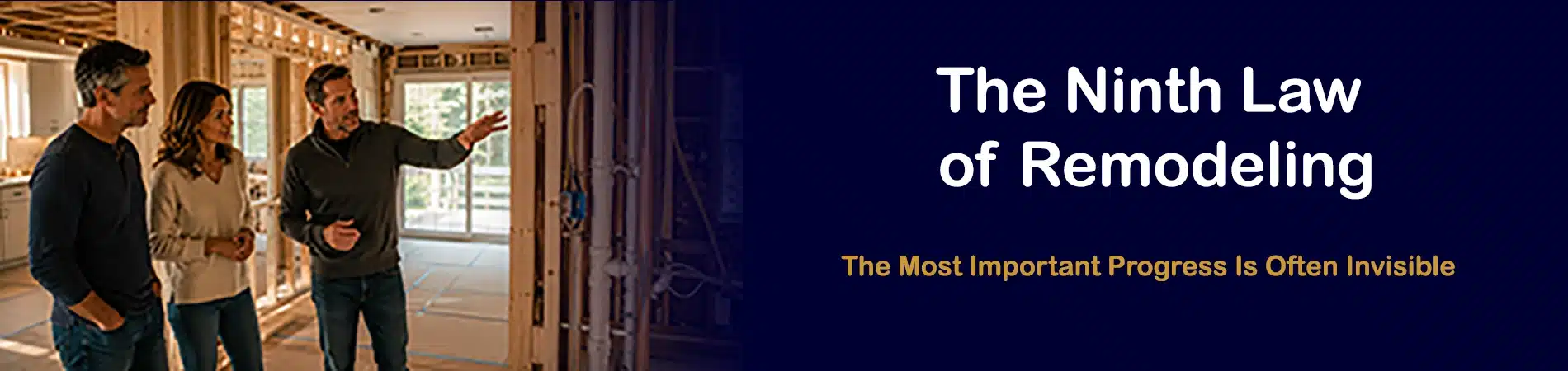
The Law
Some of the most important remodeling progress happens before anything visible changes inside the home. Planning, communication, trust, and decision-making often shape the outcome long before construction begins.
Why It Matters
Homeowners naturally look for visible signs of progress. Understanding invisible progress helps them value planning, communication, and problem-solving that prevent future issues and strengthen the project.
What You’ll Learn
This chapter explores why visible activity and meaningful progress are not always the same, how planning prevents future problems, and why relationships, communication, and patience contribute to better remodeling outcomes.
Key Insights
- Visible activity and meaningful progress are not always the same.
- Planning is progress, not a delay before progress.
- Invisible progress often prevents visible problems.
- Relationships and communication shape outcomes.
- Patience creates room for better decisions.
Connected Laws
Law #5
Clarity Creates Predictability
Law #8
Construction Is the Physical Expression of Earlier Decisions
Law #10
Successful Remodeling Is Measured by Life, Not Construction
Questions This Law Asks
- Are we measuring progress only by visible activity?
- Is the project becoming clearer, stronger, and better aligned?
- What future problems are being prevented now?
- Are communication and trust improving?
- Are we allowing enough time for better decisions to emerge?
Quick Summary
The Ninth Law of Remodeling teaches that some of the most important progress in a remodeling project is often invisible. Homeowners naturally associate progress with demolition, framing, installations, and visible construction activity. Yet many of the developments that most strongly influence project success occur before anything changes physically inside the home. Goals are clarified, assumptions are tested, priorities are established, budgets are aligned, designs are refined, communication systems are created, and relationships are strengthened.
This chapter explains why planning should be viewed as progress rather than as preparation for progress. It also explores how invisible progress prevents visible problems, why activity and progress are not always the same thing, and how trust, communication, collaboration, and patience contribute to stronger remodeling outcomes. Homeowners who understand the Ninth Law learn to evaluate progress by the quality of understanding, decision-making, alignment, and problem prevention rather than by visible activity alone.
Why Progress Is More Than What You Can See
One of the most common ways homeowners evaluate a remodeling project is by looking for visible signs of progress. They notice when demolition begins, when walls are framed, when cabinets arrive, and when finishes are installed. These activities provide tangible evidence that something is happening. Rooms change shape. Materials appear. The home looks different from one week to the next.
Because these changes are visible, homeowners naturally associate them with progress.
This assumption seems reasonable. After all, construction is the part of remodeling that physically transforms the home. It is the phase in which ideas become reality, and homeowners begin to see the results of their investment. When you see activity, it feels like the project is moving forward.
Yet one of the most important truths in remodeling is that visible activity and meaningful progress are not always the same thing.
Many of the most valuable developments in a remodeling project occur long before physical changes become visible inside the home. Goals are clarified. Problems are identified. Assumptions are tested. Priorities are established. Budgets are aligned. Trade-offs are evaluated. Designs are refined. Decisions are made. Relationships are developed. Trust is established. Communication systems are created. None of these activities produce immediate visual results, yet each one influences the success of everything that follows.
The previous Law teaches that construction is the physical expression of earlier decisions. If that is true, then those earlier decisions must have come from somewhere. They were not created during demolition. They were not created during installation. They emerged through a process of planning, communication, problem-solving, and decision-making that often remains invisible to the homeowner.
This reality helps explain why some projects seem to move slowly during planning while simultaneously making enormous progress. It also explains why projects that rush toward visible activity sometimes encounter difficulties later. The absence of visible change does not necessarily mean progress is absent. In many cases, the opposite is true. Some of the most important progress in remodeling occurs before a single wall is removed.
The Ninth Law explores this often-overlooked aspect of remodeling. It explains why homeowners naturally equate progress with visible activity, why invisible work often creates greater value than visible work, and why successful projects are often shaped by developments long before construction begins.
Understanding this principle changes the way homeowners evaluate their projects. Instead of measuring progress solely by what happens inside the home, they begin to recognize the value of the decisions, discoveries, relationships, and understanding that make successful construction possible.
Why Planning Deserves the Same Respect as Construction
One of the biggest misconceptions in remodeling is that progress begins when construction begins. Homeowners often view planning, meetings, design development, budgeting, and decision-making as activities that occur before the real work starts. The assumption is understandable because construction produces visible results while planning often does not.
The Eighth Law teaches that construction is the physical expression of earlier decisions. The Ninth Law extends that principle by explaining where those decisions come from. They emerge through a process of invisible progress that occurs throughout planning and preconstruction. Every clarified goal, tested assumption, evaluated trade-off, and resolved decision contributes to the project’s eventual success.
Consider a homeowner who spends several weeks working with a design-build team to clarify goals, evaluate alternatives, and refine project scope. From a purely visual perspective, nothing appears to be happening. The home remains unchanged. No materials have arrived. No walls have been removed. No visible construction activity has occurred.
Yet significant progress may be taking place.
The homeowner may have discovered that the original problem was different from what they initially believed. Budget expectations may have become more realistic. Priorities may have become clearer. Design solutions may have improved. Potential problems may have been identified and resolved before they could affect construction. These developments may not produce visible changes inside the home, but they can dramatically improve the eventual outcome.
This principle appears repeatedly throughout successful remodeling projects. Successful outcomes often emerge gradually through conversations, evaluations, revisions, and discoveries. Homeowners gain understanding. Professionals gain insight. Assumptions are challenged. Better solutions emerge. By the time construction begins, the project may be substantially stronger than it was at the beginning of planning.
The same principle applies to relationships. Homeowners often think of progress in terms of drawings, budgets, schedules, and construction activities. Yet trust, communication, collaboration, and shared understanding are also forms of progress. A homeowner who develops a productive working relationship with the design and construction team often creates conditions that improve decision-making, problem-solving, and project outcomes. These developments are largely invisible, but their influence can be profound.
This helps explain why experienced remodeling professionals place such a strong emphasis on planning. They understand that planning is not merely preparation for progress. Planning is progress. Every unresolved question that becomes resolved, every uncertainty that becomes clear, and every decision that becomes understood strengthens the project long before visible construction begins.
The Ninth Law teaches that homeowners should not judge progress solely by what they can see. Some of the most important work in remodeling occurs beneath the surface of the project, within conversations, decisions, relationships, and understanding. These invisible forms of progress frequently determine whether construction proceeds smoothly or struggles under the weight of unresolved issues.
For this reason, successful homeowners learn to recognize two forms of progress. The first is visible progress, which occurs during construction and is directly observable. The second is invisible progress, which occurs during planning and decision-making and often shapes everything that follows. Both forms matter, but the invisible progress often determines the quality of the visible results.
The Ninth Law reminds homeowners that the absence of visible activity does not mean the absence of progress. In many cases, the most important progress in the entire project occurs before anything changes physically inside the home. The decisions, understanding, and relationships developed during this period create the foundation upon which successful construction is ultimately built.
Why Homeowners Equate Progress with Visible Activity
The Ninth Law teaches that some of the most important progress in remodeling is invisible. While this principle becomes obvious once understood, it can feel counterintuitive to many homeowners because people naturally associate progress with things they can see. Visible activity provides reassurance. It creates the impression that the project is progressing and producing tangible results.
This tendency is not unique to remodeling. In many areas of life, people measure progress by visible outcomes. Students focus on completed assignments rather than learning. Businesses focus on finished products rather than planning and development. Athletes focus on competition rather than training. Remodeling follows a similar pattern. Homeowners see construction activity and instinctively view it as evidence of progress because it produces immediate, observable change.
The challenge is that visibility and importance are not always the same thing.
A wall can be demolished in hours. Cabinets can be installed within days. Flooring can transform a room’s appearance almost immediately. These activities are highly visible, yet they often implement decisions that require weeks or months to develop. The visible work captures attention because it is dramatic, while the earlier work that made it possible is often forgotten or overlooked.
Popular media has reinforced this perception for decades. Television programs, social media content, and online videos tend to focus on dramatic transformations rather than the planning processes that precede them. Viewers see demolition, construction, and before-and-after reveals because these activities are visually engaging. They rarely see the countless meetings, discussions, evaluations, revisions, and decisions that shaped the outcome. As a result, many homeowners develop an incomplete understanding of how remodeling projects actually progress.
This perception often creates impatience during planning. Homeowners may spend weeks discussing goals, reviewing designs, refining scope, and evaluating options. Because little is changing physically within the home, it can feel as though progress has stalled. In reality, some of the most consequential work in the entire project may be occurring during this period. Decisions are being made that will influence budgets, schedules, functionality, aesthetics, and long-term satisfaction. Progress is real even when it isn’t visible.
Another reason homeowners equate progress with visible activity is that visible progress is easier to measure. It is easy to see that cabinets have been installed or walls have been framed. It is harder to measure improved understanding, clarified priorities, resolved assumptions, or stronger communication. These forms of progress leave no physical evidence in the home, yet they often have a greater influence on the eventual outcome.
The Eighth Law teaches that construction is the physical expression of earlier decisions. The Ninth Law reveals that many of those decisions emerge through invisible forms of progress. Homeowners who focus exclusively on visible activity often overlook the work that shapes construction before it begins. They see the outcome but not the process that created it.
This misunderstanding can sometimes lead homeowners to push prematurely toward construction. Eager to see visible results, they may be tempted to shorten planning, rush decisions, or move forward before important questions are fully resolved. While the desire is understandable, the result is often increased uncertainty because construction is being asked to implement decisions that have not yet matured. What looks like faster progress can slow things later when unresolved issues surface.
Experienced remodeling professionals understand this dynamic and therefore help homeowners recognize progress in forms other than visible construction activity. They point to clarified goals, improved designs, stabilized budgets, resolved selections, completed engineering, refined scope, and stronger communication as evidence that the project is moving forward. These developments may not be visible in the home, but they create tremendous value by improving the quality of future decisions and reducing the likelihood of future problems.
The Ninth Law teaches homeowners not to confuse activity with progress or visibility with value. Construction is certainly progress, but it is not the only kind. Many of the developments that contribute most directly to successful outcomes occur before construction begins and remain largely invisible throughout the process.
For this reason, successful homeowners learn to evaluate projects differently. They recognize that progress can occur even when nothing appears to be changing physically. They understand that decisions are being strengthened, risks are being reduced, relationships are being developed, and understanding is increasing. These invisible developments may not attract attention in the same way construction does, but they often determine the quality of everything that follows.
The Ninth Law reminds homeowners that visible activity is only one measure of progress. The most important progress is often harder to see because it occurs within planning, communication, decision-making, and understanding. Yet these invisible forms of progress frequently create the greatest impact on the outcome.
The Invisible Work Behind Every Successful Remodel
Every successful remodeling project contains two stories.
The first story is visible. It includes demolition, framing, cabinetry, flooring, painting, and all of the physical activities homeowners associate with construction. This is the story people see when they visit the project. It is the story captured in photographs and highlighted in before-and-after comparisons.
The second story is largely invisible.
It takes place in conversations, meetings, sketches, drawings, decisions, evaluations, revisions, and discoveries. It occurs as homeowners and professionals work together to understand problems, define goals, explore alternatives, and create solutions. This story rarely appears in photographs because you can’t measure its progress by physical changes inside the home. Yet it often influences the outcome more than the visible work that follows.
The Ninth Law teaches that every successful remodel is built upon a foundation of invisible progress.
Long before construction begins, homeowners and professionals engage in a process of discovery. Existing frustrations are identified. Goals are clarified. Assumptions are challenged. Priorities are established. Future needs are discussed. Alternative approaches are explored. Through these conversations, the project gradually evolves from a general idea into a clearly defined plan.
This work may not produce immediate visual results, but it often determines the direction of everything that follows.
Consider a homeowner who initially believes they need an addition. During planning, discussions reveal that the real problem is not a lack of square footage but an inefficient layout. The discovery changes the entire project. Instead of building outward, the focus shifts toward reorganizing existing space. Months later, visitors may admire the completed remodel without realizing that one conversation during planning completely changed the project’s direction.
The same principle applies to budgeting. Homeowners frequently begin projects with assumptions about costs, priorities, and investment levels. Through planning, those assumptions become more refined. Resources are allocated differently. Priorities become clearer. Expectations become more realistic. These developments rarely create visible changes within the home, but they often prevent future disappointment and improve the overall outcome.
Invisible progress also occurs through problem-solving.
Many potential construction challenges are identified and resolved before construction begins. Engineering review may uncover structural concerns. Existing conditions may be investigated. Product availability issues may be addressed. Design conflicts may be corrected. The team may identify and resolve scope gaps. Homeowners rarely see these problems because successful planning often prevents them from becoming visible construction issues.
This is one reason invisible progress can be hard to appreciate. When planning succeeds, many problems never occur. Homeowners experience a smoother project but may never realize how many complications behind-the-scenes work avoided.
The invisible work behind successful remodeling also includes coordination. Designers, project managers, engineers, suppliers, permitting authorities, and construction professionals often spend considerable time aligning information, confirming details, and preparing for future activities. These efforts leave little visible evidence in the home, yet they contribute significantly to the project’s stability and predictability.
Relationships represent another important form of invisible progress. As homeowners and professionals work together, communication improves. Trust develops. Expectations become aligned. Shared understanding grows. These developments may seem intangible, but they often influence decision-making, problem-solving, and collaboration throughout the project.
A homeowner who trusts the project team is often more comfortable discussing concerns openly. A designer who understands the homeowner’s priorities can make more effective recommendations. A project manager with strong communication channels can resolve challenges more efficiently. These relationships do not appear on plans or schedules, but they contribute directly to project success.
The Eighth Law teaches that construction is the physical expression of earlier decisions. The Ninth Law reveals that those decisions emerge from a great deal of invisible work. Every successful construction outcome can usually be traced back to conversations, discoveries, evaluations, and decisions that occurred long before visible activity began.
This understanding changes the way homeowners think about progress. Instead of viewing planning as something that happens before the project starts, they begin recognizing that planning is part of the project. The discussions, decisions, and discoveries during this period don’t delay progress. They are creating it.
The Ninth Law teaches that successful remodeling depends upon much more than what happens during construction. Behind every visible result exists a layer of invisible work that shaped, refined, and strengthened the project before construction ever began. Homeowners may not always see this progress, but they experience its benefits throughout the life of the finished remodel.
For this reason, don’t view the invisible work behind every successful remodel as preparation for progress. Recognize it as progress itself.
Why Planning Is Progress
One of the most common frustrations homeowners experience during remodeling occurs during the planning phase. Weeks may pass while goals are discussed, designs are refined, budgets are evaluated, and decisions are made. From the homeowner’s perspective, very little appears to be happening. The home looks exactly as it did before. No walls have been removed. No materials have arrived. No visible transformation is taking place. As a result, many homeowners begin to wonder when the project will finally start.
The question is understandable, but it is based on a misunderstanding of how remodeling actually works.
The assumption is that planning happens before the project begins and that construction marks the start of real progress. The Ninth Law teaches something very different. Planning is not a waiting period before progress starts. Planning is progress. In many ways, it is one of the most important aspects of progress during the remodeling process because it establishes the direction construction will ultimately take.
Planning is often undervalued because its results are largely invisible. Homeowners naturally associate progress with physical change because it’s easy to observe. A demolished wall, a newly framed room, or an installed cabinet provides immediate evidence that something has happened. Planning creates a different type of value. Instead of changing the home, it changes the quality of the decisions that will ultimately shape the home.
As planning progresses, goals become clearer, priorities become better defined, and assumptions begin giving way to understanding. Homeowners frequently discover that the solutions they initially envisioned are not necessarily the solutions that best address their needs. Alternative approaches emerge. Trade-offs become easier to evaluate. Budget expectations become more realistic. Design ideas improve as they are tested against practical realities. None of these developments produces visible changes inside the home, yet each one strengthens the project and improves the likelihood of a successful outcome.
Consider a homeowner who spends several weeks evaluating alternative kitchen layouts. From a construction perspective, it may appear that little progress has occurred because the existing kitchen remains untouched. Yet those weeks of discussion and evaluation may ultimately determine how the family uses the space for the next twenty years. A well-considered layout can improve daily routines, simplify entertaining, increase storage efficiency, and create a more enjoyable living environment. The visible construction that eventually follows may take only a few weeks, but the value of the earlier decision may influence the homeowner’s experience for decades.
The same principle applies to budgeting. Homeowners often begin projects with assumptions about costs, priorities, and investment levels. Through planning, those assumptions become more refined. Resources are allocated more intentionally. Expectations become aligned with reality. Priorities become clearer. The result is not simply a more accurate budget but a stronger understanding of how financial decisions support project goals. This progress may never be visible in the home itself, yet it often profoundly influences the homeowner’s satisfaction with the completed project.
Planning also creates value by reducing uncertainty. The earlier Laws teach that clarity creates predictability and that many remodeling problems begin long before construction starts. Planning directly addresses both realities. As decisions become clearer, uncertainty decreases. As assumptions are tested, risk is reduced. As scope becomes more defined, future construction activities become more predictable. The project gradually shifts from a collection of ideas into a coordinated strategy that can be executed with greater confidence.
Another reason planning should be viewed as progress is that it frequently prevents problems from ever becoming visible. Homeowners tend to notice challenges during construction because they demand attention. They rarely notice the countless issues that were identified and resolved before construction began. A structural conflict discovered during planning may prevent expensive changes later. A clarified selection decision may avoid scheduling delays. A more complete scope may reduce misunderstandings during construction. The homeowner experiences a smoother project, often without realizing how many potential problems earlier planning eliminated.
Planning also creates progress through alignment. Remodeling projects involve homeowners, designers, project managers, engineers, suppliers, and construction professionals, each bringing different knowledge, responsibilities, and perspectives. Planning provides an opportunity to align these perspectives around shared goals and expectations. As understanding improves and communication becomes clearer, the project develops a stronger foundation for future decisions and future construction activities.
This is one reason experienced remodeling professionals resist the temptation to rush through planning. They understand that planning is not an obstacle to the homeowner’s construction. Planning is the process through which better decisions are created. Every goal clarified, every assumption tested, every alternative evaluated, and every uncertainty resolved strengthens the project before visible construction ever begins.
The Eighth Law teaches that construction is the physical expression of earlier decisions. The Ninth Law explains how those decisions are developed. Planning is where ideas are tested, priorities are established, expectations are aligned, and solutions are refined. Construction may eventually make those decisions visible, but planning is where many of them are born.
For this reason, homeowners who understand the Ninth Law stop viewing planning as waiting. They recognize that the project is already moving forward, even when nothing has physically changed inside the home. The conversations, evaluations, discoveries, and decisions during planning actively shape the outcome. They are not delaying progress. They are progress.
The Ninth Law teaches that planning deserves the same respect homeowners naturally give to construction. While construction creates visible results, planning creates the foundation those results depend on. The better the planning, the stronger the decisions. The stronger the decisions, the more likely construction is to produce outcomes that truly support the life homeowners hope to create within their homes.
How Invisible Progress Prevents Visible Problems
One of the most overlooked benefits of planning is that successful planning often prevents problems from ever becoming visible. This can make the value of planning difficult for homeowners to appreciate, because people naturally notice problems that occur but rarely notice problems that were avoided. When planning succeeds, many potential challenges never become part of the construction experience.
This reality helps explain why invisible progress often produces some of the greatest value in remodeling.
Consider a homeowner who spends additional time during planning evaluating structural implications before finalizing a design. The engineering review identifies a challenge that would have complicated construction if it had remained undiscovered. Because the issue is identified early, the design can be adjusted before submitting permits, ordering materials, or starting construction. The homeowner experiences a smoother project but may never realize how much disruption a decision made months earlier prevented.
The same principle applies to scope development. Many construction problems originate from assumptions that were never fully tested or decisions that were never completely resolved. During planning, homeowners and professionals can identify these uncertainties before they become construction issues. Questions about functionality, budget priorities, material selections, scheduling requirements, and project objectives can be addressed while changes remain relatively easy and inexpensive. Once construction begins, those same questions often become more disruptive because they affect work already in progress.
This relationship reinforces a central theme of the Remodeling Decision System: prevention is often more valuable than correction.
A problem identified during planning is usually easier to address than a problem discovered during construction. Resolving a misunderstanding before work begins is less costly than discovering it after materials have been installed. A design conflict identified during review is easier to resolve than one uncovered after demolition. Invisible progress creates value by enabling homeowners and professionals to solve problems when solutions are most readily available.
Budget planning provides another useful example. Homeowners often assume that budgeting is primarily about determining how much a project will cost. In reality, budgeting also helps prevent future disappointment. As priorities become clearer and resources are allocated intentionally, homeowners gain a more realistic understanding of what they can accomplish within their investment range. This alignment helps reduce the likelihood of discovering later that expectations and resources are incompatible.
Planning also prevents problems by improving communication. Many remodeling challenges are not technical problems at all. There are communication problems. Misunderstood expectations, incomplete information, conflicting assumptions, and unclear responsibilities can create difficulties even when everyone involved has good intentions. Planning provides opportunities to establish communication systems, clarify expectations, and create shared understanding before construction begins.
Relationships also play an important role in this process. Trust, collaboration, and open communication help teams identify concerns earlier and address them more effectively. Homeowners who feel comfortable asking questions and professionals who feel comfortable providing honest feedback often identify potential issues before they become visible problems. These relationship-based forms of progress may be difficult to measure, but they frequently contribute to smoother construction experiences and stronger outcomes.
The Ninth Law also explains why experienced professionals sometimes appear to move more slowly during planning than homeowners expect. Their objective is not merely to generate drawings, create budgets, or prepare schedules. Their objective is to identify uncertainties, evaluate risks, and resolve questions before those issues can affect construction. The time invested in these activities often reduces future delays, disruptions, and frustrations.
This principle becomes especially clear when comparing projects that face frequent construction challenges with those that proceed relatively smoothly. While many factors influence outcomes, the difference often lies in the extent of invisible progress that occurred before construction began. Projects that invest heavily in planning, clarification, coordination, and communication often face fewer surprises because they address many potential problems before they become visible.
The Eighth Law teaches that construction reveals earlier decisions. The Ninth Law reveals that invisible progress often determines which decisions construction will reveal. Strong planning tends to produce stronger decisions. Strong decisions tend to reduce uncertainty. Reduced uncertainty often leads to fewer visible problems during construction.
For this reason, homeowners should not evaluate planning solely according to what it produces. They should also consider what it prevents. Every misunderstanding avoided, every conflict resolved, every assumption tested, and every risk reduced represents value that may never become visible. Yet these invisible victories often contribute as much to project success as the visible construction activities that follow.
The Ninth Law teaches that some of the greatest progress in remodeling happens when you prevent future problems before they arise. Homeowners may never see these successes directly, but they benefit from smoother projects, stronger decisions, fewer surprises, and better outcomes. In many cases, the absence of visible problems is itself evidence that important invisible progress has already occurred.
The Difference Between Activity and Progress
One reason homeowners sometimes become frustrated during remodeling is that activity and progress can seem the same, even though they are actually very different. Remodeling projects involve countless meetings, discussions, decisions, drawings, emails, schedules, deliveries, and construction tasks. Because so much is happening, it can be tempting to measure progress by the amount of activity.
The Ninth Law teaches that activity and progress are not synonymous.
Activity means something is happening. Progress means the project is moving closer to its desired outcome. While activity can contribute to progress, it alone does not guarantee progress. In some cases, a project can be extremely busy yet make very little meaningful progress. In other cases, a project may appear relatively quiet while accomplishing some of its most important work.
This distinction matters most during planning. Homeowners often judge progress by visible activity because it is easy to observe. Construction crews arrive. Materials are delivered. Walls are framed. Fixtures are installed. These activities create a strong impression of momentum. Yet visible momentum does not always mean the project is getting stronger.
Consider a homeowner who repeatedly changes design directions over several weeks. Meetings are occurring. Drawings are being revised. Discussions are taking place. Activity is abundant. Yet if the project remains unclear and important decisions remain unresolved, meaningful progress may be limited. The project is busy, but it is not necessarily moving closer to a successful outcome.
Conversely, a homeowner may spend a single planning session identifying the true source of a long-standing problem within the home. That discovery may lead to a dramatically improved design solution and eliminate months of future frustration. From an activity perspective, very little occurred. From a progress perspective, the project may have advanced significantly because understanding improved and better decisions became possible.
The difference often comes down to clarity.
The earlier Laws teach that clarity creates predictability and that construction is the physical expression of earlier decisions. Progress occurs when uncertainty decreases, understanding increases, priorities become clearer, and decisions improve. Activity may or may not contribute to these outcomes. Progress is measured not by how much effort is being expended but by whether the project is becoming better defined and better prepared for success.
This principle also applies during construction. A project can have a great deal of visible activity while still struggling with unresolved questions, shifting priorities, or unclear expectations. Construction may appear productive on the surface, while underlying uncertainty continues to create challenges. By contrast, a project with fewer visible activities may be progressing more effectively because decisions are clear, communication is strong, and work follows a well-defined plan.
Experienced remodeling professionals understand this distinction and therefore focus on outcomes rather than activity alone. They recognize that the objective is not simply to keep people busy. The objective is to improve the project. Sometimes that improvement requires visible construction. Other times it requires thoughtful evaluation, problem-solving, coordination, or decision-making. The amount of activity matters less than the value it creates.
This perspective helps explain why planning meetings, design reviews, engineering evaluations, budget discussions, and coordination efforts deserve to be viewed as legitimate forms of progress. These activities may not create visible changes within the home, but they often increase understanding, reduce uncertainty, and strengthen future decisions. Measure their contribution by the clarity they create, not the visibility they produce.
The distinction between activity and progress also helps homeowners avoid a common mistake: equating speed with effectiveness. Fast-moving activity can create the appearance of progress even when important questions remain unanswered. Slower, more deliberate decision-making may sometimes create stronger outcomes because it allows assumptions to be tested, alternatives to be evaluated, and solutions to be refined before construction begins.
The Ninth Law teaches that successful remodeling should not be measured according to how busy the project appears. It should be measured according to whether the project is becoming stronger. Are goals becoming clearer? Are priorities becoming better defined? Is uncertainty decreasing? Are decisions improving? Is the project becoming more capable of delivering the desired outcome?
When viewed through this lens, progress often looks very different than homeowners initially expect. Some of the most important advancements in a project may happen during conversations, evaluations, and discoveries that leave no visible evidence. Yet those moments frequently create more value than days of visible activity because they improve the quality of everything that follows.
For this reason, homeowners who understand the Ninth Law learn to look beyond motion and focus on direction. Activity indicates that work is occurring. Progress indicates that the work is moving the project toward a better outcome. The difference may seem subtle, but it fundamentally changes the way successful remodeling is understood and evaluated.
Why Relationships Are Part of the Progress
When homeowners think about remodeling progress, they typically think about completed plans, approved permits, selected materials, or construction activities inside the home. While these forms of progress matter, they aren’t the only ones that happen throughout a project. Some of the most valuable developments occur in the relationships formed between homeowners and the professionals who bring the project to life.
These relationships may not appear on drawings, schedules, or budgets, yet they often profoundly influence project outcomes.
Remodeling is fundamentally a collaborative process. Homeowners, designers, project managers, engineers, suppliers, and construction professionals each contribute specialized knowledge and perspectives. The quality of the finished project depends not only on the decisions made but also on the relationships that support them. Trust, communication, mutual respect, and shared understanding create an environment where better solutions can emerge, and problems can be addressed more effectively.
This is one reason experienced professionals spend time learning about homeowners before recommending solutions. They are not merely gathering technical information. They are building understanding. As communication improves and trust develops, the project team gains a clearer picture of the homeowner’s goals, priorities, concerns, and expectations. This shared understanding constitutes a form of invisible progress, as it improves future decision-making throughout the project.
The importance of relationships is often overlooked because their benefits are difficult to measure. Homeowners can see a wall being framed or a cabinet being installed. They cannot easily see trust being established or communication becoming more effective. Yet these invisible developments frequently influence the project just as much as visible construction activities.
This becomes particularly apparent when homeowners and professionals encounter challenges. Remodeling projects are complex, and questions inevitably arise. Existing conditions are discovered. Design details require clarification. Material availability changes. New information emerges. In these moments, strong relationships become invaluable because they create an environment where concerns can be discussed openly and solutions can be developed collaboratively.
Designers and construction professionals also bring something to a project that homeowners may not immediately recognize: creativity. While remodeling certainly involves technical expertise, it also involves interpretation, problem-solving, and artistic judgment. Designers are not simply arranging walls and selecting finishes. They are creating environments designed to support how people live. Skilled craftspeople are not merely following instructions. They are applying experience, judgment, and attention to detail to transform ideas into reality.
For this reason, the most effective professionals are often both technicians and artists. They understand structural requirements, building systems, and construction methods, but they also understand proportion, aesthetics, functionality, and human experience. Their work requires creativity and technical skill.
This reality has important implications for homeowners. Oversight is appropriate and necessary because the project ultimately belongs to the homeowner. Questions should be asked. Concerns should be raised. Expectations should be communicated clearly. Productive collaboration depends upon active homeowner participation.
However, an important difference exists between oversight and micromanagement.
Oversight seeks understanding and alignment. Micromanagement often attempts to control every detail of execution. Oversight encourages communication. Micromanagement can unintentionally create hesitation, defensiveness, and uncertainty. When every recommendation is immediately challenged, every decision is second-guessed, and every action is constantly criticized, professionals may focus more on avoiding mistakes than on creating exceptional outcomes.
This shift can subtly change the character of the work. Creative problem-solving gives way to cautious execution. Initiative decreases. Communication becomes more guarded. The work may still be completed successfully, but the collaborative environment that often produces the best solutions begins to weaken.
The issue is rarely the homeowner’s intent. Most micromanagement originates from concern rather than hostility. Homeowners care deeply about their homes and want the project to succeed. The challenge is that excessive control can sometimes undermine the very expertise that homeowners hired professionals to provide.
A more productive approach is to focus on understanding before judgment. Instead of assuming a recommendation is wrong, homeowners can ask questions about the reasoning behind it. Instead of immediately criticizing an approach, they can seek clarification regarding the objectives it is intended to achieve. These conversations often reveal considerations that may not have been visible initially and create opportunities for better collaboration.
Communication systems also play an important role. Successful remodeling projects typically establish clear channels for communicating questions, concerns, and decisions. In many design-build environments, the project manager serves as the central point of coordination. This structure exists for a reason.
Individual tradespeople often have deep expertise in their specific areas of responsibility, but they may not have full visibility into every decision affecting the project. A tile installer understands tile installation. An electrician understands electrical systems. A cabinet installer understands cabinetry. The project manager, however, coordinates the broader picture. They understand design intent, scope decisions, budget considerations, scheduling requirements, approved changes, and project-wide priorities.
For this reason, concerns are often best addressed through the project manager rather than individual tradespeople. Questions directed through the appropriate communication channels tend to receive more complete answers because they can be evaluated within the full context of the project. This approach also helps prevent conflicting information, unnecessary confusion, and unintended changes that may affect other parts of the project.
Strong communication systems are another form of invisible progress. Homeowners may never see them directly, yet they help maintain alignment, improve coordination, and support better decision-making throughout construction.
Ultimately, relationships are part of the progress because remodeling is not simply a construction process. It is a human process. The quality of communication, trust, collaboration, and mutual respect often influences how effectively problems are solved, how confidently decisions are made, and how successfully the project achieves its goals.
The Ninth Law teaches that some of the most important developments in a remodeling project cannot be measured in square feet, schedules, or construction milestones. Shared understanding, productive communication, professional trust, and healthy collaboration may be largely invisible, yet they often create extraordinary value. These relationships form the foundation of successful remodeling, making them among the most important forms of progress homeowners will never physically see.
Why Patience Creates Better Outcomes
One of the biggest challenges homeowners face during remodeling is balancing the desire for progress with the time the process needs to deliver the best outcome. Remodeling is exciting. Homeowners naturally look forward to enjoying improved spaces, solving long-standing frustrations, and seeing their vision become reality. Once you decide to remodel, it is natural to want the project to move forward as quickly as possible.
The challenge is that remodeling isn’t simply a construction process. It is also a decision-making process. Decisions require understanding. Understanding requires communication. Communication requires time. As a result, you can’t accelerate the most valuable remodeling activities without consequences.
The Ninth Law teaches that patience is not the absence of progress. Patience is often what allows meaningful progress to occur.
This reality becomes particularly apparent during planning. Homeowners frequently feel pressure to move quickly through design development, budgeting, scope definition, and product selections so construction can begin sooner. While momentum matters, rushing decisions often creates unintended consequences because homeowners finalize choices before they fully understand the options.
A homeowner who takes additional time to evaluate alternative layouts may discover a significantly better solution. A family that spends more time discussing priorities may avoid future disappointment by aligning expectations before construction begins. A project team that invests additional effort in clarifying the scope may prevent misunderstandings that would otherwise emerge later. In each case, patience creates opportunities for stronger decisions and stronger outcomes.
The same principle applies to communication. Productive communication rarely occurs through hurried conversations or assumptions. It develops through thoughtful discussion, active listening, clarification, and shared understanding. Homeowners who make time for these conversations often gain a deeper understanding of their options, the reasoning behind recommendations, and the trade-offs behind various decisions. The result is not merely better communication but better decision-making.
Relationships benefit from patience as well.
The previous section explained that trust, collaboration, and communication constitute invisible progress. Like most meaningful relationships, these qualities develop over time. Homeowners and professionals gradually learn how to work together. Expectations become clearer. Confidence increases. Shared understanding grows. These developments cannot be rushed because they depend upon experience, interaction, and consistent communication.
Patience also creates space for discovery.
Many of the most valuable remodeling insights emerge during the planning process, not at the start. Homeowners often start with assumptions about what they need, what they want, and how to solve problems. As discussions progress, they refine those assumptions. Better ideas emerge. Alternative approaches become visible. Priorities become clearer. The project evolves because understanding evolves.
This process rarely follows a perfectly straight path. A design may go through multiple revisions before the best solution emerges. A budget may need adjustment before priorities align. Product selections may change as homeowners better understand their options. While these developments can sometimes feel like delays, they often show the project is getting stronger.
The desire to move quickly can occasionally lead homeowners to confuse speed with efficiency. A fast decision is not necessarily a good decision. A rapid start is not necessarily a successful start. The goal of remodeling is not simply to begin construction as soon as possible. The goal is to create outcomes that support the homeowner’s life long after construction is complete. Achieving that objective often requires patience during the earlier stages of the process.
Experienced remodeling professionals understand this balance. They appreciate the homeowner’s desire for momentum while also recognizing the importance of thoughtful decision-making. Their objective is not to unnecessarily slow the project. Their objective is to ensure that the project moves forward with clarity, alignment, and understanding. Sometimes that means allowing additional time for conversations, evaluations, or decisions that will ultimately improve the result.
The Eighth Law teaches that construction is the physical expression of earlier decisions. The Ninth Law reveals that many of those decisions improve through patience. The time invested in understanding goals, evaluating alternatives, building relationships, and refining solutions often creates value that extends far beyond the planning phase itself.
For this reason, homeowners who understand the Ninth Law begin viewing patience differently. Instead of seeing it as waiting, they see it as an investment in quality. They recognize that some of the most important progress in remodeling happens when ideas are tested, assumptions are challenged, and understanding deepens. These developments may not produce visible changes in the home, but they often lead to better outcomes once construction begins.
The Ninth Law teaches that patience should not be confused with inactivity. Patience allows invisible progress to occur. It creates room for better decisions, stronger relationships, clearer communication, and more thoughtful solutions. While the benefits may not be immediately visible, they often become evident throughout construction and continue creating value long after the project is complete.
In many cases, the homeowners who experience the strongest remodeling outcomes are not the ones who move through the process the fastest. They are the homeowners who give the process enough time to do its best work.
Real Remodeling Decisions Shaped by the Ninth Law
The Ninth Law teaches that some of the most important progress in remodeling occurs long before construction begins. While this principle can seem abstract in theory, it becomes much easier to recognize through the lens of real remodeling projects. Again and again, the decisions that ultimately lead to successful outcomes trace back to conversations, discoveries, relationships, and insights that developed before any visible work began in the home.
Consider a homeowner who begins a remodeling project with a very specific vision. They’ve collected inspiration photos, mentally selected materials, and feel they largely understand the solution. From their perspective, the challenge appears straightforward. The project needs to be designed and built.
As planning progresses, however, a different reality emerges. Discussions about daily routines, storage frustrations, circulation patterns, and family interaction reveal that the homeowner’s challenges stem from issues they didn’t initially identify. The real problem lies deeper in how the home functions. What initially appeared to be a design problem gradually reveals itself as a planning problem. What appeared to require additional space may actually require better use of existing space.
By the time a final design solution emerges, the project may look very different from the homeowner’s original vision. Yet the outcome is often significantly better because it addresses the underlying causes of the frustration rather than merely responding to the symptoms. Visitors who later admire the completed remodel naturally focus on the visible transformation. What they cannot see is that the most important progress happened much earlier, when the homeowner gained a clearer understanding of the problem that needed solving.
A similar pattern frequently appears during budgeting. Homeowners often begin projects believing that the greatest value will come from premium finishes, upgraded materials, or highly visible features. As planning continues, discussions about lifestyle, priorities, and long-term goals sometimes reveal a different opportunity. Improvements to circulation, storage, functionality, or space planning may ultimately contribute more to daily satisfaction than the most expensive finishes available.
When these discoveries occur, resources are often allocated differently than originally expected. The project becomes more closely aligned with how the family actually lives. Months later, guests may admire the beauty of the completed home, while the homeowners appreciate something far more meaningful. Daily routines are easier. Frustrations have been reduced. The home functions more naturally. These benefits began not during construction, but during the invisible progress that clarified priorities and improved decision-making.
The influence of invisible progress extends beyond planning and budgeting into the relationships that develop throughout the remodeling process. Consider a homeowner who encounters an unexpected condition during construction. An issue hidden within an existing wall creates a challenge that planning could not have anticipated. While the physical problem itself may be relatively ordinary, how it is handled often depends on what was established much earlier.
Projects built upon trust, communication, and mutual respect typically approach these situations very differently than projects where those relationships never developed. When homeowners and professionals have established strong working relationships, conversations remain productive. Questions are asked openly. Concerns are addressed directly. Solutions are evaluated collaboratively. The project team works together because a foundation of trust already exists.
In projects where communication is strained or trust is limited, the same construction challenge can create far greater disruption. Assumptions replace conversations. Frustration replaces collaboration. Small issues become larger than necessary because the relationships required to solve them efficiently were never fully developed. The difference is not the construction issue itself. The difference is the invisible progress that occurred before the issue ever appeared.
Communication systems often create similar benefits. During planning, homeowners and project teams often set expectations for how they’ll communicate questions, concerns, and decisions. At the time, these discussions may seem relatively minor compared to the design and construction work ahead. Their value often becomes apparent only after construction is underway.
A homeowner who notices something concerning during construction may feel tempted to approach the nearest tradesperson and ask for an explanation. While the intention is understandable, the tradesperson often has only a partial understanding of the project’s overall context. The project manager, by contrast, understands the broader framework of design intent, approved decisions, budget considerations, scheduling requirements, and project priorities. By routing concerns through the communication system established earlier, the team can evaluate questions more accurately and resolve them more efficiently.
What seems like a simple conversation is actually evidence of progress you can’t see. The team created the communication structure before it was needed, making future problem-solving more effective when questions eventually arise.
Even patience frequently reveals the influence of invisible progress. Homeowners naturally want projects to move forward, and the desire to begin construction can create pressure to make decisions quickly. Yet some of the strongest outcomes emerge when homeowners allow enough time to explore alternatives, challenge assumptions, and let ideas mature. A decision that takes an additional week during planning may influence the homeowner’s experience for decades after construction is complete.
These examples reveal a common pattern across successful remodeling projects. Visible construction eventually gets much of the attention because it is easy to observe and remember. Yet the quality of those visible outcomes often depends on work done much earlier. Planning, communication, trust, collaboration, problem-solving, and thoughtful decision-making all contribute to an invisible foundation of progress that shapes everything construction eventually reveals.
The practical significance of the Ninth Law is that it teaches homeowners to recognize and value these forms of progress even when they cannot be seen directly. Understanding may be improving. Risks may be decreasing. Relationships may be strengthening. Decisions may be becoming clearer. Communication may be becoming more effective. None of these developments create immediate visual change, yet each contributes to the quality of the eventual outcome.
The Ninth Law reminds homeowners that every successful remodel contains a hidden story. Beneath the visible construction lies a foundation of invisible progress that shaped the project long before the first wall was opened. Homeowners may never see this progress directly, but they experience its benefits every day they live in the finished home.
Real Remodeling Decisions Shaped by the Ninth Law
The Ninth Law teaches that some of the most important progress in remodeling occurs before visible construction begins. While this principle may initially seem abstract, its influence becomes easier to recognize when you look at how successful remodeling projects actually develop. Again and again, the decisions that ultimately create exceptional outcomes trace back to conversations, discoveries, relationships, and insights that happen long before any physical work begins inside the home.
Consider a homeowner who begins the remodeling process convinced that a kitchen addition is the only viable solution to the frustrations the family experiences each day. The existing kitchen feels crowded, traffic patterns are awkward, and family members constantly compete for space. From the homeowner’s perspective, the problem appears obvious, and the solution seems equally obvious. More square footage seems like the answer.
As planning progresses, however, a different picture emerges. Discussions about daily routines, entertainment habits, storage challenges, and circulation patterns reveal that much of the frustration stems from the space’s arrangement rather than its size. Several alternative layouts are explored. Storage is reorganized. Sightlines are improved. Connections between adjoining rooms are reconsidered. By the end of the planning process, the project bears little resemblance to the homeowner’s original assumption.
When construction is eventually completed, visitors admire the transformed kitchen and naturally attribute the project’s success to the visible work. What they do not see is the invisible progress that created the solution. The most important breakthrough occurred when the homeowner gained a clearer understanding of the real problem. Construction ultimately revealed the answer, but planning, discussion, and discovery produced it.
Budget decisions often follow a similar pattern. A homeowner may begin a project intending to invest heavily in premium finishes, believing that higher-end materials will deliver the greatest value. As planning continues, conversations about lifestyle, functionality, and long-term goals gradually shift the homeowner’s perspective. The family realizes that improving circulation, increasing storage capacity, and enhancing the overall layout will have a greater impact on daily life than selecting the most expensive materials available.
This realization influences numerous decisions throughout the project. Resources are allocated differently. Priorities become clearer. The project evolves to better align with how the family actually lives. When construction is complete, guests may admire the beauty of the finished spaces, but homeowners often appreciate something deeper. The home functions better. Daily routines are easier. Frustrations have been reduced. These benefits came not from construction itself, but from the invisible progress that happened when priorities were clarified, and decisions became more intentional.
The influence of invisible progress extends beyond planning and budgeting into the relationships that develop throughout the remodeling process. Consider a homeowner who encounters an unexpected condition during construction. An existing wall contains structural elements that were impossible to evaluate fully before demolition. The discovery poses a challenge that requires further discussion and problem-solving.
The physical issue itself is relatively ordinary. Similar situations occur in remodeling projects every day. The outcome often depends not on the condition discovered, but on the quality of the relationship already between the homeowner and the project team. When communication is strong and trust has been established, discussions remain productive. Questions are asked openly. Solutions are evaluated collaboratively. Decisions are made with confidence because everyone is working from a foundation of mutual respect and shared understanding.
In a different project, the same physical condition could create significantly more stress if communication is weak and trust has not been established. The difference is not the construction issue itself. The difference is the invisible progress that occurred before the issue appeared. The relationship becomes part of the solution.
Communication systems provide another example of invisible progress creating visible benefits. During planning, project teams often establish expectations regarding how questions, concerns, and decisions will be communicated. At the time, these conversations may seem administrative and relatively unimportant compared to the design or construction work ahead. Their value often becomes apparent later.
Imagine a homeowner noticing something during construction that raises a concern. Rather than approaching individual tradespeople and receiving partial information from those who may understand only one part of the project, the homeowner brings the question to the project manager. Because the project manager understands the broader context—including design intent, approved decisions, budget considerations, scheduling requirements, and project-wide priorities—they can evaluate the concern more accurately and resolve it more efficiently.
What seems like a simple conversation is actually the result of invisible progress made much earlier, when communication systems, responsibilities, and expectations were established. The homeowner experiences a smoother project because the communication structure was developed before it was needed.
Patience often similarly influences outcomes. Homeowners often feel pressure to decide quickly so construction can begin sooner. While momentum matters, the strongest solutions don’t always emerge immediately. In many projects, the most valuable insights develop through continued discussion, evaluation, and refinement.
A homeowner may spend additional time exploring alternatives before finalizing a design decision. During that process, a solution emerges that better supports long-term goals, improves functionality, and addresses concerns that were not initially obvious. The extra planning time may seem insignificant once construction begins, yet the homeowner benefits from that decision every day after the project is complete. The value created by patience often lasts far longer than the delay patience required.
These examples reveal a consistent pattern. Successful remodeling outcomes rarely originate solely from visible construction activities. They emerge from a foundation of invisible progress, including planning, communication, trust, collaboration, problem-solving, and thoughtful decision-making. Construction eventually makes these developments visible, but they often occur long before construction begins.
This is the practical significance of the Ninth Law. It teaches homeowners to recognize forms of progress that are easy to overlook because they do not produce immediate visual results. Understanding grows. Assumptions are challenged. Relationships strengthen. Communication improves. Decisions become clearer. Risks are reduced. Problems are prevented. None of these developments may be visible within the home, yet each one contributes directly to the quality of the outcome that construction will eventually reveal.
The Ninth Law reminds homeowners that every successful remodel contains a hidden story. Beneath the visible construction lies a foundation of invisible progress that shaped, refined, and strengthened the project long before the first wall was opened. Homeowners may never see this progress directly, but they experience its benefits every day they live in the finished home.
Why Every Other Law Depends Upon the Ninth Law
The Ninth Law occupies a unique position within the Remodeling Decision System because it explains where many of the principles described in the earlier Laws actually take shape. The previous Laws establish how remodeling works, how decisions influence outcomes, and why successful projects depend upon thoughtful planning. The Ninth Law reveals where much of that work occurs. It occurs through forms of progress that are often invisible to homeowners yet essential to the project’s success.
This relationship becomes apparent when homeowners look back through the earlier Laws.
The First Law teaches that every remodeling project begins as a life decision. Before budgets are discussed, drawings are created, or construction begins, homeowners must first understand why they are considering remodeling at all. Conversations that identify frustrations, goals, priorities, and desired outcomes create invisible progress. These discussions may leave no physical evidence within the home, yet they establish the purpose that guides everything that follows.
The Second Law teaches that remodeling is a system of interconnected decisions. The Ninth Law helps explain how homeowners come to understand those connections. Through planning discussions, design reviews, budgeting conversations, and collaborative problem-solving, homeowners gradually see how individual decisions influence one another. This understanding does not emerge during construction. It develops through invisible progress that occurs long before construction begins.
The Third Law teaches that most remodeling problems begin long before construction. The Ninth Law reveals why many of those problems can also be prevented long before construction. Assumptions are tested. Risks are evaluated. Uncertainties are identified. Questions are answered. Potential conflicts are addressed before they become visible construction issues. The work may not be visible, but its impact often becomes apparent through the absence of future problems.
The Fourth Law teaches that the order of decisions matters. The Ninth Law explains how homeowners learn to follow that sequence. Homeowners establish priorities before selecting solutions. Goals are clarified before finalizing scope. Design evolves before construction begins. These activities often occur through meetings, evaluations, and discussions that leave no visible trace inside the home, yet they help ensure that decisions are made in the proper order.
The Fifth Law teaches that clarity creates predictability. The Ninth Law reveals how clarity is created. Clarity rarely appears suddenly. It develops gradually through conversations, discoveries, design development, budgeting exercises, and decision-making. Every question answered and every uncertainty reduced contributes to greater predictability. This progress is largely invisible, yet it directly affects how smoothly construction proceeds.
The Sixth Law teaches that knowledge without context creates confusion. The Ninth Law shows how context develops. Homeowners gain context through communication, planning, collaboration, and shared understanding. As goals become clearer and priorities become better defined, information becomes easier to interpret because it can be evaluated within a meaningful framework. This process occurs before construction begins and often remains invisible throughout the project.
The Seventh Law teaches that every remodeling decision involves trade-offs. The Ninth Law explains how homeowners learn to evaluate those trade-offs effectively. Trade-offs rarely become clear through information alone. They become clearer through discussion, exploration, and reflection. Homeowners gradually discover which priorities matter most and which compromises best support their goals. This understanding emerges through invisible progress long before the consequences of those trade-offs become visible during construction.
The Eighth Law teaches that construction physically expresses earlier decisions. The Ninth Law reveals where many of those earlier decisions are developed. The plans, priorities, assumptions, relationships, and communication systems that eventually guide construction are all products of invisible progress. Construction may be the visible expression, but the work that created the expression often occurred much earlier.
The relationship between the Ninth Law and the rest of the Remodeling Decision System ultimately reveals a larger truth. Nearly every principle discussed in the previous Laws depends on processes homeowners cannot immediately see. Understanding develops before construction. Clarity develops before construction. Trust develops before construction. Communication develops before construction. Decisions develop before construction. Construction eventually makes many of these developments visible, but it does not create them.
This perspective changes the way homeowners think about remodeling success. Instead of focusing exclusively on visible milestones, they begin recognizing the value of conversations, discoveries, planning activities, relationship-building, and decision-making. These efforts may not produce immediate visual results, but they often determine whether the visible results ultimately succeed.
The Ninth Law therefore bridges the earlier principles and the visible outcomes homeowners experience during construction. It explains how ideas become decisions, how decisions become plans, and how plans eventually become reality. Without invisible progress, the other Laws remain theoretical concepts. Invisible progress is what transforms those principles into practical actions that shape the project’s direction.
For this reason, every other Law depends upon the Ninth Law. Each principle requires time, understanding, communication, and thoughtful decision-making to become effective. These developments rarely occur through visible construction activities. They occur through the invisible progress that quietly shapes the project long before physical work begins.
The Ninth Law reminds homeowners that successful remodeling is built on far more than what is visible. Behind every visible outcome lies a foundation of invisible progress that helped create it. Understanding this relationship helps homeowners appreciate the full scope of what it takes to turn a remodeling idea into a successful reality.
Applying the Ninth Law
Understanding that the most important progress is often invisible changes the way homeowners evaluate and participate in the remodeling process. Rather than focusing exclusively on visible construction activity, homeowners begin to pay attention to the decisions, conversations, relationships, and discoveries shaping the project behind the scenes. This shift in perspective often leads to better decisions, healthier expectations, and stronger outcomes because it recognizes that visible results are usually built upon a foundation of invisible progress.
One practical way to apply the Ninth Law is to stop measuring progress solely by what is happening inside the home. When construction has not yet begun, homeowners sometimes assume little is being accomplished. The Ninth Law encourages a broader perspective. Progress should also be measured by the quality of understanding developed, the clarity of decisions achieved, and the reduction in uncertainty throughout the project. A project can be advancing significantly even when no visible construction activity is taking place.
Applying the Ninth Law also means treating planning as a valuable investment rather than as an obstacle standing between the homeowner and construction. The time spent clarifying goals, evaluating alternatives, refining scope, aligning budgets, and developing solutions is not time lost. It is time invested in improving the quality of the eventual outcome. Homeowners who recognize this reality are often more willing to engage thoughtfully in planning because they understand that the decisions being made during this period will influence the project long after construction is complete.
The Ninth Law also encourages homeowners to focus on understanding rather than simply seeking answers. Speed alone rarely improves remodeling decisions. Better decisions often emerge when homeowners take time to explore alternatives, ask questions, evaluate trade-offs, and consider how various options support their long-term goals. This process may require patience, but it often creates value that extends far beyond the construction phase.
Communication represents another important application of the Ninth Law. Homeowners benefit from viewing communication as progress, not merely an exchange of information. Every productive conversation that improves understanding, clarifies expectations, or strengthens alignment contributes to the project’s overall quality. Encourage questions because they often create understanding. Discuss concerns because discussion often prevents future misunderstandings. The goal is not simply to communicate more frequently but to communicate more effectively.
The Ninth Law also reminds homeowners to respect the communication systems established for the project. Concerns, questions, and observations are most productive when directed through the appropriate channels. Project managers, designers, and other designated leaders typically have the broad perspective needed to evaluate issues in the context of the entire project. By using these communication systems consistently, homeowners help preserve clarity, reduce confusion, and support more effective decision-making throughout construction.
Relationships deserve attention as well. Homeowners often focus on plans, schedules, and construction activities while overlooking the importance of trust, collaboration, and mutual respect. Yet these relationships frequently influence how effectively problems are solved and how confidently decisions are made. Homeowners who invest in productive working relationships with their project team often create forms of progress that may never be visible but still contribute directly to successful outcomes.
Applying the Ninth Law also requires homeowners to distinguish between activity and progress. A busy project is not necessarily a healthy project, and a quiet project is not necessarily stalled. The more important question is whether the project is becoming stronger. Are goals becoming clearer? Is uncertainty decreasing? Is understanding increasing? Are decisions improving? These indicators often measure progress more accurately than visible activity alone.
Patience plays an important role in applying the Ninth Law. Homeowners naturally want to see results, but meaningful progress sometimes requires time. Design solutions improve through refinement. Relationships strengthen through interaction. Understanding grows through conversation. The strongest remodeling outcomes often emerge when homeowners allow these processes to develop rather than rushing prematurely toward visible construction activity.
Ultimately, applying the Ninth Law means recognizing that remodeling success comes from much more than what is visible. The visible work during construction matters, but it is only part of the story. Behind every successful project lies a foundation of planning, communication, decision-making, trust, collaboration, and understanding. These invisible forms of progress shape the project’s direction long before construction begins and continue influencing outcomes throughout the remodel.
The Ninth Law teaches homeowners to appreciate the work happening beneath the project’s surface. The more value they place on invisible progress, the more likely they are to create the conditions for visible success.
Key Takeaways
- Homeowners naturally associate progress with visible activity, but visible activity and meaningful progress are not always the same thing.
- Some of the most important developments in a remodeling project occur long before construction begins.
- Goals, priorities, budgets, designs, trade-offs, communication systems, and relationships are often developed through forms of progress that leave no visible evidence inside the home.
- Don’t view planning as a delay before the project starts. Planning is part of the project and often determines the quality of everything that follows.
- Invisible progress frequently creates value by preventing problems before they become visible during construction.
- A project can appear busy without making significant progress, just as a project can appear quiet while accomplishing important work.
- Progress should be measured by increased understanding, reduced uncertainty, improved decisions, stronger communication, and greater alignment rather than by activity alone.
- Trust, collaboration, communication, and mutual respect are forms of invisible progress that often profoundly influence project outcomes.
- Designers, project managers, and construction professionals contribute not only technical expertise but also creativity, problem-solving, and professional judgment.
- Oversight improves outcomes when it encourages communication and understanding. Micromanagement can unintentionally reduce creativity, initiative, and collaboration.
- Address concerns through established communication channels, especially through the project manager, who understands the project’s broader context.
- Patience creates opportunities for stronger decisions, better solutions, improved relationships, and more thoughtful outcomes.
- Many of the benefits homeowners experience after construction is complete come from invisible progress that happened months earlier.
- Every successful remodel contains a hidden story of planning, communication, decision-making, trust, collaboration, and discovery that helped shape the visible result.
- The most important progress is often invisible because it happens in the understanding, relationships, and decisions that determine what construction will eventually reveal.
Continue to the Tenth Law
Explore Related Remodeling Guides
The Ninth Law teaches that many of the most important developments in a remodeling project occur long before they become visible. These guides explore the planning, preparation, coordination, and decision-making activities that create successful outcomes behind the scenes.
Preconstruction Explained
Discover the planning, investigation, coordination, and decision-making activities that occur before construction begins and why they are often among the most valuable stages of a project.
Why Problems Feel Bigger During Construction
Learn why challenges often seem larger during construction, and how understanding the invisible progress behind the scenes can build greater confidence throughout the remodeling journey.
Design-Build Remodeling Explained
Explore how communication, planning, design development, budgeting, and project coordination work together to create visible construction success long before construction begins.