
How Remodeling Decisions Create (or Destroy) Peace of Mind
Peace of Mind Is Built Through Decisions, Not Reassurance
Homeowners often believe peace of mind comes from trust, contracts, or verbal reassurance. They assume that once they feel comfortable with a contractor, stress will naturally diminish. In practice, reassurance without structure is fragile. It holds only until the first moment of uncertainty appears.
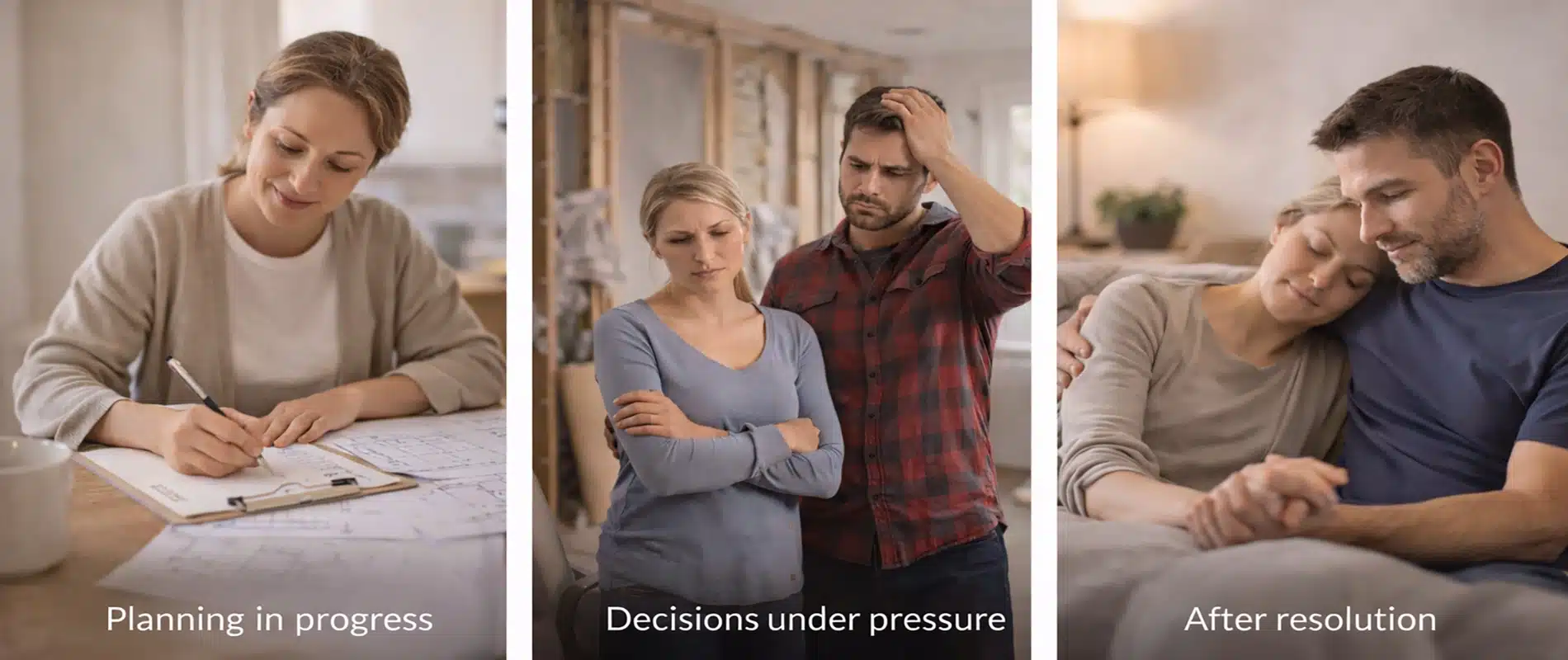
Peace of mind in remodeling is not emotional—it is operational. It emerges when decisions are made deliberately, supported by information, and sequenced logically. When decisions are vague, deferred, or rushed, reassurance evaporates quickly, even if intentions are good.
Every remodel introduces uncertainty. The question is not whether uncertainty exists, but whether it is addressed intentionally or allowed to surface unpredictably. Decisions are the mechanism through which uncertainty is either contained or released.
Homeowners feel calm when decisions feel anchored. They feel anxious when decisions feel improvised. Peace of mind is the byproduct of a system that makes uncertainty navigable rather than threatening.
Why Decision Timing Matters More Than Decision Quality
Most remodeling stress is not caused by bad decisions. It is caused by decisions made at the wrong time. Even objectively good choices feel stressful when they are forced under urgency or made without full context.
In many remodeling models, decisions are postponed until construction demands them. At that point, options are constrained, schedules are active, and costs feel volatile—conditions explored further in
Why Problems Feel Bigger During Construction.
Well-timed decisions feel fundamentally different. When choices are made during pre-construction, homeowners have room to think. They can evaluate trade-offs, understand consequences, and align decisions with priorities.
Decision quality cannot be separated from decision timing. A well-considered choice made under duress still feels destabilizing. A reasonably good choice made early often feels calming because it restores orientation.
The Hidden Cost of “We’ll Figure That Out Later
Few phrases undermine peace of mind more quietly than “we’ll figure that out later.” It sounds flexible and accommodating, but it quietly transfers uncertainty into the most disruptive phase of the project.
Deferred decisions accumulate. Each unresolved choice becomes a future interruption. When multiple deferred decisions collide during construction, homeowners experience decision compression—many choices arriving at once, each carrying time and cost implications.
This compression creates stress not because homeowners are incapable of deciding, but because the process forces urgency. Decisions that could have been calm become emergencies simply because of timing.
Late decisions also distort responsibility. Homeowners may blame themselves for not having answers sooner, even though the process encouraged deferral. Peace of mind erodes when homeowners feel responsible for structural flaws in the decision process.
“Later” does not eliminate uncertainty. It concentrates it.
Decision Load and the Weight Homeowners Are Asked to Carry
Every remodel requires hundreds of decisions, but not all of them should be carried by the homeowner. When decision roles are unclear, homeowners absorb more cognitive load than they should.
In poorly structured projects, homeowners are asked to choose finishes, layouts, and solutions without understanding how those choices affect cost, schedule, or constructability—an issue tightly linked to
Why Remodeling Costs Feel So Unpredictable.
This creates a subtle but exhausting dynamic. Homeowners remain mentally “on call,” anticipating the next question, especially in high-use spaces like kitchen remodeling, where layout, storage, and workflow decisions affect daily life immediately. They never fully relax because they sense that another decision is always coming.
Well-run projects redistribute decision load. Teams analyze options internally, resolve conflicts, and present homeowners with clear, bounded choices. The homeowner remains engaged, but not overwhelmed.
Peace of mind increases when homeowners feel guided rather than burdened, particularly in spaces like bathrooms, where usability, privacy, and long-term comfort are closely tied to thoughtful planning .
How Allowances and Vague Scope Quietly Erode Confidence
Allowances and loosely defined scope are often framed as flexibility, but they quietly undermine peace of mind. They create the appearance of progress while postponing resolution.
When allowances are exceeded—as they frequently are—homeowners feel misled, even when the outcome is predictable. The stress comes not just from increased cost, but from realizing the decision was never truly made.
This same mechanism is explored in
Why Square-Foot Pricing Fails in Remodeling, where early numbers provide comfort but collapse under real conditions.
Peace of mind requires closure. While clarity may feel uncomfortable early, it allows homeowners to relax later. Ambiguity does the opposite.
Decision Structure Is the True Source of Calm
Calm remodeling experiences are not accidental. They are produced by decision structure. Decisions are sequenced intentionally. Dependencies are explained. Choices are made before they become urgent.
This structure gives homeowners orientation. They know what has been decided, what remains flexible, and when future input will be required—often established during
Pre-Construction Explained: What Happens Before Construction Starts.
Without structure, homeowners live in constant readiness. With structure, questions feel like milestones rather than threats.
Peace of mind is not about eliminating uncertainty. It is about placing uncertainty inside a framework that makes sense.
Why Fast Decisions Rarely Feel Like Good Decisions
Speed is often framed as decisiveness in remodeling. Homeowners are told that quick answers keep projects moving. While mechanically true, this ignores how humans experience decisions under uncertainty.
Fast decisions compress evaluation time. Homeowners may understand the surface choice but not its downstream effects—especially in projects involving structure or sequencing, as outlined in
Structural Remodeling: What Homeowners Need to Understand Before Removing Walls.
Peace of mind depends on decision confidence, not velocity. Projects that allow decisions to mature create steadier emotional footing, even when adjustments are required.
How Decision Context Prevents Regret
Regret rarely comes from choosing the “wrong” option. It comes from choosing without context.
Decision context connects a choice to cost behavior, construction complexity, maintenance, and future adaptability, especially in projects like casitas or ADUs, where decisions affect not just the home, but how additional living space functions independently over time. Without it, homeowners revisit decisions with doubt—even when outcomes are successful.
Peace of mind grows when homeowners feel like authors of their decisions, not passengers.
The Emotional Cost of Re-Deciding the Same Thing Twice
One of the most destabilizing experiences in remodeling is being asked to revisit decisions believed to be final.
Re-decisions usually result from unresolved dependencies—systems not evaluated, structure not verified, or sequencing ignored early. This is why process choice matters, as explained in
Design-Build vs. Traditional Remodeling: Why the Process Changes Everything.
Peace of mind depends on knowing which decisions are locked and which remain intentionally flexible.
How Transparency Turns Trade-Offs Into Stability
Every remodel involves trade-offs. Stress emerges when trade-offs are hidden.
Transparency stabilizes expectations. When homeowners understand what is prioritized—and what is compromised—they align emotionally with outcomes, even imperfect ones.
Peace of mind comes from alignment, not perfection.
How Process Protects Homeowners From Themselves
Remodeling places homeowners in unfamiliar territory. Without structure, even capable people feel overwhelmed.
A strong process slows decisions that should not be rushed and filters complexity before it reaches the homeowner. This protection is not paternalistic—it is supportive.
Peace of mind emerges when homeowners trust the process enough to stop second-guessing themselves.
Peace of Mind Is an Outcome, Not a Personality Trait
Peace of mind is not reserved for easygoing people. It is produced by structure.
When decisions are sequenced logically, supported with context, and resolved before urgency, even complex remodels feel manageable.
Peace of mind is not luck.
It is the result of how decisions are handled.