
Remodeling Older Homes Without Losing Character
Why Homeowners Fear Losing Character More Than Gaining Space
Homeowners who live in older homes rarely fear remodeling itself. What they fear is loss. Loss of proportion. Loss of craftsmanship. Loss of the quiet details that made them fall in love with the house in the first place.
Unlike newer homes, older houses often feel intentional. Even when layouts are closed or systems are outdated, there is a sense that rooms relate to one another in a way that feels human rather than optimized. Remodeling introduces the fear that modernization will flatten that personality—turning a layered home into something generic.
This fear is justified. Many remodels erase character unintentionally, not through malice but through simplification. Standardized solutions, oversized openings, or inappropriate finishes can overwhelm the scale and rhythm of an older structure. Once removed, character is difficult—sometimes impossible—to restore authentically.
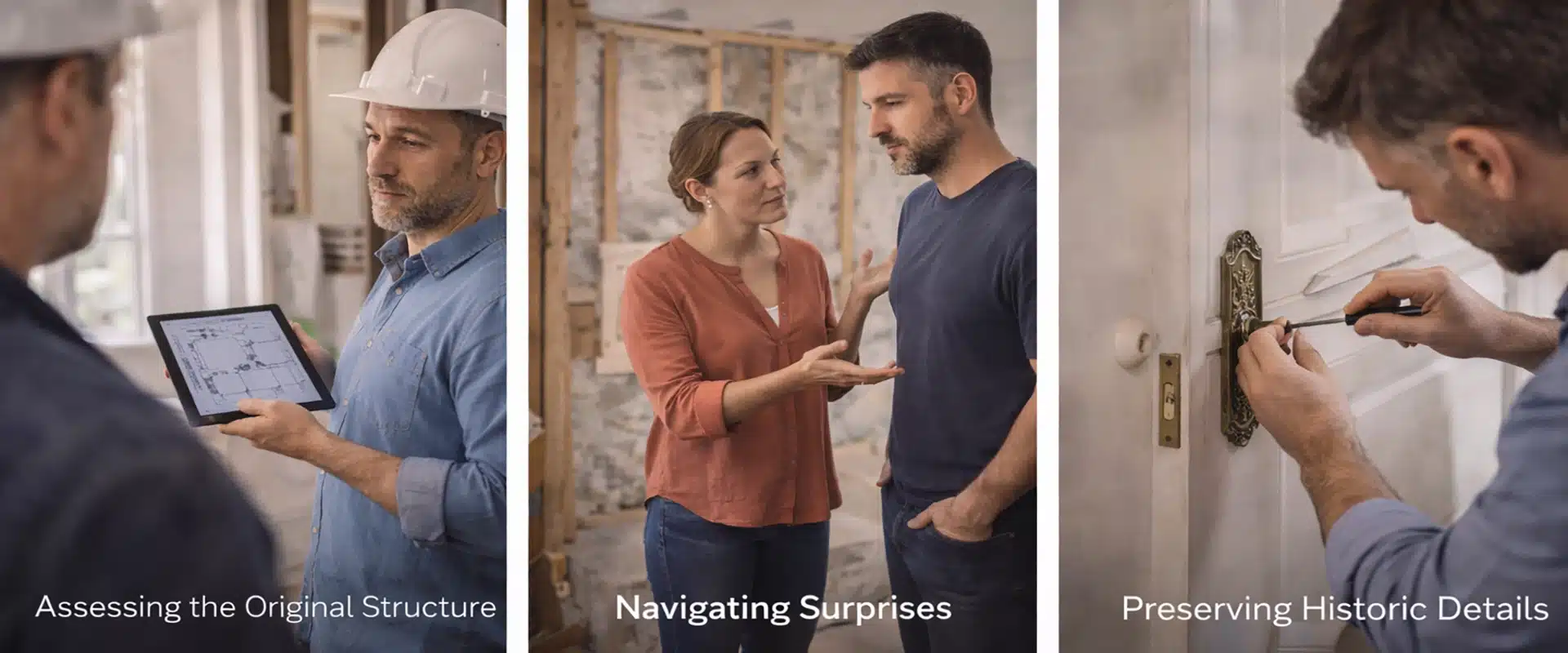
Understanding how character is created is the first step in protecting it. Character is not nostalgia. It is the result of proportion, material honesty, and restraint a principle that also defines mid-century homes, where proportion and simplicity are central to the architecture. Remodeling older homes successfully requires respecting those principles before changing anything which is explored more fully in this guide to remodeling historic homes, where preservation and modernization are carefully balanced .
What “Character” Actually Is (and Why It’s Often Misunderstood)
Character is often mistaken for surface elements: trim profiles, archways, hardwood floors, or vintage fixtures. While these details matter, they are not the foundation of character. They are expressions of deeper structure.
True character comes from scale, rhythm, and hierarchy. Ceiling heights relative to room size. Window placement that aligns with structure. Doorways that frame movement intentionally rather than maximize openness. These relationships create comfort even when finishes age.
When remodels fail to preserve character, it is usually because these underlying relationships are disrupted. Enlarging openings without considering proportion. Lowering ceilings to accommodate systems. Flattening transitions in the name of efficiency.
Preserving character does not mean freezing a home in time. It means understanding why it feels right before deciding how to improve it. When homeowners and remodelers share this understanding, modernization becomes additive rather than destructive.
Why Open-Concept Thinking Often Conflicts With Older Homes
Many older homes were designed around separation. Rooms served distinct purposes, circulation followed predictable paths, and transitions created moments of pause. This structure supported privacy, acoustics, and scale in ways modern open plans often overlook.
When open-concept ideas are applied without adaptation, older homes can lose their sense of containment. Large openings erase the hierarchy that once guided movement. Sound travels differently. Light behaves unpredictably. What was once cohesive becomes visually and acoustically flat.
This does not mean older homes cannot be opened up but it does require a more thoughtful approach, especially in projects involving open-concept remodeling. It means openness must be designed, not imposed — a distinction that becomes especially important when walls are involved, as explored in
Structural Remodeling: What Homeowners Need to Understand Before Removing Walls.
The goal is not maximum openness. It is appropriate openness. Homes retain character when openness is introduced with restraint and intention rather than default modern logic.
How Structure and Character Are Intertwined
In older homes, structure often plays a visible role in defining character. Load-bearing walls establish rhythm. Beams and columns anchor spaces. Even when hidden, structure dictates proportion.
Removing walls without understanding their role can disrupt more than load paths—it can distort the way rooms relate. A wall that feels like an obstacle may actually be the element that gives adjacent spaces their sense of place.
Structural remodeling in older homes requires dual awareness: what the wall carries, and what the wall means. Sometimes preserving a portion of a wall, a header drop, or a framed opening maintains character even as structure is reworked.
When structure and character are evaluated together, design decisions become more nuanced. Instead of asking “Can this wall come out?” the better question becomes “What role is this wall playing—and how do we honor that role while improving function?”
Modern Systems Are the Silent Threat to Character
One of the most common ways character is lost has nothing to do with finishes. It happens quietly through systems. HVAC ducting lowers ceilings. Recessed lighting flattens surfaces. Oversized vents and registers disrupt visual rhythm.
Older homes were not designed around today’s mechanical expectations. Introducing modern comfort without strategy often forces compromises that alter scale and proportion. Ceilings drop. Soffits appear where none existed. Rooms feel compressed.
Character-sensitive remodeling treats systems as design constraints, not afterthoughts. Ductless systems, high-velocity HVAC, careful lighting layering, and intentional vent placement preserve visual integrity while improving comfort.
When systems are coordinated early—during planning rather than construction—character is protected without sacrificing performance. This is why system coordination belongs in
Pre-Construction Explained: What Happens Before Construction Starts, not deferred into the build phase.
Why Planning Depth Determines Whether Character Survives
Preserving character is not achieved through taste alone. It is achieved through sequencing. Decisions about layout, structure, systems, and finishes must be made in the right order to avoid reactive compromises.
Shallow planning forces late decisions. Late decisions force simplification. Simplification erodes character.
Deep planning allows alternatives to be evaluated before irreversible changes occur. It gives homeowners time to weigh tradeoffs between openness and enclosure, between convenience and proportion, between modernization and restraint.
Homes that retain their character after remodeling are not lucky. They are planned. Character survives when it is named, understood, and protected deliberately—not when it is assumed to endure on its own.
Why “Matching the Old” Is Often the Wrong Goal
Many homeowners assume preserving character means perfectly matching existing details. Matching trim profiles, duplicating doors, or sourcing period-correct materials can feel like the safest path. In practice, strict replication often produces the opposite effect.
Older homes carry character not because everything matches perfectly, but because additions and changes were historically layered over time. Subtle variation is part of their authenticity. When new work tries too hard to disappear, it can feel artificial—like a stage set rather than a living home.
A more durable approach is compatibility, not imitation. New elements should respect scale, proportion, and material honesty without pretending to be original. When new work is quietly contemporary but deferential, the old and new read as intentional rather than confused.
Character is preserved when additions feel appropriate, not invisible.
The Risk of Over-Correcting Toward “Modern
Fear of losing character can sometimes push remodels too far in the opposite direction. Homeowners may avoid change altogether or preserve features that actively undermine function or comfort.
Older homes were designed for different lifestyles. Narrow kitchens, compartmentalized circulation, and limited storage were normal. Preserving these constraints without evaluation can turn character into inconvenience.
The goal is not to preserve inconvenience—it is to preserve identity. Thoughtful remodeling distinguishes between features that define the home and features that merely reflect outdated use patterns.
When homeowners allow selective modernization—improving flow, daylight, or usability—while protecting proportion and detail, the home becomes more livable without becoming generic.
Why Additions Pose the Greatest Threat to Character
Additions are where character is most often lost particularly when expansion is prioritized over proportion, which is why home additions require a different level of planning and restraint . Size, massing, and rooflines can overwhelm an older home if they are designed for maximum square footage rather than architectural balance.
Character-sensitive additions prioritize relationship over size. They respect existing roof pitches, window rhythms, and setbacks. They allow the original structure to remain visually dominant rather than swallowed.
Poorly planned additions feel obvious. Well-planned additions feel inevitable—as though the home always anticipated growth.
This level of restraint requires early design exploration, not late correction — another reason additions benefit from the integrated approach discussed in
Design-Build vs. Traditional Remodeling: Why the Process Changes Everything.
How Material Choices Reinforce or Undermine Authenticity
Materials communicate intention. In older homes, overly glossy finishes, exaggerated contrasts, or hyper-modern textures can feel disconnected even when beautifully executed.
This does not mean materials must be historic. It means they must be honest. Natural materials, restrained palettes, and consistent detailing reinforce continuity even when styles evolve.
Transitions matter as much as materials themselves. Flooring changes, trim intersections, and ceiling conditions are where character is most often compromised. When transitions are abrupt or unresolved, the home feels patched together rather than thoughtfully evolved.
Material decisions should support the home’s narrative, not compete with it.
How Homeowners Can Advocate for Character Without Micromanaging
Homeowners play a critical role in protecting character, but that role is strategic—not supervisory. Character preservation begins with articulation, not oversight.
When homeowners can describe what they value—scale, warmth, rhythm, restraint—they give the project a compass. Designers and builders can then test decisions against those values without constant approval cycles.
Micromanagement usually signals uncertainty. Clear principles reduce the need for constant correction. When character is defined early and referenced often, decisions stay aligned even as details evolve.
Advocacy works best when it is philosophical rather than prescriptive.
Remodeling Older Homes Is an Exercise in Judgment, Not Rules
There is no checklist for preserving character. No formula guarantees success. Older homes vary too widely, and character itself resists standardization.
What successful projects share is judgment. Decisions are made in context. Tradeoffs are acknowledged rather than ignored. Modern needs are balanced against architectural integrity instead of competing with it.
When homeowners understand that character is protected through process—not promises—they stop fearing change. Remodeling becomes an act of stewardship rather than risk. That level of judgment is rarely accidental—it is typically the result of a structured process that aligns design and construction decisions from the beginning.
A well-remodeled older home does not feel frozen in time.
It feels respected.