
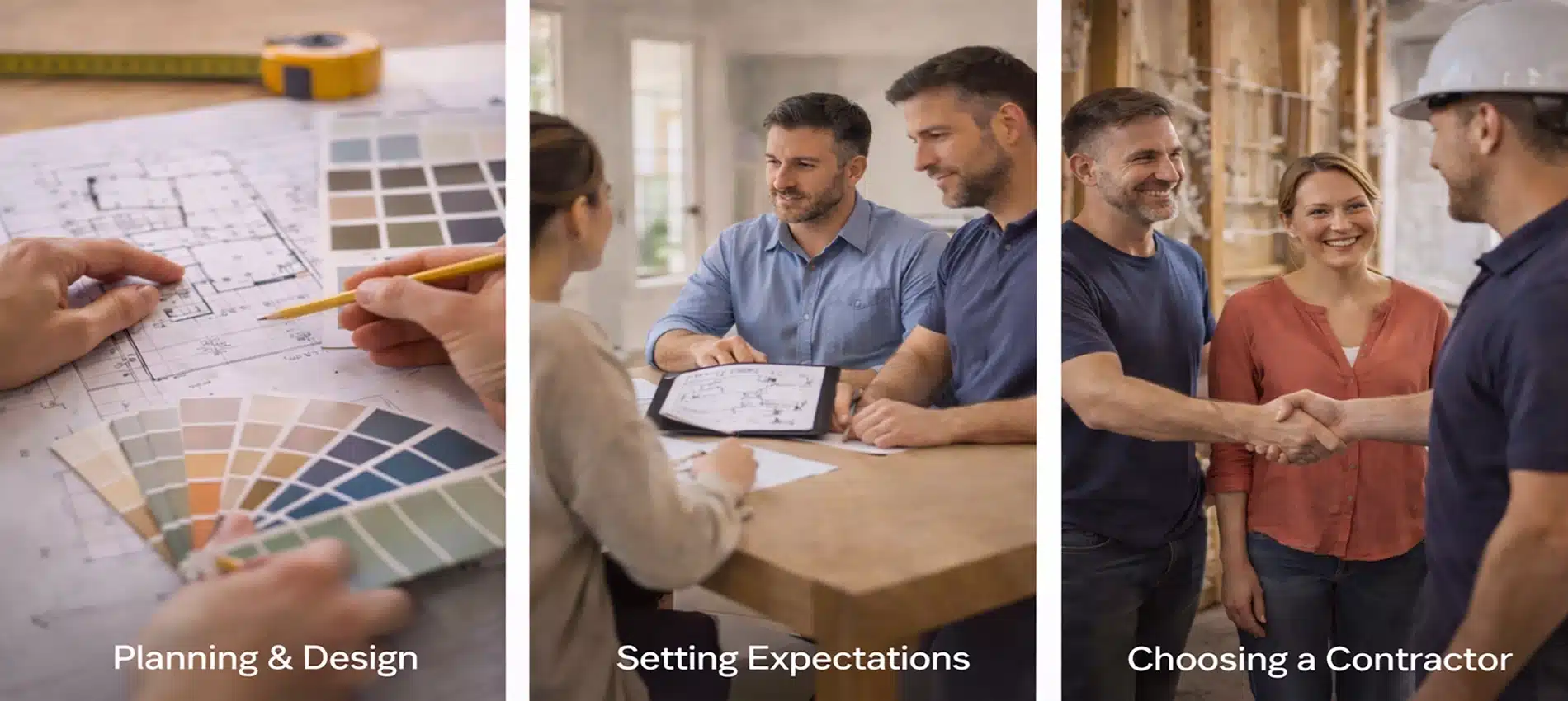
Pre-Construction Explained: What Happens Before Construction Starts
Pre-construction often feels uncomfortable to homeowners because it asks for commitment before anything visibly changes. No walls come down. No trucks arrive. No progress looks measurable. Yet money and time are already being spent, which naturally raises concern about whether the project is actually moving forward.
This discomfort is not about impatience. It comes from uncertainty. Homeowners worry that they are paying for conversations rather than results, or that planning is simply a way to delay construction without reducing risk. When progress is invisible, it can feel abstract and even unnecessary.
Pre-construction exists precisely because remodeling is unpredictable. It is the phase where uncertainty is confronted deliberately rather than discovered accidentally. Understanding what actually happens during this phase reframes it from overhead into protection.
Why Pre-Construction Feels Counterintuitive to Homeowners
Most homeowners associate progress with physical change. Demolition, framing, and installation feel tangible. Planning does not. Because pre-construction happens on paper and through analysis, it can feel disconnected from outcomes.
There is also a natural desire to “get started.” Once the decision to remodel is made, momentum feels important. Waiting to begin construction can feel like wasted time, especially when excitement and motivation are high. Pre-construction appears to slow that momentum rather than support it.
The counterintuitive truth is that moving too quickly increases disruption later. Pre-construction feels slow only when its purpose is misunderstood. It is not a pause before progress. It is the phase where progress is made possible without chaos.
What Pre-Construction Actually Is (Not Meetings, But Decisions)
Pre-construction is often misunderstood as a series of meetings or design conversations. In reality, it is a structured decision-making process. Its purpose is to resolve questions that would otherwise interrupt construction.
During pre-construction, layouts are finalized, systems are evaluated, and structural implications are addressed. Selections are coordinated so materials can be ordered intentionally rather than reactively. Conflicts between systems are identified before walls are opened.
This phase transforms assumptions into verified information. Instead of guessing how existing conditions will behave, the project team investigates them. Instead of deferring decisions, choices are made in sequence so construction can proceed without interruption.
This decision sequencing is one of the reasons outcomes differ so dramatically between processes, as explored in
Design-Build vs. Traditional Remodeling: Why the Process Changes Everything.
How Pre-Construction Reduces Cost Volatility
Cost volatility in remodeling is rarely caused by a single decision. It emerges when multiple unknowns are addressed simultaneously under time pressure. Pre-construction reduces this pressure by resolving uncertainty early.
When scope is fully defined before construction begins, pricing reflects reality rather than optimism. Systems are evaluated, allowances are minimized, and dependencies are understood. This does not guarantee that costs will not change, but it dramatically reduces the magnitude and frequency of adjustments.
This relationship between early clarity and cost behavior is examined more deeply in
Why Remodeling Costs Feel So Unpredictable.
Pre-construction also creates transparency. Homeowners understand what is included, what remains flexible, and what risks still exist. Cost changes, when they occur, feel expected rather than surprising.
How Pre-Construction Stabilizes Timelines
Timelines feel unpredictable when sequencing breaks down. Pre-construction stabilizes schedules by organizing work before it begins. Materials are ordered based on confirmed selections. Permits are prepared with complete information. Trades are scheduled around realistic dependencies.
When decisions are made during construction, work must pause while information is gathered or approvals are secured. Pre-construction moves those pauses forward, where they are less disruptive and less expensive.
This is why planning depth has such a strong influence on schedule stability — a dynamic explored further in
Why Remodeling Timelines Feel So Uncertain.
This does not eliminate delays entirely. It reduces their impact. Projects that invest in planning experience fewer stops, fewer resets, and a more consistent rhythm once construction begins.
Structural and System Risks Are Addressed Here — Not Later
Structural and mechanical risks are unavoidable in remodeling, but when they are addressed matters greatly. Pre-construction is the phase where these risks should be evaluated, not discovered mid-build.
Engineering reviews, load-path analysis, and system coordination identify potential conflicts before finishes are installed. This prevents situations where completed work must be undone to address underlying issues.
These risks become especially visible when walls are altered or removed — conditions examined in
Structural Remodeling: What Homeowners Need to Understand. This is especially true when walls are altered or removed, as explored in this complete guide to removing load-bearing walls.
Addressing risks early protects both budget and timeline. It also reduces stress, because difficult decisions are made deliberately rather than under pressure particularly in projects involving open-concept remodeling, where structure and system coordination must be resolved early. .
Why Skipping Pre-Construction Shifts Risk Into Construction
When pre-construction is skipped or significantly compressed, unresolved questions do not disappear — they simply relocate. Instead of being addressed calmly during planning, they surface during construction, when time pressure, labor sequencing, and material dependencies amplify their impact.
Decisions that should have been resolved upstream are forced downstream. Layout clarifications happen after framing has begun. System conflicts emerge after walls are opened. Selections are finalized after orders should have been placed. Each of these moments interrupts momentum and increases cost, not because the work is harder, but because it is being done out of sequence.
This is where change orders multiply. Not because homeowners are indecisive, but because the project was never fully decided. Crews must stop, revisit completed work, or wait while new information is gathered. What feels like construction inefficiency is often planning debt being paid with interest.
Skipping pre-construction does not make a remodel simpler or faster. It simply shifts complexity into the most expensive, disruptive, and emotionally charged phase of the project.
What Homeowners Gain Emotionally From Pre-Construction
Beyond logistics, pre-construction provides emotional stability. Homeowners gain confidence because they understand the plan, the sequence, and the rationale behind decisions.
Instead of reacting to surprises, homeowners participate in informed choices. They feel prepared rather than caught off-guard. Stress decreases because uncertainty is managed rather than ignored.
This emotional payoff connects directly to how confidence is built — or lost — throughout a remodel, a theme expanded in
How Remodeling Decisions Create (or Destroy) Peace of Mind.
Why Pre-Construction Is Often Misunderstood or Undervalued
Pre-construction is often undervalued because it produces no immediate visual payoff. It does not photograph well. It does not create dramatic before-and-after moments. Its success is measured by what doesn’t happen later — fewer delays, fewer surprises, fewer conflicts.
There is also a marketing disadvantage. Promising a fast start feels more compelling than explaining careful planning. Homeowners may interpret speed as competence and planning as hesitation.
This gap between perception and reality is why pre-construction must be explained, not assumed. Its value is preventative rather than corrective.
How to Evaluate a Remodeler’s Pre-Construction Process
Homeowners can evaluate pre-construction by listening closely to how a remodeler talks about decisions, risk, and sequence. Strong processes explain when decisions are made, why they are timed that way, and what happens if information changes.
Vague answers often indicate shallow planning. If timelines are promised without dependencies, or costs are discussed without scope clarity, preparation is likely being deferred rather than performed.
This evaluation mindset aligns closely with the criteria outlined in
Design Build vs Traditional Remodeling
Pre-Construction Is Where Predictability Is Built
Predictability in remodeling is not promised at the start. It is built through preparation. Pre-construction is where that work happens.
By resolving decisions, evaluating systems, and organizing sequence before construction begins, pre-construction converts uncertainty into strategy.
Projects that feel calm and controlled are not accidental. They are planned.
Why Pre-Construction Shapes the Entire Remodeling Experience
The remodeling experience is not defined by demolition day or the final walkthrough. It is shaped by how well the project was prepared before work began.
When pre-construction is thorough, construction feels purposeful rather than reactive. Decisions feel intentional rather than rushed. Adjustments feel informed rather than disruptive.
Homeowners who understand this phase stop viewing planning as delay and start recognizing it as protection.
Pre-construction does not slow remodeling down.
It keeps it from breaking down.