
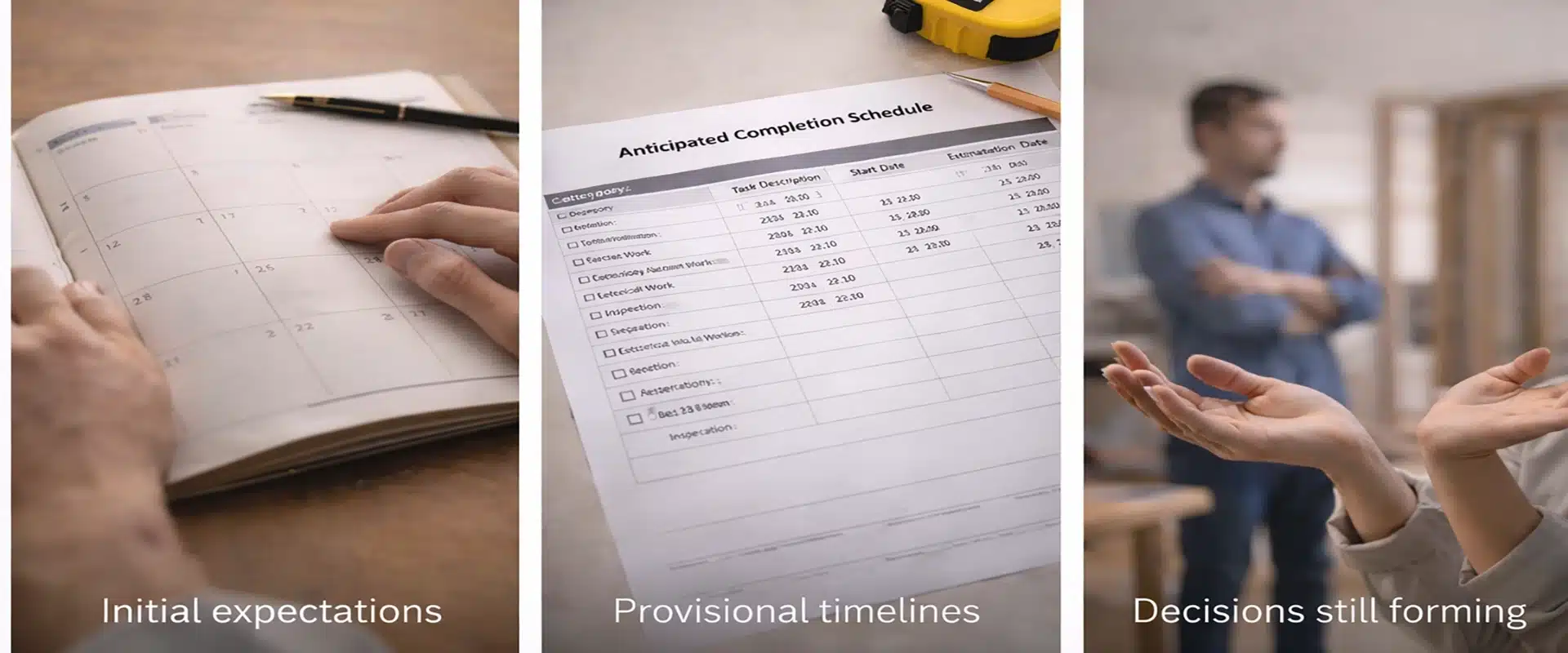
Why Remodeling Timelines Feel So Uncertain
When homeowners ask how long a remodel will take, they are rarely asking for a calendar date. What they are really trying to understand is whether the project will move forward with intention, or whether it will feel like a series of pauses, surprises, and shifting expectations once construction begins.
Timeline anxiety does not come from impatience. It comes from not knowing which parts of a remodel are predictable, which parts depend on decisions that have not yet been made, and which delays are unavoidable versus preventable. Without that context, even reasonable schedules can feel unreliable or misleading.
Remodeling timelines feel uncertain not because contractors are careless, but because most homeowners are never shown how timelines are actually constructed, what assumptions they rely on, or how easily they can change when planning, coordination, and decision-making happen out of sequence. This is because the underlying planning and sequencing are not always visible—something explored in depth in this guide to planning a remodel.
Remodeling Timelines Are Management Tools, Not Promises
A remodeling timeline is not a promise that life will return to normal on a specific date. It is a management tool used to organize labor, materials, inspections, and decisions based on what is known at a given point in time. Its role is coordination, not certainty.
Unlike manufacturing or shipping, remodeling happens inside an existing structure with conditions that are partially hidden and historically layered especially in larger projects like whole-home remodeling, where multiple systems and spaces must be coordinated simultaneously. Walls conceal plumbing and wiring installed under different codes. Framing may not match drawings. Previous renovations may have altered load paths or systems without documentation. These realities mean timelines must adapt as assumptions are replaced by verified conditions.
When homeowners interpret a timeline as a guarantee, every adjustment feels like failure. When they understand it as a working plan that evolves with information, changes feel like management rather than breakdown — the same distinction that explains why remodeling costs feel unpredictable.
Planning Depth Determines How Stable a Timeline Feels
The single most important factor affecting timeline stability is how much planning is completed before construction begins. Design development, structural evaluation, system coordination, and material selection all determine whether work can proceed without interruption once demolition starts.
Shallow planning produces schedules that look attractive on paper but perform poorly in reality. Decisions are deferred into construction, where they interrupt progress. Trades arrive without complete information. Materials are ordered late or out of sequence. Each unresolved issue introduces friction that compounds as the project moves forward.
Time invested in planning does not slow a remodel down. It reduces the number of stops, resets, and pauses later. Homeowners who understand this stop viewing planning as delay and begin to see it as schedule protection — a role explained in detail in what happens before construction starts. This closely parallels how budgeting behaves during remodeling, as explained in this guide to remodeling costs.
Decision Timing Shapes the Entire Schedule
Many homeowners assume timelines stretch because work is slow. In practice, timelines stretch because decisions are unresolved at the moment they are required. Construction cannot proceed cleanly when layouts, finishes, or system strategies remain undecided.
Early decisions preserve sequencing. Late decisions force resequencing. Even small changes can halt progress if they affect work already underway. A delayed cabinet decision can stall electrical rough-in. A late plumbing fixture selection can delay inspections. These dependencies are invisible until they are triggered.
Timelines feel uncertain when decision-making lacks structure. When homeowners know when decisions are required, what information they will receive, and how those decisions affect sequencing, schedules feel more predictable even when changes occur.
Permits and Inspections Define Real-World Timing
Permits and inspections are often treated as external delays rather than structural components of a remodel timeline. In reality, they define when work can legally proceed and when it must pause for verification.
Review timelines vary by jurisdiction. Inspector availability fluctuates. Corrections may be required before approval is granted. These factors are not controllable, but they are consistent in type and must be accounted for honestly.
Timelines that ignore permitting realities often feel optimistic early and disappointing later. Timelines that incorporate them upfront may appear longer, but they behave more reliably and create fewer surprises once construction begins.
Material Lead Times Control Construction Flow
Modern remodeling timelines are heavily influenced by material availability. Custom cabinetry, specialty windows, appliances, tile, and fixtures often carry long lead times that must be integrated into the schedule long before construction reaches those phases.
When selections are finalized early, materials can be ordered and delivered in sequence. When selections are delayed, work pauses or proceeds inefficiently, creating gaps that ripple through the schedule. Trades may be forced to leave and return multiple times, increasing both time and disruption.
Waiting to choose does not preserve flexibility. It transfers pressure into construction, where indecision is far more costly in both time and experience — a dynamic closely tied to why square-foot pricing fails in remodeling.
Structural Discoveries Affect Sequence, Not Just Budget
Structural discoveries are often associated with cost increases, but their impact on timelines is just as significant. When framing, foundations, or load paths differ from assumptions, which is especially common in projects involving layout changes such as open-concept remodeling, work may need to pause for evaluation, engineering, or redesign.
These pauses are not inefficiencies. They are safeguards that prevent long-term risk. Rushing through structural questions can create far more disruptive delays later when problems surface after finishes are installed.
Timelines feel uncertain when homeowners interpret pauses as delays rather than responsible decision points. Understanding this distinction reframes interruptions as protective rather than problematic.
Trade Coordination Is Where Timelines Succeed or Fail
A remodel involves many trades working in a precise sequence. Electrical work depends on framing. Drywall depends on inspections. Finish work depends on multiple preceding steps being completed correctly.
Well-run projects build margin into critical transitions. Poorly coordinated projects stack trades too tightly, leaving no room for adjustment when something shifts. One missed inspection or delayed delivery can cascade through the schedule.
Timelines feel fragile when there is no margin. They feel resilient when coordination anticipates real-world variability rather than ideal conditions — a difference driven more by process than paperwork, as explained in why the remodeling timelines feel so uncertin.
A Timeline Through the Eyes of a Homeowner
From a homeowner’s perspective, remodeling timelines rarely fail all at once. Instead, uncertainty accumulates quietly. A day passes without visible progress. A crew leaves earlier than expected. A scheduled delivery does not arrive. None of these moments feel catastrophic on their own, but together they create the sensation that the project is drifting rather than advancing.
What homeowners often interpret as inactivity is usually coordination happening out of sight. Inspections are being scheduled and rescheduled based on availability. Trades are being resequenced to avoid conflicts. Materials are being tracked, reordered, or adjusted to align with updated conditions. Without context, these invisible efforts feel like absence rather than management.
When homeowners are given visibility into this behind-the-scenes coordination, the emotional experience changes completely. The same pause that once felt like neglect now feels intentional.
Why Fast Timelines Often Feel the Most Chaotic
Aggressively compressed timelines are often marketed as efficient, but they frequently create the most chaotic remodeling experiences. When planning is rushed and decisions overlap construction, work may begin quickly but stall repeatedly as unresolved conflicts surface.
Early momentum can be misleading. Crews arrive, demolition starts, and visible activity creates confidence. As construction advances, however, missing decisions, delayed materials, or uncoordinated trades begin to interrupt progress. What felt fast at the beginning becomes fragmented in the middle.
Speed and progress are not the same thing. A timeline that prioritizes readiness over acceleration usually produces a calmer and more predictable experience overall.
How Communication Stabilizes Timeline Anxiety
Timeline anxiety is rarely driven by duration alone. It is driven by uncertainty. Homeowners can tolerate long projects when they understand what is happening, why it is happening, and what comes next.
Effective timeline communication does more than provide updates. It explains context. It clarifies what changed, why it changed, what the change affects, and whether action is required.
Frequency matters more than precision. Silence invites speculation. Context restores trust.
Timeline Predictability Is a Process Outcome
Predictable timelines are not promised. They are produced. They emerge from planning depth, decision structure, trade coordination, and communication discipline.
Projects that feel calm over time are rarely lucky. They are managed intentionally. That level of coordination is typically the result of a structured process—something explained in this guide to design-build remodeling.
The Real Measure of a Good Timeline
A good remodeling timeline is not one that never changes. It is one that changes for understandable reasons, communicates clearly, and adapts responsibly.
That is how uncertainty becomes manageable — and how remodeling timelines regain credibility.