
Why Remodeling Costs Feel So Unpredictable
The Cost Question Homeowners Are Really Asking
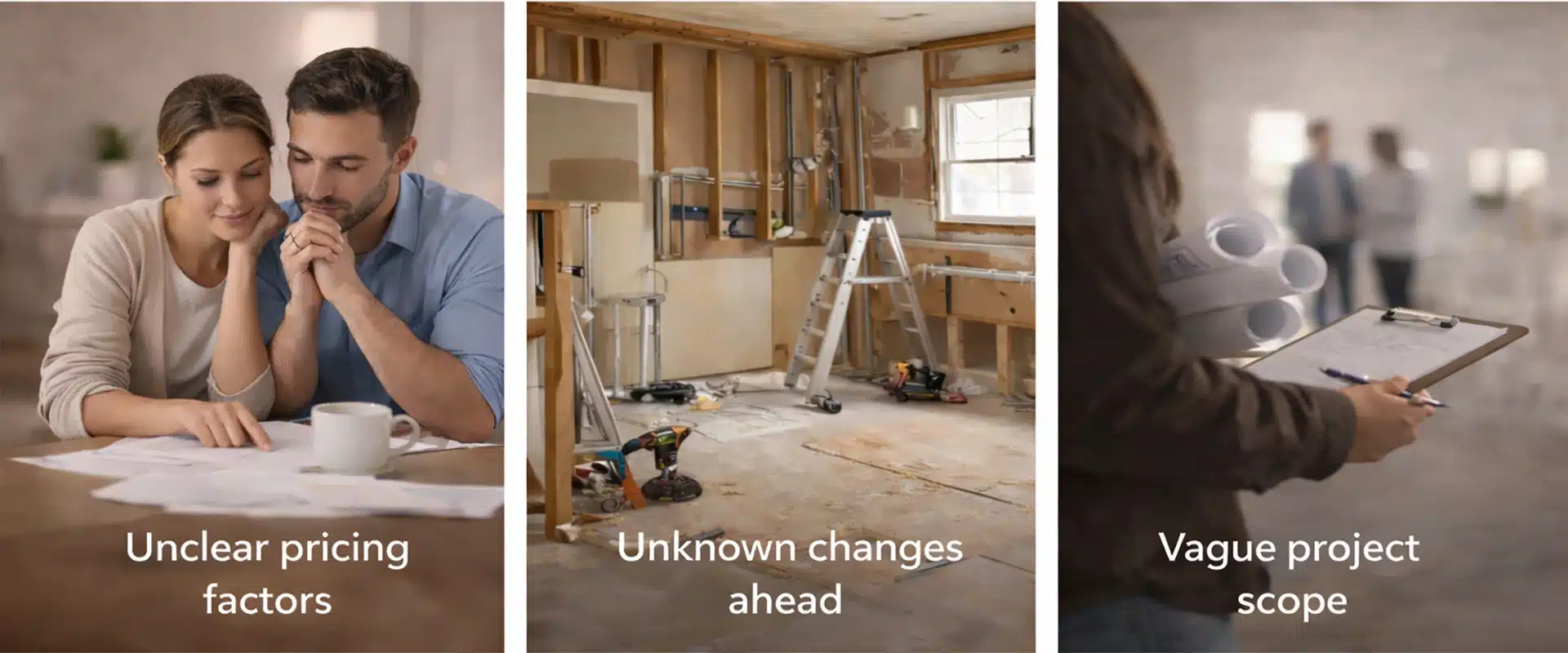
When homeowners ask how much a remodel will cost, they are rarely asking for a number. What they are really trying to understand is whether the project will feel controlled once it begins — or whether the process will slowly drift beyond their expectations.
The discomfort doesn’t come from the price itself. It comes from not knowing which decisions will affect that price, when those decisions will happen, or how much of the project is truly defined versus assumed. That uncertainty is what makes remodeling costs feel unpredictable.
Understanding where that uncertainty comes from — and how it can be reduced — changes the entire experience of remodeling.
Remodeling Is Not Priced Like New Construction
One of the most common misunderstandings homeowners bring into a remodel is the assumption that pricing should work the same way it does in new construction. In new builds, conditions are largely controlled. The site is cleared, systems are designed together, and repetition creates predictability. Costs can be standardized because the variables are known.
Remodeling operates in the opposite environment. Work takes place inside an existing structure with a history—often decades long. Walls conceal plumbing and wiring installed under different codes. Framing may not match drawings. Previous renovations may have altered structural paths or systems without documentation. These conditions are not theoretical; they are discovered as work progresses.
Because remodeling costs are shaped by investigation and adaptation rather than repetition, they resist the clean predictability homeowners expect. This difference alone explains much of the discomfort people feel when comparing remodel pricing to new construction logic — and why homeowners often rely on shortcuts that don’t actually reflect remodeling risk, such as square-foot pricing.
Scope Clarity Drives Cost Confidence
The single greatest factor influencing cost predictability is how clearly the scope is defined. Scope is not just what a space will look like when finished—it includes what will be removed, relocated, upgraded, reinforced, or corrected along the way. The more detailed the scope, the more reliable the cost.
When scope is vague, pricing becomes optimistic. Important details are left unresolved, either intentionally to keep early numbers low or unintentionally due to incomplete planning. As decisions are finalized later, costs rise—not because the remodel became more expensive, but because it was never fully defined to begin with.
Clear scope does not make a project cheaper. It makes it honest. That honesty is what creates confidence, even when the number itself is higher than expected.
Unknown Conditions Are Not Rare—They Are Normal
Every existing home contains unknowns. Aging plumbing, outdated electrical systems, concealed water damage, or structural modifications from past remodels are common, not exceptional. These conditions often remain invisible until walls are opened or systems are tested.
When unknown conditions are discovered, the project must adapt. That adaptation can add cost, time, or both. Homeowners are often surprised by this, not because the issue is unusual, but because they were never told to expect it.
Some remodelers price aggressively and address unknowns later through change orders. Others invest in early investigation and conservative assumptions. The difference between these approaches shows up in how costs evolve—and how stressful the experience feels.
Decision Timing Shapes Cost Outcomes
Remodeling costs are deeply influenced by when decisions are made. Early decisions allow systems to be coordinated, materials to be ordered efficiently, and work to proceed without interruption. Late decisions introduce friction, rework, and expedited costs.
For example, finalizing layouts before framing begins allows structural and mechanical work to proceed smoothly. Delaying those decisions may require revisiting completed work, modifying plans, or replacing materials already ordered.
Costs don’t increase because homeowners change their minds—they increase because changes occur after dependencies are already in motion. Understanding this relationship helps homeowners see cost changes as consequences of timing, not arbitrary adjustments.
This is where cost outcomes are truly shaped, long before construction begins, during planning before construction begins.
Allowances Create the Illusion of Certainty
Allowances are often presented as safeguards, but they are frequently misunderstood. An allowance is a placeholder for a selection that has not yet been made. If the allowance is set unrealistically low, the final cost will rise regardless of how reasonable the homeowner’s choice is.
Homeowners may feel misled when selections exceed allowances, even though the outcome was predictable from the start. The issue is not the selection—it is the assumption embedded in the allowance.
True cost clarity comes from resolved selections, not placeholders. Allowances delay clarity; they do not provide it.
Structural and System Upgrades Behave Differently Than Finishes
Many homeowners expect costs to scale evenly with size or finishes, but structural and system upgrades don’t follow that logic. A small space can trigger significant upgrades if existing systems are undersized or outdated which is why even smaller projects like kitchen remodeling can carry disproportionate cost due to system and infrastructure requirements.
For example, a compact kitchen remodel may require a new electrical panel, structural reinforcement, or HVAC modifications. A larger cosmetic remodel may not. These costs are not proportional to square footage, which is why simple pricing formulas fail.
Understanding this non-linear behavior helps homeowners make sense of why similar-sized projects can have very different budgets.
Why Estimates Vary Between Remodelers
Wide price variation between remodelers often confuses homeowners. These differences usually reflect assumptions, not competence or honesty. One remodeler may assume existing systems are adequate. Another may assume upgrades are required. One may include engineering or contingency. Another may defer those costs.
Without understanding what is assumed—and what is excluded—homeowners are left comparing numbers without context. This comparison fuels the feeling that pricing is arbitrary.
Better questions reveal better information: What has been evaluated? What remains unknown? What risks are included? Those answers explain variance far better than the final number.
Cost Is a Reflection of Risk Management
At its core, remodeling cost is not simply a tally of materials and labor. It is a reflection of how uncertainty and risk are identified, evaluated, and managed throughout the project.
This is why cost outcomes are governed less by legal language and more by how the project is structured day to day — a distinction explored in why process differences between design-build and traditional remodeling matter.
This is how process—not paperwork—controls cost outcomes.
How Planning Converts Uncertainty Into Strategy
Pre-construction planning is where cost unpredictability is reduced. Design development, system evaluation, structural review, and coordinated selections transform unknowns into decisions.
Skipping planning does not eliminate cost—it relocates it into construction, where adjustments are more disruptive and more expensive.
Planning does not eliminate uncertainty. It contains it.
Cost Predictability Is a Process Outcome
Homeowners often assume cost predictability is a promise that can be made early. In reality, it is an outcome that emerges as decisions are resolved and risks are addressed.
Projects that feel calm financially are not lucky. They are planned.
What This Understanding Changes for Homeowners
When homeowners understand why remodeling costs feel unpredictable, they stop interpreting changes as failures or broken promises. They become informed participants rather than anxious observers.
Cost clarity becomes something they build with their team, not something they demand upfront.
Predictability Comes From How the Project Is Run
Ultimately, remodeling costs feel unpredictable when the process behind them is unclear.
When planning is thorough and communication is consistent, costs feel grounded—even when they evolve.
The difference is not the house.
It is how the project is run.