
Universal Design Explained: Remodeling for Life, Not Just for Today
Why Universal Design Is Often Misunderstood
Universal Design is frequently misunderstood because it is framed through the wrong lens. Many homeowners associate it with aging, medical need, or institutional environments, and as a result, they dismiss it as irrelevant to their lives today. This misunderstanding is not accidental. The language surrounding Universal Design has often emphasized limitation rather than possibility.
When people hear terms like “aging-in-place” or “accessibility,” they often imagine grab bars, ramps, or clinical aesthetics. That imagery creates emotional resistance, especially among homeowners who feel active, capable, and far from needing accommodations. The result is a reflexive rejection of ideas that are perceived as premature or unnecessary.
What gets lost in this framing is that Universal Design is not about preparing for decline. It is about removing friction from daily life. It is about designing spaces that work intuitively, comfortably, and safely for a wide range of people and situations — many of which homeowners already experience but do not label as “needs.”
Because Universal Design works quietly, it is often overlooked. Its success lies in what does not happen: strain, awkward movement, unnecessary risk, or frustration. When misunderstood, it is dismissed. When understood, it becomes one of the most practical design strategies available. This quiet effectiveness is also why Universal Design contributes to long-term remodeling value beyond resale in ways that rarely show up in market comparisons but shape everyday living for years.
What Universal Design Actually Means
Universal Design refers to an approach to design that allows spaces to be used comfortably and effectively by people of different ages, abilities, and circumstances — without requiring adaptation or specialized features later. It is not a checklist of medical accommodations. It is a design philosophy rooted in usability.
Unlike ADA requirements, which are regulatory and context-specific, Universal Design is voluntary and flexible. It focuses on principles such as intuitive use, reduced physical effort, tolerance for error, and flexibility in how spaces are navigated and used. These principles guide decisions long before any visible feature is added.
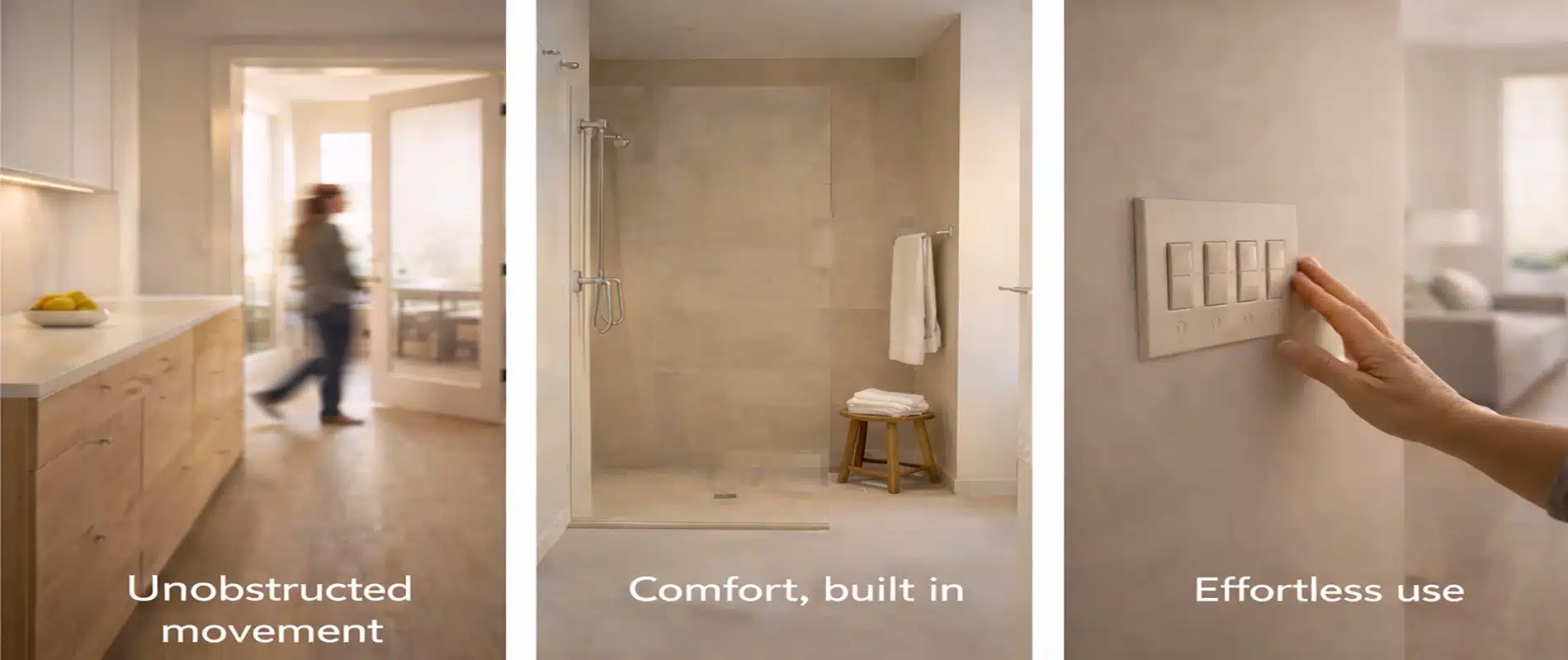
In practice, Universal Design often looks unremarkable. Wider circulation paths, better lighting, intuitive layouts, and thoughtful transitions rarely draw attention to themselves. They simply make a home easier to live in.
The defining characteristic of Universal Design is that it anticipates variation. It assumes that people move differently when carrying groceries, recovering from an injury, hosting guests, or aging into new phases of life. Instead of forcing homeowners to adapt to their house, it allows the house to adapt quietly to them.
Why Universal Design Is Relevant to All Homeowners
Universal Design is relevant not because homeowners will someday face limitations, but because everyday life already involves them. Temporary injuries, fatigue, carrying children, managing pets, hosting older relatives, or navigating a home during low-light conditions all introduce moments where design either helps or hinders.
Most homeowners encounter these moments without labeling them. A narrow hallway becomes inconvenient when moving furniture. Poor lighting becomes frustrating when eyesight is strained. Slippery surfaces become risky when balance is compromised, even briefly.
Universal Design addresses these realities proactively. It improves comfort and safety for everyone, regardless of age or ability. This makes it relevant to homeowners at every stage of life, not just those planning decades ahead.
It also supports long-term ownership especially in projects like casitas or ADUs, where flexibility and independent living become important over time . Homes designed with flexibility in mind are easier to adapt over time without major renovation. This reduces future disruption and regret, especially as priorities shift.
By framing Universal Design as a quality-of-life strategy rather than a contingency plan, its relevance becomes clear.
Where Universal Design Shows Up in Remodeling
Universal Design is most effective when integrated into core remodeling decisions rather than added as an afterthought. Kitchens, bathrooms, entries, and circulation paths are common areas where its impact is felt most immediately.
In kitchens, Universal Design influences layout, reach ranges, and workflow which is why thoughtful planning is essential in kitchen remodeling where daily usability matters most . Thoughtful spacing allows multiple users to move comfortably without congestion. Controls are placed intuitively. Storage is designed to be accessible without strain.
Bathrooms benefit from Universal Design through curbless showers, slip-resistant surfaces, and layouts that allow safe movement without sacrificing aesthetics and are often one of the most impactful areas to plan carefully during a bathroom remodeling project. When planned early, these features feel intentional rather than reactive.
Entries and circulation paths also play a critical role. Level transitions, adequate clearances, and well-placed lighting reduce effort and increase safety. These features often go unnoticed precisely because they work so well.
Universal Design does not announce itself. It is embedded in decisions that make spaces feel calm, intuitive, and accommodating.
Universal Design and Layout Decisions
Layout is where Universal Design has its greatest influence. Accessibility is not created by square footage alone, but by how space is organized and how people move through it.
Open layouts are often assumed to be universally accessible, but openness alone does not guarantee usability. Circulation paths must be clear and logical. Doorways and transitions must accommodate varied movement. Furniture placement must be considered alongside structural constraints.
Universal Design encourages layouts that support smooth movement without forcing compromise. Turning radii, sightlines, and adjacency matter more than raw size. These considerations often align naturally with good design principles when addressed early.
Because layout decisions frequently intersect with structural elements, Universal Design must be coordinated with structural planning. Early integration avoids conflicts and preserves design intent without costly revisions.
Layout is not just about aesthetics. It is about how life unfolds within a space.
Why Universal Design Is Best Integrated Early
Universal Design is most successful when it is integrated during pre-construction planning, not retrofitted later. Early planning allows these principles to shape structure, systems, and layout holistically.
When Universal Design is added late, it often feels compromised. Clearances are forced. Transitions are awkward. Costs increase because systems and structure were not designed to accommodate flexibility from the start.
Early integration preserves both function and aesthetics. It allows designers to embed usability invisibly rather than layering it on. It also minimizes cost by aligning decisions instead of revisiting them.
Perhaps most importantly, early integration prevents regret. Homeowners rarely wish they had planned less thoughtfully. They often wish they had anticipated more.
Universal Design is not about predicting the future precisely. It is about respecting that life changes — and designing homes that respond gracefully when it does.
The Cost Myth Around Universal Design
One of the most persistent misconceptions about Universal Design is that it significantly increases remodeling costs. This belief often prevents homeowners from even considering it. In reality, Universal Design is less about adding expensive features and more about making smarter decisions earlier.
Many Universal Design choices cost little or nothing when incorporated during planning. Wider circulation paths, better lighting placement, intuitive layouts, and thoughtful transitions are design decisions, not premium upgrades. They rely on intention, not specialized materials.
Costs tend to rise only when Universal Design is treated as an afterthought. Retrofitting clearances, reworking structure, or revisiting systems after construction has begun introduces inefficiency. When Universal Design principles are integrated early, they often replace other costs rather than add to them.
Perhaps the most overlooked cost is omission. Homes that are difficult to adapt later often require disruptive renovations when needs change. Universal Design reduces the likelihood of future remodels by preserving flexibility from the start.
The myth persists because cost is discussed in isolation. When evaluated in context, Universal Design is more often a cost stabilizer than a cost driver.
Universal Design vs Aging-in-Place (An Important Distinction)
Universal Design and aging-in-place are often used interchangeably, but they are not the same. Aging-in-place describes an outcome — the ability to remain in a home over time. Universal Design is the strategy that quietly supports that outcome.
Aging-in-place solutions are often reactive. They respond to specific needs once limitations appear. Universal Design, by contrast, anticipates variation before it becomes a constraint. It reduces the need for visible adaptations later.
This distinction matters because language shapes perception. When Universal Design is framed solely as preparation for aging, it triggers resistance. When framed as a way to design better spaces now, it becomes far more approachable.
Universal Design avoids signaling decline. It preserves dignity by making spaces usable without announcing why. That subtlety is its strength.
Understanding this difference allows homeowners to plan proactively without feeling defined by future limitations.
How Universal Design Protects Resale and Longevity
Universal Design supports resale not by advertising accessibility, but by broadening appeal. Homes that are easy to navigate, well-lit, and intuitively organized feel better to a wider range of buyers.
Features such as step-free entries, generous circulation, and flexible layouts often register subconsciously. Buyers may not identify them as Universal Design, but they respond positively to how the space feels.
Because Universal Design avoids specialized or institutional features, it does not date a home. Instead, it preserves adaptability. Future owners can live comfortably without immediate modification, which increases perceived value.
Longevity is also enhanced. Homes designed with flexibility in mind remain functional as lifestyles change. This reduces the likelihood of future renovations and supports long-term satisfaction.
Universal Design does not chase trends. It protects usefulness.
What Homeowners Should Ask About Universal Design
Homeowners evaluating Universal Design should focus less on features and more on philosophy. The most revealing questions explore how flexibility, safety, and usability are being considered within the overall design.
Questions such as: How does this layout support movement over time? What assumptions are being made about future use? Which decisions preserve flexibility rather than locking it in? These inquiries surface whether Universal Design is embedded or superficial.
Strong responses explain trade-offs and priorities. They acknowledge that not every feature is necessary, but that choices are being made deliberately. They emphasize integration rather than add-ons.
Universal Design is not a checklist to be completed. It is a lens through which decisions are evaluated. Asking the right questions reveals whether that lens is being used.
What This Understanding Changes for Homeowners
When homeowners understand Universal Design properly, resistance fades. Planning ahead no longer feels pessimistic or premature. It feels responsible.
Homeowners begin prioritizing flow, lighting, and usability alongside aesthetics. This shift also reduces the likelihood of losing control during a remodel, because key decisions are made deliberately rather than under pressure once construction is underway.
This understanding also reduces regret. Homeowners are less likely to look back and wish they had considered certain details earlier. Instead of reacting to change, they feel prepared for it.
Universal Design shifts the remodeling conversation from fear of the future to respect for it.
Universal Design Is About Living Well Longer
At its core, Universal Design is about continuity. It allows people to live well in their homes for longer, with fewer disruptions and fewer compromises.
It does not announce itself. It does not demand attention. It simply works — quietly supporting daily life as circumstances evolve.
Homes designed this way feel calmer, more intuitive, and more resilient. They adapt without requiring explanation. They accommodate change without signaling it.
Universal Design is not about planning for worst-case scenarios.
It is about designing spaces that remain generous, usable, and welcoming over time.
That is not a medical strategy.
It is good design.