
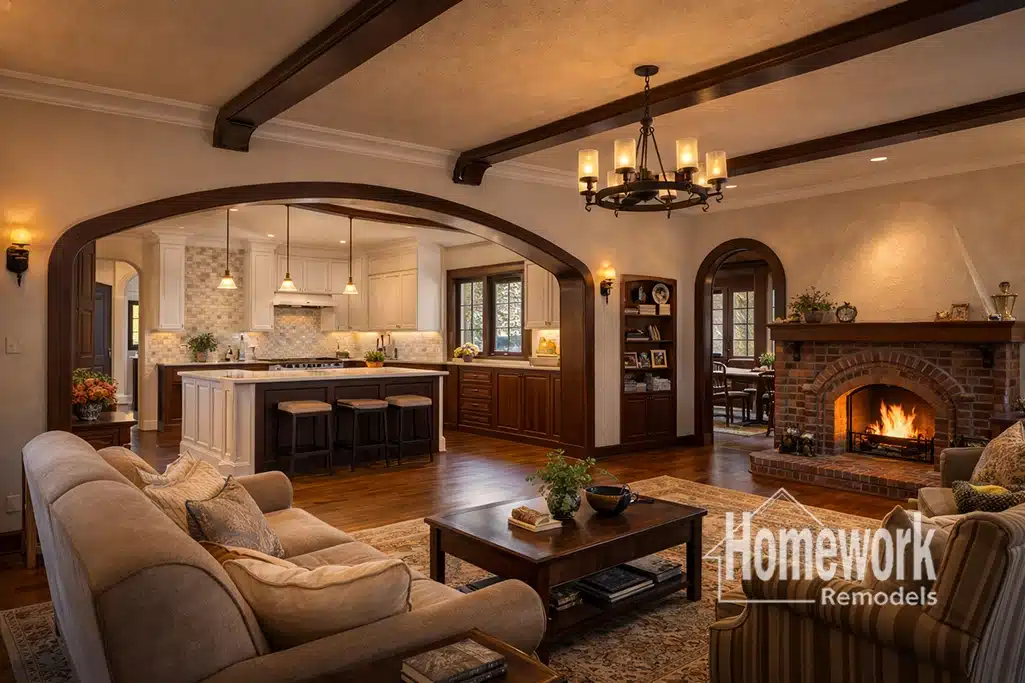
F.Q. Story Living Room Remodels: When “Opening It Up” Actually Makes the Room Smaller
Living rooms in the F.Q. Story Historic District are modest by modern standards—but they were never meant to feel cramped. Built primarily in the 1940s, these homes relied on proportion, furniture placement, and subtle separation to make small spaces function comfortably. Today, many homeowners look at these rooms and assume the solution is simple: remove walls, open everything up, and let the space breathe.
In practice, that instinct often backfires. In small historic homes, opening a living room can actually make it feel smaller, less usable, and more frustrating day to day. The problem isn’t openness itself—it’s losing the structural and functional cues that small spaces rely on.
Why Openness Works Differently in Small Homes
Open-concept remodeling is often showcased in large homes, where excess square footage absorbs inefficiencies. F.Q. Story homes do not have that margin. Every wall, corner, and surface plays a role.
When walls are removed in small living rooms, furniture loses anchoring points. Seating floats awkwardly. Circulation paths cut through conversation areas. Storage disappears. The room may look larger at first glance—but it often works worse.
The core decision tension is visual openness versus functional clarity. In F.Q. Story homes, clarity usually wins.
Furniture Logic Is the Hidden Constraint
Living rooms are defined less by walls than by how furniture fits. Sofas need backing. Chairs need balance. Media, books, or art need placement.
When walls are removed, these reference points disappear. Homeowners may gain sightlines but lose usable layouts. In small rooms, there are fewer alternative arrangements to compensate.
Before removing walls, it’s critical to test furniture layouts realistically—not just imagine openness abstractly.
Partial Openings Often Outperform Full Removal
Many F.Q. Story living rooms benefit from partial openings rather than full wall removal. Cased openings, widened doorways, or lowered wall sections can improve connection without sacrificing definition.
These strategies preserve furniture logic while improving light and flow. They also retain structural stability and reduce the need for extensive reinforcement.
Homeowners considering wall changes benefit from understanding what is involved in removing load-bearing walls in Phoenix’s older homes before committing to full openness.
Ceiling Height and Lighting Shape Perception
Small living rooms rely heavily on ceiling and lighting cues. Uniform lighting across an overly open space can flatten depth and exaggerate smallness.
Layered lighting—combined with defined zones—often makes a room feel larger than a single, undifferentiated volume. Ceiling treatments, beams, or subtle transitions reinforce scale without walls.
The decision tension is simplicity versus dimensionality. Dimensionality creates comfort.
Storage Loss Is Often Overlooked
Walls in small living rooms often double as storage or display surfaces. Built-ins, shelving, or even simple wall length support daily function.
Removing walls eliminates these opportunities. The result is a room that looks open but struggles to store everyday items.
In F.Q. Story homes, storage and openness must be balanced carefully. Losing one usually harms the other.
Circulation Can Overwhelm the Room
Open plans invite traffic. In small homes, circulation paths often cut directly through living rooms once walls are removed.
This disrupts seating arrangements and makes rooms feel transitional rather than restful. Retaining subtle boundaries keeps circulation predictable and comfortable.
The decision tension is free movement versus livable movement. Livable movement respects the room’s purpose.
The “Borrowed Space” Trap
Sometimes homeowners remove a living room wall to “borrow” space from a dining room or hallway. While square footage technically increases, usability often declines.
The borrowed space may not align with furniture needs or lighting patterns. Instead of one functional room, homeowners end up with one awkward one.
Understanding how small rooms interact prevents this common mistake.
Whole-Home Planning Protects Small Spaces
Living room changes affect adjacent rooms, circulation, and storage. When decisions are made in isolation, small inefficiencies multiply quickly.
Whole-home planning evaluates how each room supports the next. Homeowners who understand how whole-home remodeling in Phoenix works are better equipped to choose openness selectively rather than universally.
Why Design-Build Matters in Compact Homes
In small historic homes, design assumptions carry real consequences. A design-build approach allows layout ideas to be tested against construction realities and daily use before walls come down.
This integration reduces regret and ensures that openness improves life rather than complicates it. Learning how the design-build remodeling process works helps homeowners understand why it is especially valuable in compact neighborhoods like F.Q. Story.
The Core Decision Tension: Bigger Looking or Better Living
In F.Q. Story living rooms, the goal should not be to chase the appearance of size. It should be to support comfort, function, and balance.
Rooms that respect their scale often feel more generous than those that try to escape it. When openness is applied selectively, small homes live better—not just look different.
A Note for Homeowners…
Many of the questions raised in this article—around planning, cost, timing, and long-term outcomes—are part of a broader remodeling system that most homeowners aren’t shown upfront.
Our Core Guides were created to explain why remodeling often feels unpredictable and what actually brings clarity and stability before construction begins.
Let’s Redesign Your Living Room to Work Better, Not Just Look Bigger
If you are considering changes to a living room in the F.Q. Story Historic District, thoughtful planning can prevent common pitfalls. With neighborhood-specific experience and an integrated design-build approach, it is possible to improve flow while preserving the function small homes depend on.
We invite you to schedule a free remodeling consultation to explore options that enhance comfort without sacrificing usability.