
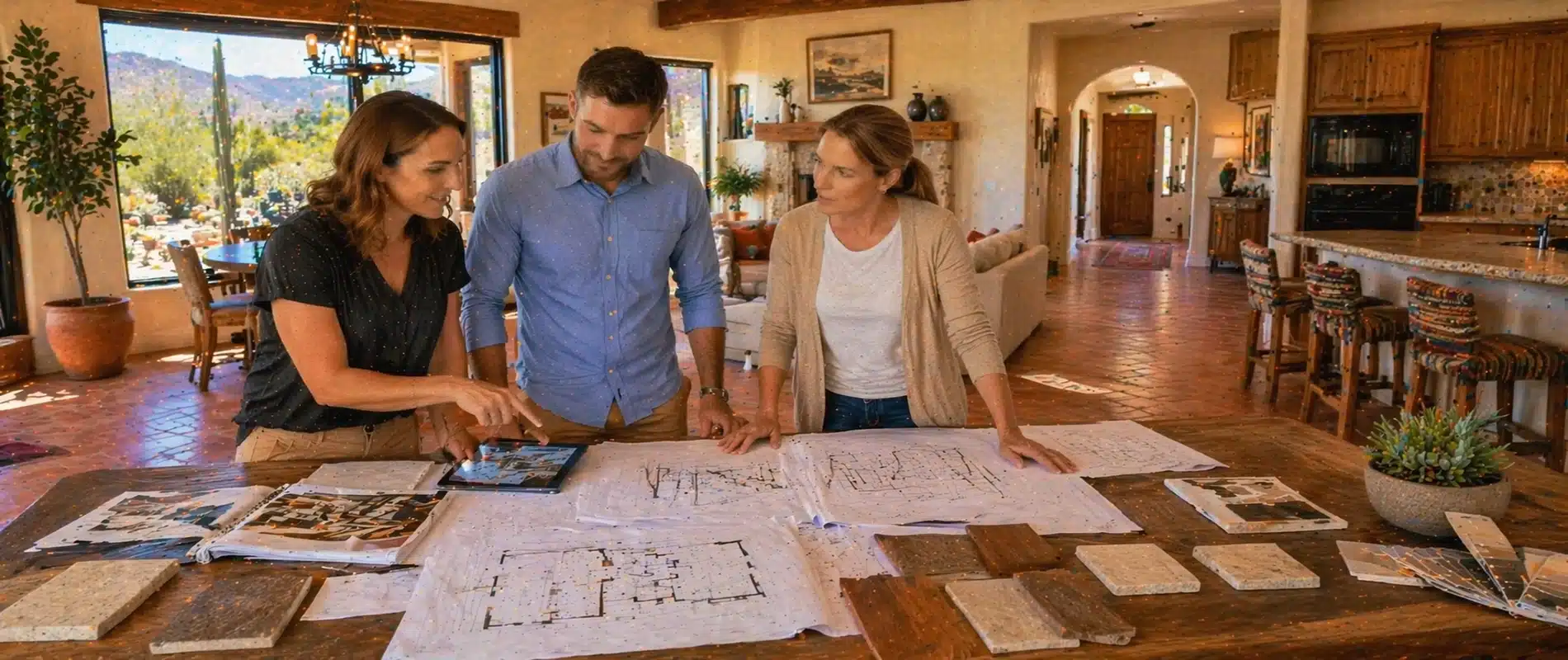
 Whole-Home Remodeling in Phoenix — Planning a Major Renovation
On This Page
Introduction: Whole-Home Remodeling Starts Before Construction
What Is Whole-Home Remodeling?
Why Homeowners Choose Whole-Home Remodeling
Planning the Remodel: The Preconstruction Phase
Structural Changes and Layout Transformation
Kitchen, Bathroom, and Core Living Spaces
Cost Planning for Whole-Home Remodeling
Timeline and Project Sequencing
Living Through a Whole-Home Remodel
What a Successful Whole-Home Remodel Feels Like
Introduction: Whole-Home Remodeling Starts Before Construction
When homeowners begin thinking about a whole-home remodel, it’s natural to picture the visible transformation—walls coming down, new spaces taking shape, finishes being installed, and the home gradually becoming something new. But the reality is that a successful whole-home remodel does not begin with construction. It begins long before that, in the decisions, planning, and clarity that shape the project from the very start.
Whole-home remodeling is not simply a larger version of a kitchen or bathroom remodel. It is a fundamentally different type of project. Instead of focusing on one space, it involves rethinking how the entire home functions as a connected system. Layout, structure, mechanical systems, circulation, natural light, and the relationship between rooms all come into play at once. Because so many elements are interconnected, early decisions carry more weight, and the path to construction requires a higher level of coordination.
Many of the challenges homeowners associate with remodeling—unexpected costs, shifting timelines, and mid-project changes—can often be traced back to what happens before construction begins. When a project moves forward without fully defined scope, aligned expectations, or a clear understanding of the home’s existing conditions, uncertainty tends to surface later. By contrast, when the early phases of the project are approached with intention and structure, the overall experience becomes more predictable and manageable.
This is why the process leading up to construction is so important. It is during this time that the vision for the home is explored, refined, and translated into a plan that can be built. Homeowners begin to define how they want to live in the space, what changes will support that lifestyle, and how different parts of the home need to work together. These decisions are not just about aesthetics—they influence structure, systems, cost, and the sequence of construction itself.
In the Phoenix area, whole-home remodeling often involves additional considerations. Homes built in different decades may have varying structural methods, insulation levels, and system capacities. The climate also plays a role in how homes perform, influencing decisions related to energy efficiency, window placement, shading, and indoor-outdoor connections. Addressing these factors effectively requires thoughtful planning, not just reactive construction.
Another important aspect of starting before construction is understanding that remodeling is a process of alignment. Design, budget, and scope must come together in a way that supports the homeowner’s goals. When these elements are considered separately, projects can drift out of alignment, leading to revisions, delays, or compromises. When they are developed together, the path forward becomes clearer, and construction can proceed with greater confidence.
It is also during this early phase that homeowners begin to understand the full scope of what a whole-home remodel entails. Beyond the visible changes, there are systems behind the walls, structural elements that support the home, and sequences of work that must happen in a specific order. Gaining this understanding early helps set realistic expectations and reduces the likelihood of surprises later.
Ultimately, whole-home remodeling starts with clarity. It starts with understanding the home as it is, defining what it needs to become, and creating a plan that bridges that gap. Construction is where that plan is brought to life, but the quality of the outcome is largely determined by what happens beforehand.
For homeowners considering a major renovation, recognizing that the process begins before construction is one of the most important insights. It shifts the focus from reacting to problems as they arise to preparing for the project in a way that supports a smoother, more intentional transformation from beginning to end.
What Is Whole-Home Remodeling? (Definition + Scope)
Whole-home remodeling is the comprehensive redesign and renovation of an entire home, planned and executed as one coordinated project rather than a series of separate updates. Instead of focusing on a single room—like a kitchen or bathroom—a whole-home remodel looks at how every space, system, and structural element works together and reshapes the home as a unified environment.
At its core, whole-home remodeling is about improving how the home functions as a complete system. Layout, structure, mechanical systems, natural light, circulation, and design are all considered together. This allows homeowners to move beyond surface-level upgrades and create a home that feels cohesive, intentional, and aligned with how they actually live.
In practical terms, whole-home remodeling often includes reconfiguring floor plans, updating kitchens and bathrooms, removing or relocating walls, improving storage, and modernizing finishes throughout the home. Just as important—but less visible—are the updates to systems behind the walls. Electrical, plumbing, HVAC, insulation, and windows are frequently evaluated and upgraded during a whole-home remodel to improve comfort, efficiency, and long-term performance.
The scope of a whole-home remodel can vary depending on the home and the goals of the homeowner. Some projects focus on transforming the main living areas and creating a more open, connected layout. Others may involve extensive structural changes, additions, or a complete rethinking of how the home is organized. In the Phoenix area, scope is often influenced by the age of the home, construction methods, and climate considerations such as heat management, energy efficiency, and indoor-outdoor living.
A key distinction of whole-home remodeling is that decisions are not made in isolation. Changes in one area affect other parts of the home. Opening a kitchen impacts adjacent living spaces, lighting, and structural support. Expanding a primary suite may affect circulation, storage, and exterior design. Because of this, the project is planned holistically, with each decision contributing to a larger, coordinated outcome.
It is also important to understand what whole-home remodeling is not. It is not simply a collection of smaller projects completed over time. While phased remodeling can work in certain situations, it often leads to inconsistencies, repeated disruptions, and missed opportunities to improve the home as a whole. A whole-home remodel, by contrast, is designed with a clear vision from the beginning, allowing all parts of the home to evolve together.
Whole-home remodeling is also different from building a new home. It works within the existing structure, adapting and improving it rather than starting from the ground up. This requires a deeper understanding of how the home was originally built and how new elements will integrate with what already exists.
Ultimately, whole-home remodeling is a system-based approach to renovation. It is not just about updating finishes or adding space—it is about rethinking how the home functions, how spaces connect, and how the environment supports daily life. By addressing the home as a whole, homeowners can achieve a more cohesive design, improved performance, and a living experience that feels intentional from one room to the next.
Why Homeowners Choose Whole-Home Remodeling
Whole-home remodeling is rarely about changing a single room. It’s usually the result of a larger realization: the home no longer supports the way the homeowner wants to live. Over time, needs evolve, families grow, routines shift, and expectations change. What once worked well can begin to feel limiting, disconnected, or outdated. Rather than making isolated improvements that only partially solve the problem, many homeowners choose a whole-home remodel to address the house as a complete system.
One of the most common reasons homeowners pursue whole-home remodeling is the desire for a cohesive layout. Many homes in the Phoenix area—especially those built in earlier decades—were designed with compartmentalized floor plans that no longer reflect how people live today. Kitchens may feel separated from living spaces, circulation paths may be inefficient, and natural light may be underutilized. A whole-home remodel allows these issues to be addressed together, creating a more open, connected environment that supports daily life more naturally.
Another key driver is functionality. Over time, homeowners often adapt to spaces that don’t quite work, making small compromises along the way. Storage may be inadequate, bathrooms may feel undersized, or rooms may be used for purposes they were never designed to support. A whole-home approach provides the opportunity to rethink how each part of the home functions in relation to the others. Instead of fixing symptoms, it allows for a more intentional redesign that aligns with how the home is actually used.
Aging homes also bring systems that are no longer performing at their best. Electrical, plumbing, HVAC, insulation, and windows all play a role in comfort and efficiency, yet these systems are often upgraded only when something fails. Whole-home remodeling creates an opportunity to evaluate and improve these systems together, rather than addressing them in a piecemeal way over time. This can lead to a more comfortable, efficient, and reliable home overall.
Consistency in design is another reason homeowners choose to remodel the entire home at once. When updates are done room by room over many years, it can be difficult to maintain a cohesive look and feel. Materials, finishes, and styles may vary, and transitions between spaces can feel disconnected. A whole-home remodel allows for a unified design direction, where each space complements the others and contributes to a consistent experience throughout the home.
In the Phoenix area, lifestyle considerations often play a significant role. Indoor-outdoor living, natural light, energy efficiency, and heat management are all important factors that influence how a home performs. A whole-home remodel makes it possible to address these elements holistically—adjusting window placement, improving insulation, reworking layouts, and enhancing connections to outdoor spaces in a coordinated way.
For many homeowners, the decision also comes down to long-term thinking. Instead of investing in multiple smaller projects over time, a whole-home remodel allows for a more comprehensive plan. This approach can reduce repeated disruptions, streamline decision-making, and create a clearer path from the current home to the desired outcome. It also allows homeowners to prioritize improvements in a way that reflects their long-term goals rather than short-term fixes.
There is also an emotional component that should not be overlooked. Homes carry meaning. They are where routines take place, where families gather, and where daily life unfolds. When a home no longer supports that experience, it can create a sense of friction. Whole-home remodeling offers a way to realign the environment with the way homeowners want to live, creating a space that feels more natural, comfortable, and supportive.
Ultimately, homeowners choose whole-home remodeling because it allows them to move beyond surface-level updates and address the deeper structure of how their home works. It is not simply about updating finishes or increasing square footage. It is about creating a home that functions better, feels more connected, and supports the way life is lived today and in the years ahead.
Planning the Remodel: The Preconstruction Phase
Before construction begins, the most important work of a whole-home remodel is already underway. The preconstruction phase is where the project is defined, clarified, and aligned. It is the stage that turns a general idea—“we want to remodel our home”—into a clear, coordinated plan that can be built with confidence. While it may not be as visible as framing or finishes, this phase has the greatest influence on how smoothly the project will unfold.
Homeowners often begin with a vision: a more open layout, updated kitchens and bathrooms, better use of space, or a home that feels more cohesive overall. Preconstruction is where that vision is explored in detail. Measurements are taken, existing conditions are evaluated, and the relationship between different parts of the home is carefully considered. Rather than focusing on individual rooms in isolation, the home is approached as a complete system, with each decision influencing others.
One of the first priorities in this phase is understanding feasibility. Not every idea can be implemented exactly as imagined, especially in homes that have structural constraints, limited space, or existing system limitations. Walls may be load-bearing, rooflines may restrict expansion, and mechanical systems may need to be rerouted or upgraded. Identifying these factors early allows the design to evolve in a way that is both realistic and aligned with the homeowner’s goals.
Budget alignment is another critical component of preconstruction. Early conversations about investment range help establish a framework for decision-making. Rather than designing first and pricing later, a design-build approach integrates budgeting into the design process. This allows homeowners to see how choices—such as layout changes, structural work, material selections, and system upgrades—affect the overall cost. When budget and design are aligned early, the project is less likely to encounter disruptive changes during construction.
As the design develops, the project moves into documentation. Drawings become more detailed, capturing dimensions, structural elements, and the integration of systems such as electrical, plumbing, and HVAC. These documents are not just for visualization; they are the foundation for engineering, permitting, and construction. Clear documentation reduces ambiguity and helps ensure that everyone involved in the project is working from the same understanding.
Material and finish selections also begin during preconstruction. Cabinetry, flooring, tile, fixtures, lighting, and other elements are considered in relation to both design and budget. Making these decisions early allows for more accurate pricing and helps prevent delays later when materials need to be ordered and installed. It also contributes to a more cohesive design, as selections are made with the entire home in mind rather than room by room.
Permitting preparation is another key aspect of this phase. Whole-home remodels often involve structural changes, system upgrades, and modifications that require approval from local jurisdictions. In the Phoenix area, permitting requirements can vary based on the scope of work and the municipality. Having complete and accurate plans prepared during preconstruction helps streamline the review process and reduces the likelihood of revisions that could delay the start of construction.
Scheduling begins to take shape as well. While exact timelines depend on many factors, preconstruction allows the project team to outline a sequence of work that reflects the scope and complexity of the remodel. This includes identifying key milestones, anticipating inspection points, and coordinating the order in which different trades will be involved. A well-thought-out schedule provides a roadmap for construction, even though adjustments may still occur along the way.
Equally important is communication. Preconstruction is where expectations are established—how decisions will be made, how updates will be shared, and how changes will be handled if they arise. When homeowners understand the process and feel informed about what is happening and why, the overall experience becomes more predictable and less stressful.
It is worth noting that the time invested in preconstruction is not a delay; it is a form of preparation that reduces uncertainty later. Projects that move too quickly into construction without sufficient planning often encounter challenges that could have been addressed earlier. These may include unclear scope, incomplete selections, or unforeseen conditions that require redesign. By contrast, a thorough preconstruction phase creates a stronger foundation, allowing construction to proceed with greater clarity and fewer interruptions.
In the context of whole-home remodeling, where multiple spaces and systems are being transformed at once, the importance of preconstruction becomes even more pronounced. Decisions made during this phase affect not just one area of the home, but the way the entire home functions together. Taking the time to plan carefully helps ensure that the final result is not only well-built, but also well-conceived.
Ultimately, preconstruction is where the remodel begins to take shape in a meaningful way. It is where ideas become plans, where expectations become aligned, and where the path from concept to completion becomes clear. For homeowners considering a major renovation, understanding and embracing this phase is one of the most important steps toward a successful outcome.
Structural Changes and Layout Transformation
In whole-home remodeling across Phoenix, structural changes are often the most visible aspect of the transformation, but they are also the most complex and consequential. These changes are not made simply to create openness or visual impact, but to support a reconfiguration of how the home functions as a whole. Many homes were originally designed with segmented layouts that no longer align with modern living patterns, where connection, flexibility, and flow are prioritized. Addressing these limitations often requires modifying structural elements so that spaces can be redefined and better integrated. This process must be approached with both design intent and engineering precision, ensuring that the home remains structurally sound while becoming more functional.
One of the most common structural modifications involves removing load-bearing walls, which allows adjacent spaces to connect and creates a more cohesive environment. However, removing a structural wall is not simply a matter of demolition, as the load it carries must be redistributed through beams and supporting elements. These components must be carefully designed to transfer weight safely to the foundation, requiring coordination between engineering and construction. When this process is handled correctly, the resulting space feels seamless and natural, as though it was always intended to function that way. When it is not, structural and system conflicts can arise, leading to complications that affect both performance and design.
Beyond individual wall removals, layout transformation in a whole-home remodel often involves rethinking entire sections of the house. Rooms may be resized, circulation paths may be redirected, and functions may be relocated to better support how the home is used. These changes are interconnected, meaning that adjustments in one area influence how other areas perform and relate to one another. A kitchen repositioning, for example, may improve connection to living spaces while also affecting plumbing, electrical, and airflow systems. This level of coordination requires a comprehensive approach that considers the home as a unified system rather than a collection of separate rooms.
Open-concept design is frequently a goal in these projects, but it must be implemented with restraint to maintain structure and clarity. Completely removing all boundaries can result in spaces that feel undefined and lack proportion, which can diminish both function and comfort. Instead, thoughtful design uses structural elements such as beams or subtle transitions in ceiling planes to maintain organization within openness. This approach allows the home to feel connected while still preserving a sense of scale and hierarchy. The balance between openness and definition is what creates a layout that feels both modern and grounded.
Structural changes also play a critical role in strengthening indoor-outdoor connections, which are especially valuable in the Phoenix climate. Expanding openings to exterior spaces can extend living areas and improve how the home interacts with its environment. These modifications must account for sun exposure, airflow, and orientation to ensure that the benefits of openness are fully realized. Aligning interior spaces with exterior features creates a more cohesive experience that enhances both daily living and overall usability. When these relationships are thoughtfully developed, the home begins to function as an integrated indoor-outdoor system.
All structural modifications must be coordinated with systems that run through the home, including electrical, plumbing, and HVAC components. Walls often contain wiring, piping, and ductwork, which must be rerouted when structural changes occur. This adds another layer of complexity, requiring detailed planning to ensure that all elements remain aligned. The preconstruction process is where this coordination takes place, allowing structural solutions and system adjustments to be developed together. By addressing these factors early, the project can move into construction with a clear and cohesive plan.
Cost and timeline are directly influenced by the extent and complexity of structural changes within the project. Larger openings, more intricate load conditions, and extensive system modifications all contribute to the overall investment and duration of the remodel. As explained in the guide to remodeling cost unpredictability, these factors become more defined as decisions are made and scope is clarified. Similarly, the sequence of construction must be carefully planned to ensure that structural work supports subsequent phases. The timeline guide outlines how this sequencing creates a more predictable and efficient process.
Ultimately, structural changes and layout transformation are about creating alignment between the home’s physical structure and the way it is used. When these elements are coordinated effectively, the home feels more intuitive, more connected, and more supportive of daily life. The transformation goes beyond visual openness, creating a space that functions with clarity and purpose. This is what distinguishes a well-executed whole-home remodel from one that simply alters appearance. The result is a home that not only looks different, but works better in every sense.
Systems Behind the Walls
In whole-home remodeling across Phoenix, the most important changes are often the least visible, as they occur within the systems that support the home. Electrical, plumbing, HVAC, and insulation systems form the infrastructure that allows the home to function effectively, yet they are rarely considered until something no longer works. In many older homes, these systems were designed for a different era, with lower demands and simpler requirements. As a result, they often need to be upgraded or reconfigured to support modern living. Addressing these systems as part of a whole-home remodel ensures that the improvements extend beyond appearance to performance.
Electrical systems are typically one of the first areas that require attention, as modern homes rely on significantly more power than those built decades ago. Panels may be undersized, circuits may be overloaded, and outlet placement may not align with current usage patterns. Upgrading the electrical system involves more than increasing capacity, as it also requires thoughtful distribution of power throughout the home. Lighting design, appliance integration, and technology needs must all be considered together. When these elements are coordinated, the home becomes more functional and adaptable to daily use.
Plumbing systems present a different set of challenges, particularly in homes with slab foundations common in Phoenix. Pipes embedded in the slab limit flexibility and require careful planning when layouts are changed. Reconfiguring kitchens and bathrooms often involves rerouting supply and drain lines, which must be done in a way that maintains efficiency and reliability. Aging pipes may also need to be replaced to prevent future issues and improve performance. Integrating these upgrades into the overall remodel ensures that plumbing supports the new layout without creating additional complications.
HVAC systems are especially critical in the Phoenix climate, where maintaining consistent indoor comfort is essential. Many older systems are inefficient or unable to handle modern expectations for temperature control. Upgrading HVAC may involve replacing equipment, redesigning ductwork, and improving airflow distribution throughout the home. These changes must be integrated carefully to avoid disrupting architectural features such as ceiling lines or structural elements. When done correctly, the system operates quietly and effectively, enhancing comfort without drawing attention to itself.
Insulation and building envelope improvements also play a significant role in system performance. Many older homes lack adequate insulation, which affects both energy efficiency and comfort. Upgrading insulation in walls, ceilings, and roof assemblies helps regulate temperature and reduce energy consumption. Windows and doors may also be updated to improve performance while maintaining the architectural character of the home. These improvements work together to create a more consistent and controlled indoor environment.
Ventilation is another essential component that supports both comfort and air quality within the home. Kitchens, bathrooms, and living spaces all require proper ventilation to manage moisture, odors, and airflow. Integrating ventilation systems into an existing structure requires careful planning to ensure that they function effectively without becoming visually intrusive. This is particularly important in whole-home remodeling, where multiple systems must work together seamlessly. Proper ventilation contributes to the overall health and longevity of the home.
All of these systems are interconnected, meaning that changes in one area often affect others. Electrical upgrades may influence lighting design, while HVAC adjustments may impact how spaces are arranged and used. Plumbing changes must align with both layout and structural modifications. This level of interdependence is what makes system upgrades complex, but also what makes them valuable when coordinated properly. Treating systems as a unified network rather than isolated components leads to better overall performance.
The preconstruction process is where this coordination is developed, allowing system upgrades to be planned alongside structural and design decisions. This approach reduces the likelihood of conflicts during construction and ensures that all elements are aligned before work begins. As described in the guide to remodeling cost unpredictability, addressing systems early also helps create more accurate cost expectations. By defining scope and making decisions in advance, homeowners gain a clearer understanding of the investment required.
Ultimately, successful system upgrades are those that enhance how the home functions without drawing attention to themselves. The home feels more comfortable, more efficient, and more reliable, even if the changes are not immediately visible. These improvements support every aspect of daily living, creating a foundation for the rest of the remodel. When systems are thoughtfully integrated, the home performs at a higher level while maintaining its overall design integrity. This balance between performance and design is what makes whole-home remodeling truly effective.
Kitchen, Bathroom, and Core Living Spaces
In whole-home remodeling across Phoenix, kitchens, bathrooms, and core living spaces form the functional heart of the home, and their transformation is central to the success of the project. While these areas are often remodeled individually in smaller projects, a whole-home approach requires them to be developed together as part of a unified system. Each space must not only perform well on its own, but also connect seamlessly with the surrounding areas. This level of coordination ensures that the home feels cohesive rather than fragmented. When these core spaces are aligned, the entire home begins to function more effectively.
The kitchen typically serves as the primary gathering space, making its layout and integration especially important. In many older homes, kitchens are isolated or only partially connected to living areas, limiting both usability and interaction. Whole-home remodeling allows the kitchen to be repositioned or opened up to better align with how the home is used. This may involve structural modifications such as removing load-bearing walls to create a more connected environment. When these changes are planned carefully, the kitchen becomes a natural extension of the living space rather than a separate room.
Design decisions in the kitchen must balance function, proportion, and integration with the rest of the home. Cabinetry, materials, and appliances should align with the overall design language, creating continuity between spaces. Storage must be expanded to meet modern needs, but it should be integrated in a way that maintains visual clarity. Lighting must support both task and ambient needs while complementing the architectural structure of the home. You can see how these elements are developed in more detail within kitchen remodeling strategies that prioritize both usability and design cohesion.
Bathrooms present a different set of challenges, as they are often limited by existing space and infrastructure. In whole-home remodeling, bathrooms can be reconfigured to improve layout, storage, and comfort while still working within the constraints of the home. Expanding a bathroom may involve reallocating space from adjacent areas, while reconfiguring fixtures can improve efficiency without increasing footprint. Plumbing upgrades are often necessary, particularly in older homes, and must be coordinated with overall system improvements. These changes are not isolated decisions but part of a larger strategy that ensures consistency throughout the home.
Material selection in bathrooms must align with the overall design approach, avoiding abrupt transitions between spaces. While bathrooms may have their own functional requirements, they should still feel connected to the rest of the home in terms of tone, scale, and detail. Overly complex or overly decorative finishes can disrupt this connection, making the space feel separate rather than integrated. A restrained and intentional approach creates a more cohesive result. This aligns with broader principles outlined in bathroom remodeling, where function and clarity guide design decisions.
Core living spaces—including living rooms, dining areas, and circulation zones—tie the entire home together. These spaces are often where the impact of layout transformation is most apparent, as they define how the home is experienced on a daily basis. Improving flow between these areas allows for more flexible use and better connection between functions. Furniture placement, sightlines, and transitions between spaces all contribute to how these areas perform. When these elements are aligned, the home feels more intuitive and easier to navigate.
Indoor-outdoor integration is also a critical component of core living spaces in Phoenix homes. Living areas often connect directly to patios, courtyards, or outdoor environments, extending the usable space of the home. Enhancing these connections through larger openings, aligned materials, and improved circulation strengthens the relationship between interior and exterior spaces. This creates a more dynamic environment that supports both daily living and entertaining. When these connections are thoughtfully developed, the home feels larger and more adaptable.
Lighting plays a significant role in unifying these spaces, as it influences both function and atmosphere. Natural light should be maximized through layout decisions and window placement, while artificial lighting should support specific tasks and enhance overall comfort. Consistency in lighting design helps maintain a cohesive feel throughout the home. Electrical planning must support these decisions, ensuring that power is distributed where it is needed without disrupting the design. This level of coordination is essential in whole-home remodeling.
All of these spaces must be developed together during the planning phase to ensure that they function as a cohesive system. The preconstruction process allows these relationships to be defined before construction begins, reducing the likelihood of conflicts and ensuring alignment between design and execution. As outlined in the guide to remodeling cost unpredictability, defining these elements early also helps create a clearer understanding of cost and scope. This approach supports both efficiency and predictability throughout the project.
Ultimately, the success of a whole-home remodel is determined by how well these core spaces work together. Kitchens, bathrooms, and living areas must function individually while contributing to the overall experience of the home. When they are aligned, the home feels cohesive, comfortable, and well organized. The transformation extends beyond individual rooms, creating an environment that supports daily life in a meaningful way. This is what defines a successful whole-home remodeling project.
Cost Planning for Whole-Home Remodeling
Cost planning for whole-home remodeling in Phoenix is not a matter of assigning a price per square foot or estimating based on finishes alone. It is the process of defining scope, aligning decisions, and understanding how structure, systems, and design interact to shape the total investment. Because a whole-home remodel affects every part of the house, cost must be approached as a comprehensive strategy rather than a collection of line items. Early assumptions often feel simple, but they rarely reflect the true complexity of the work involved. Clear planning replaces those assumptions with defined choices, which is what ultimately creates cost clarity.
The most significant driver of cost is scope, and scope is determined by decisions. Structural changes, such as removing load-bearing walls, can transform how a home functions, but they also introduce engineering, materials, and labor requirements that must be carefully planned. The size of openings, the type of structural support required, and the integration of those elements into the design all influence the level of investment. These are not isolated costs; they are connected to how the entire home is being reconfigured. When structure is addressed thoughtfully, it supports the overall plan rather than creating unexpected complications.
Systems upgrades represent another major component of cost planning. Electrical, plumbing, and HVAC systems in many homes are not designed for modern demands, and upgrading them often requires work that extends beyond individual rooms. Electrical panels may need to be replaced, circuits expanded, and wiring redistributed to support new layouts and technologies. Plumbing systems may require rerouting or replacement, particularly when kitchens and bathrooms are reconfigured. HVAC systems may need to be redesigned to provide consistent comfort throughout the home, especially in the Phoenix climate. These upgrades are essential for performance, and they must be integrated into the overall scope to avoid piecemeal solutions.
Material selection also plays a significant role, but not in the way many homeowners initially expect. Whole-home remodeling benefits from consistency, which means materials are chosen not only for individual spaces but for how they relate across the entire home. Flooring transitions, cabinetry, surfaces, and finishes must align to create a cohesive environment. This often involves selecting materials that balance durability, aesthetics, and cost, rather than focusing on any one factor alone. Higher-quality materials may represent a greater upfront investment, but they contribute to long-term value and reduce the likelihood of future replacements.
Labor and craftsmanship are equally important considerations. Whole-home remodeling requires coordination across multiple trades, each contributing to different phases of the project. Structural work, system upgrades, and finish installation must all be executed with precision to ensure that the final result is cohesive. Skilled labor is not simply a cost factor; it is what allows complex plans to be realized effectively. Investing in experienced professionals helps prevent errors and rework, which can ultimately reduce overall cost and improve outcomes.
Another key aspect of cost planning is sequencing. Because the entire home is being addressed, work must follow a logical order, beginning with structural modifications, followed by systems, and concluding with finishes. This sequence allows each phase to build on the previous one without disrupting completed work. Planning this sequence in advance avoids inefficiencies and helps maintain control over both cost and timeline. The preconstruction process is where this coordination is developed, ensuring that all elements are aligned before construction begins.
Uncertainty is a natural part of remodeling, particularly when working within an existing structure. Hidden conditions, such as outdated wiring, plumbing issues, or structural modifications made over time, can affect cost if they are not identified early. Including a contingency within the budget allows these conditions to be addressed without disrupting the overall project. As explained in the guide to remodeling cost unpredictability, cost becomes more accurate as decisions are made and unknowns are reduced. Planning reduces risk by bringing these factors into focus before construction begins.
Timeline also influences cost, as extended schedules can increase labor and project management expenses. A well-defined plan allows construction to proceed efficiently, minimizing delays and maintaining momentum. The timeline guide highlights how sequencing and decision-making impact the overall duration of a project. When planning is thorough, the timeline becomes a structured path rather than a variable that shifts unexpectedly. This stability contributes directly to cost control.
Whole-home remodeling should also be evaluated in terms of long-term value rather than short-term expense. Improving layout, upgrading systems, and creating a cohesive design enhances both daily living and the overall worth of the home. In established Phoenix neighborhoods, where location and architectural character are significant factors, a well-executed remodel can strengthen both usability and market appeal. Value is created not by spending more, but by making decisions that align with how the home functions and how it will be used over time.
Ultimately, cost planning for whole-home remodeling is about alignment. It aligns scope with budget, decisions with priorities, and expectations with reality. When this alignment is achieved, cost becomes understandable rather than unpredictable. The investment reflects the work required to transform the home into a cohesive, functional environment. This clarity allows homeowners to move forward with confidence, knowing that the plan supports both the process and the final result.
Timeline and Project Sequencing
One of the most important aspects of a whole-home remodel is understanding not just how long it will take, but how the work will be sequenced. Unlike smaller projects that focus on a single area, whole-home remodeling involves multiple spaces, systems, and trades that must be carefully coordinated. The timeline is not simply a matter of duration—it is a matter of order. What happens first, what follows, and how each phase connects to the next has a direct impact on the efficiency and success of the project.
The process begins long before visible construction. Planning, design, and permitting form the early phases of the timeline, and these steps establish the structure for everything that follows. Once construction begins, the sequence of work becomes critical. Each phase builds on the one before it, and skipping ahead or working out of order can create complications that ripple throughout the project.
The first stage of construction typically involves preparation. This may include protecting areas of the home that are not being remodeled, setting up access points, and performing any necessary demolition. In a whole-home remodel, demolition is often selective rather than complete, removing only what needs to be replaced or reconfigured. This stage allows the project team to expose the existing structure and prepare the home for the changes ahead.
Following demolition, structural work begins. This is one of the most important phases of the project, especially when the remodel includes removing walls, reconfiguring layouts, or modifying rooflines. Structural framing defines the new shape of the home, establishing openings, connections, and support systems that will carry through the rest of the project. Because so many later steps depend on this work being correct, it is given careful attention and often includes inspections along the way.
Once the structure is in place, the project moves into rough mechanicals. Electrical, plumbing, and HVAC systems are installed or reconfigured within the walls, ceilings, and floors. In a whole-home remodel, this phase can be extensive, as systems may need to be upgraded to meet current needs and code requirements. Coordination is essential here, as each system must fit within the same spaces without conflict. Inspections during this stage help ensure that everything is installed properly before the walls are closed.
After mechanicals are complete and approved, insulation and drywall begin to enclose the space. This marks a transition point in the timeline. The home starts to feel more defined again, and the focus shifts from structure and systems to finishes and details. At this stage, the sequencing becomes more intricate, as multiple trades begin to overlap in a coordinated way.
Interior finishes follow a layered sequence. Flooring, cabinetry, tile, trim, paint, and fixtures are installed in a specific order to protect completed work and maintain efficiency. For example, cabinetry is often installed before countertops, and painting may be done in stages to accommodate different trades. In a whole-home remodel, where multiple rooms are progressing at once, sequencing ensures that work flows smoothly from one area to another without unnecessary delays or rework.
Exterior work is often happening in parallel, depending on the scope of the project. Roofing, windows, stucco or siding, and exterior finishes must be coordinated with interior progress to maintain weather protection and continuity. In the Phoenix climate, managing heat, sun exposure, and material performance can also influence how exterior work is scheduled.
Inspections and approvals are woven throughout the timeline. Rather than occurring only at the end, inspections happen at key milestones—after structural work, after mechanical installations, and before final completion. These checkpoints help maintain quality and ensure that the remodel meets code requirements, even though they can introduce pauses in the schedule.
As the project nears completion, the focus shifts to final details and adjustments. Fixtures are installed, systems are tested, and any remaining items are addressed. This phase may feel slower because it involves refining and completing many smaller elements, but it is essential to achieving a polished result. The final walkthrough provides an opportunity to review the work, ensure everything is functioning as intended, and address any outstanding items.
It is important to recognize that while the sequence of work follows a general pattern, the exact timeline can vary based on the complexity of the remodel, the size of the home, the extent of structural changes, and the level of finishes selected. Whole-home remodels are inherently dynamic, and adjustments may be needed as the project progresses. A well-managed process anticipates these variables and adapts while maintaining overall direction.
Ultimately, timeline and sequencing are about coordination and clarity. When each phase is planned in the right order and communicated clearly, the project moves forward with fewer disruptions and greater predictability. For homeowners, understanding this sequence provides a clearer picture of what to expect—not just how long the remodel will take, but how the transformation of the home will unfold step by step.
The Design-Build Advantage
Whole-home remodeling in Phoenix is not simply a construction challenge or a design challenge; it is a coordination challenge that requires every element of the project to work together from the beginning. Structure, systems, layout, materials, and sequencing are all interdependent, and decisions in one area inevitably affect outcomes in another. When these elements are handled separately, the process can become fragmented, with adjustments occurring during construction that affect cost, timeline, and overall results. This is where the design-build approach provides a clear advantage, as it integrates all aspects of the project into a single, unified process.
Traditional remodeling methods typically separate design and construction into different phases, often managed by different parties. While this can work for smaller or less complex projects, it creates challenges in whole-home remodeling, where coordination is essential. A design may appear effective on paper but fail to align with structural requirements or system constraints. Similarly, construction decisions may need to adapt to design elements that were not fully developed in advance. These disconnects can lead to revisions, delays, and cost changes that affect the overall experience of the project.
Design-build eliminates these gaps by bringing planning, design, and construction together from the outset. Instead of moving from one phase to another with limited continuity, the project is developed as a cohesive system where every decision is informed by its impact on the whole. Structural considerations are evaluated early, ensuring that layout transformations—such as removing load-bearing walls—are feasible and properly integrated. Systems are planned alongside these changes, so electrical, plumbing, and HVAC adjustments align with both structure and design. This level of integration prevents conflicts and creates a smoother path from concept to construction.
Cost development also benefits from this coordinated approach. Because all aspects of the project are considered together, pricing reflects real conditions rather than assumptions. Structural work, system upgrades, material selections, and labor are all defined within the same framework, reducing the likelihood of significant changes once construction begins. As explained in the guide to remodeling cost unpredictability, this alignment allows cost to evolve from initial concepts into accurate, well-defined investment expectations.
The preconstruction phase is where design-build delivers its greatest value. During the preconstruction process, the project is fully developed before any construction begins. Layout decisions are finalized, structural solutions are confirmed, systems are coordinated, and materials are selected. This creates a comprehensive plan that guides the entire project, allowing construction to proceed with clarity and confidence. Instead of making decisions under pressure during construction, those decisions are made deliberately during planning.
Communication is another significant advantage of the design-build approach. With a single team responsible for the entire project, information flows consistently and efficiently. Homeowners are not required to coordinate between separate designers, engineers, and contractors, which reduces confusion and ensures that all parties are aligned. This unified communication structure allows questions to be addressed quickly and decisions to be made with full context, improving both the process and the outcome.
Project sequencing also benefits from design-build integration. Because planning and construction are connected, the sequence of work is established with a clear understanding of how each phase supports the next. Structural work, system installation, and finish application are coordinated to maintain efficiency and avoid unnecessary delays. The timeline guide illustrates how this level of planning creates a more predictable and manageable construction process.
For homeowners, the impact of design-build is both practical and experiential. The project feels more organized, with fewer surprises and a clearer sense of direction. Decisions are made with confidence because they are based on a comprehensive understanding of the home and the scope of work. The process becomes something that can be navigated rather than something that must be managed through uncertainty.
Ultimately, the design-build advantage lies in alignment. It aligns structure with design, systems with layout, cost with scope, and timeline with sequencing. This alignment transforms whole-home remodeling from a series of disconnected tasks into a coordinated system that supports both the process and the final result. When every element works together from the beginning, the outcome is not only a remodeled home, but a home that functions more effectively and feels fully integrated.
That is what makes design-build the most effective approach for whole-home remodeling.
Living Through a Whole-Home Remodel
Living through a whole-home remodel in Phoenix is one of the most practical and emotional considerations homeowners face, yet it is often underestimated at the beginning of the process. While planning typically focuses on layout, design, and construction scope, the day-to-day experience of living in or around the project can have a significant impact on how the remodel feels overall. Whole-home remodeling is not confined to a single room, which means disruption extends across multiple areas of the house simultaneously. Understanding what this experience will involve allows homeowners to make informed decisions about how to approach the project.
One of the first decisions is whether to remain in the home during construction or to temporarily relocate. Staying in the home may seem convenient, but it introduces logistical challenges that must be carefully managed. Access to essential spaces such as kitchens, bathrooms, and living areas may be limited or temporarily unavailable, requiring adjustments to daily routines. Construction noise, dust, and ongoing activity can affect comfort and productivity, particularly for those who work from home. Relocating during the remodel often allows construction to proceed more efficiently, as the project can move forward without the need to phase work around occupied spaces.
When homeowners choose to remain in the home, phasing becomes an important part of the plan. Work is organized in stages so that certain areas remain usable while others are under construction, which can extend the overall timeline. Temporary solutions, such as setting up a provisional kitchen or designating alternate living areas, help maintain functionality during the project. These arrangements require planning and flexibility, as conditions will change throughout construction. Clear communication with the project team ensures that expectations are aligned and that transitions between phases are managed smoothly.
Dust and site conditions are another important consideration, as whole-home remodeling involves demolition, structural work, and system upgrades that can affect the entire environment. Protective measures such as barriers, air filtration, and regular cleaning help control dust and maintain a safer living space. Even with these precautions, some level of disruption is unavoidable, and homeowners should be prepared for changes in air quality, noise levels, and general activity. Understanding these conditions in advance reduces frustration and allows for better preparation.
Scheduling and daily coordination also play a role in the living experience. Construction crews may be working in multiple areas at once, and access to certain parts of the home may be restricted at different times. Coordinating schedules—such as when work begins and ends each day—helps establish a rhythm that homeowners can adapt to. This coordination is part of the broader sequencing established during the preconstruction process, where the flow of work is planned to maintain efficiency and organization.
Emotional impact is another aspect that should not be overlooked. Whole-home remodeling is a significant undertaking, and living through it can feel disruptive even when everything is proceeding as planned. Spaces that once felt familiar may be temporarily unrecognizable, and the pace of change can create a sense of uncertainty. Recognizing that this is a normal part of the process helps homeowners maintain perspective. Each phase of construction represents progress toward the final result, even if the intermediate stages feel incomplete.
Decision-making during construction can also influence the experience. While most decisions should be made during planning, some adjustments may still arise as the project progresses. Having a clear framework for evaluating these decisions helps maintain alignment with the overall plan and prevents unnecessary delays. This is where preparation during the planning phase reduces pressure, as fewer decisions need to be made under time constraints. The timeline guide explains how decision timing influences both progress and predictability.
Safety is another critical consideration, particularly in homes where occupants remain during construction. Work areas must be clearly defined, and access to tools, materials, and equipment should be controlled. This is especially important for households with children or pets, where additional precautions may be necessary. Establishing boundaries between construction zones and living areas helps maintain a safer environment throughout the project.
Despite these challenges, many homeowners find that living through a whole-home remodel is manageable when expectations are clear and the process is well organized. Communication, planning, and flexibility all contribute to a more positive experience. Understanding how the project will unfold allows homeowners to prepare for temporary disruptions while focusing on the long-term benefits of the remodel. The temporary inconvenience becomes part of a structured process rather than an unpredictable disruption.
Ultimately, the experience of living through a whole-home remodel is shaped by how well the project is planned and executed. When sequencing, communication, and expectations are aligned, the process feels more controlled and less overwhelming. Homeowners can anticipate changes, adapt to temporary conditions, and remain focused on the outcome. That outcome is a home that functions better, feels more cohesive, and supports daily life in a way that the original structure no longer could.
Living through the process may require adjustment, but it is also part of the transformation. When the remodel is complete, the temporary challenges give way to a lasting improvement that makes the effort worthwhile.
What a Successful Whole-Home Remodel Feels Like
When a whole-home remodel is completed correctly in Phoenix, the result is not defined by how dramatic the changes look, but by how naturally the home functions. The most successful projects do not feel like a collection of renovations or upgrades layered on top of an existing structure. Instead, they feel cohesive, as though the home was always intended to function this way. The transformation is real, but it is not disruptive to the identity of the home. It feels aligned rather than altered.
One of the most noticeable differences is how the home flows. Movement between spaces becomes intuitive, without the need to navigate around awkward transitions or inefficient layouts. Kitchens connect naturally to living areas, circulation paths feel direct, and the home supports daily activity without friction. This sense of ease is not created by any single change, but by the alignment of multiple decisions working together. When structure, layout, and systems are coordinated, the result is a home that feels easier to live in.
Light also plays a significant role in how the home is experienced. A well-executed remodel allows natural light to move more freely, enhancing both the atmosphere and the perception of space. Openings are aligned to maximize daylight, and transitions between rooms support the flow of light throughout the home. Artificial lighting complements this by providing function where needed without overwhelming the environment. The result is a home that feels brighter and more comfortable without relying on excess.
Cohesion is another defining characteristic of a successful remodel. Materials, finishes, and design elements work together across the entire home, creating consistency from one space to another. Flooring transitions feel natural, cabinetry aligns with architectural features, and finishes reflect a unified approach rather than a series of individual choices. This cohesion eliminates the sense of disconnection that often exists in homes that have been updated in stages. The home feels complete rather than pieced together.
Systems performance contributes to this experience as well, even though it is not always visible. Electrical, plumbing, and HVAC systems function reliably and support the needs of the household without requiring attention. Temperatures remain consistent, lighting operates as expected, and appliances integrate seamlessly into daily use. These improvements may not be immediately noticeable, but they create a sense of confidence in how the home performs. The environment supports the homeowner rather than requiring constant adjustment.
Proportion and scale are also preserved in a successful whole-home remodel. Spaces feel appropriately sized and balanced in relation to one another, even when walls have been removed or layouts have been reconfigured. Open areas do not feel oversized or undefined, and more intimate spaces still exist where needed. This balance maintains the architectural integrity of the home while allowing for modern functionality. It ensures that openness enhances the home rather than overwhelming it.
Connection to the outdoors is often strengthened as part of the remodel, particularly in Phoenix homes where exterior spaces play an important role. Living areas extend toward patios or outdoor environments, creating a more dynamic and flexible use of space. Openings are aligned with views, and transitions between interior and exterior areas feel intentional. This integration expands how the home can be used and reinforces its relationship with the surrounding environment.
Perhaps the most important aspect of a successful remodel is what is not noticed. There are no obvious conflicts between old and new elements, and no areas that feel unresolved or out of place. Structural changes feel integrated, systems operate quietly in the background, and design decisions support one another. The absence of disruption is what creates a sense of completion. The home feels unified in a way that is difficult to achieve without careful planning.
This sense of cohesion and functionality changes how homeowners experience their space on a daily basis. Tasks become easier, movement becomes more natural, and the home supports a wider range of activities. It adapts to different needs without requiring constant adjustment. This flexibility is one of the most valuable outcomes of a whole-home remodel, as it allows the home to evolve with its occupants over time.
Ultimately, a successful whole-home remodel is not defined by individual features or design elements. It is defined by how the home works as a complete system. When every component—structure, systems, layout, and design—is aligned, the result feels intuitive and enduring. The home is not just improved visually, but fundamentally enhanced in how it supports daily life.
That is what a successful whole-home remodel actually feels like.
Start Your Project with Clarity
Every whole-home remodeling project in Phoenix begins with a decision, but the outcome is shaped by how that decision is developed into a plan. Homeowners often reach a point where the home no longer aligns with how they live, whether due to layout limitations, outdated systems, or a lack of cohesion between spaces. Recognizing that need for change is important, but it is only the first step. The next step is understanding how to approach the project in a way that creates clarity rather than uncertainty.
Whole-home remodeling is not defined by the act of construction, but by the process that leads to it. Structure, systems, layout, and design are all interconnected, and each decision influences the others. When these elements are addressed independently, the project can feel fragmented and unpredictable. When they are aligned through a coordinated plan, the process becomes more structured and manageable. This alignment is what allows the project to move forward with confidence.
The preconstruction process provides the framework for this alignment. During this phase, the home is evaluated as a complete system, and decisions are made with full awareness of their impact. Structural requirements are defined, systems are coordinated, and layout changes are developed in relation to the entire home. This approach replaces assumptions with clarity, allowing the project to be fully understood before construction begins.
Cost and timeline are also shaped during this phase, rather than determined after the fact. As outlined in the guide to remodeling cost unpredictability, cost becomes more accurate as scope is defined and decisions are finalized. Similarly, the timeline guide explains how sequencing and planning create a more predictable construction process. When these factors are addressed early, the project moves forward with fewer surprises and a clearer sense of direction.
For homeowners, this shift in approach changes the entire experience. Instead of reacting to challenges as they arise, they are able to anticipate and plan for them. Decisions are made with context, and the project unfolds according to a defined structure. This reduces stress and allows the focus to remain on the outcome rather than the process. The remodel becomes something that is guided rather than something that must be managed through uncertainty.
The design-build approach supports this level of clarity by integrating all aspects of the project from the beginning. Structure, systems, and design are developed together, ensuring that each decision aligns with the overall plan. This integration reduces the likelihood of conflicts and allows the project to progress more efficiently. It also creates a more cohesive result, as every element is considered in relation to the whole.
Ultimately, starting a whole-home remodeling project with clarity means understanding both the home and the process. It means recognizing how the home is built, how it functions, and how it can be improved in a way that aligns with those conditions. It also means approaching the project with a structured plan that guides decisions and supports execution. This combination of understanding and planning is what leads to successful outcomes.
When clarity is established at the beginning, every phase of the project becomes more manageable. Construction follows a defined path, decisions are supported by prior planning, and the result reflects the intentions that were set early in the process. The home is not just remodeled; it is transformed in a way that feels cohesive and aligned.
The next step is to begin that process with a clear understanding of your home and your goals. You can do that by scheduling your free consultation, where your project can be explored with the structure and insight needed to move forward confidently. When a whole-home remodeling project starts with clarity, it leads to a result that feels complete, functional, and built to support the way you live.
Frequently Asked Questions About Whole-Home Remodeling
What is whole-home remodeling?
Whole-home remodeling is the process of redesigning and renovating an entire home as a unified project. Instead of updating one room at a time, it considers layout, structure, systems, and finishes together to create a cohesive and functional living environment. This system-based approach is explained in more detail in The Remodeling System That Actually Works.
How much does a whole-home remodel cost in Phoenix, AZ?
The cost of a whole-home remodel varies widely based on the size of the home, the level of structural changes, system upgrades, and finish selections. Homes requiring major layout changes, kitchen and bathroom updates, or mechanical upgrades will typically require a higher investment. For a deeper understanding of cost drivers, see Why Remodeling Costs Feel So Unpredictable and Why Square-Foot Pricing Fails in Remodeling.
Is it cheaper to remodel a whole house or build new?
In many cases, remodeling can be more cost-effective than building new, especially when the existing structure, foundation, and location are valuable. However, the answer depends on the condition of the home, the extent of changes needed, and the homeowner’s long-term goals.
How long does a whole-home remodel take?
A whole-home remodel typically takes several months or longer when you include planning, design, permitting, and construction. The timeline depends on the complexity of the project, the size of the home, and the level of coordination required between trades and systems. To understand why timelines can feel unpredictable, read Why Remodeling Timelines Feel So Uncertain.
Can I live in my home during a whole-home remodel?
In some cases, homeowners can remain in the home, but it depends on the scope of work. Projects involving major structural changes, system upgrades, or full reconfigurations often make it more practical to temporarily relocate during construction. For insight into the experience during construction, see Why Problems Feel Bigger During Construction.
What is the first step in planning a whole-home remodel?
The first step is defining your goals and understanding how you want your home to function. From there, a structured preconstruction process helps evaluate feasibility, align budget with design, and develop a clear plan before construction begins. Learn more in Pre-Construction Explained: What Happens Before Construction Starts.
What are the benefits of whole-home remodeling?
Whole-home remodeling allows for a cohesive design, improved functionality, updated systems, and better long-term performance. It also reduces the need for multiple smaller projects over time and creates a more intentional living environment. The long-term value of this approach is explained in How Remodeling Adds Long-Term Value (Beyond Resale).
What is included in a whole-home remodel?
A whole-home remodel can include layout changes, kitchen and bathroom renovations, structural modifications, system upgrades (electrical, plumbing, HVAC), interior finishes, and exterior updates. The scope depends on the goals of the project and the condition of the home. For structural considerations, see Structural Remodeling: What to Know Before Removing Walls.
How do I know if my home is a good candidate for a whole-home remodel?
Most homes can be remodeled, but suitability depends on structural condition, layout limitations, zoning considerations, and budget. A professional evaluation during the planning phase helps determine what is possible and what approach is best.
What is the biggest mistake homeowners make in whole-home remodeling?
One of the most common mistakes is starting construction without fully defining the scope, design, and budget. This often leads to changes during construction, which can increase costs and extend timelines. Understanding how decisions affect the process is key—explained in How Remodeling Decisions Create (or Destroy) Peace of Mind.
How does a design-build approach help with whole-home remodeling?
A design-build approach integrates design, budgeting, and construction into one coordinated process. This helps align expectations early, reduce miscommunication, and create a more predictable path from concept to completion. Learn more in Design-Build vs. Traditional Remodeling: Why the Process Changes Everything.
Will a whole-home remodel increase the value of my home?
A well-designed remodel can improve both the functionality and long-term value of a home. While resale value is one factor, many homeowners prioritize how the remodel improves daily living, comfort, and overall usability. For more perspective, see How Remodeling Adds Long-Term Value (Beyond Resale).
Do I need permits for a whole-home remodel in Phoenix?
Yes, most whole-home remodels require permits, especially when structural changes, electrical, plumbing, or HVAC work is involved. Requirements vary by municipality, so proper planning and documentation are essential.
How do I choose the right contractor for a whole-home remodel?
Look for a contractor with experience in large-scale remodeling, a clear process, and the ability to guide you through design, budgeting, and construction. A structured approach is especially important for complex projects like whole-home remodels, as outlined in The Remodeling System That Actually Works.