
Casitas, ADUs & Guest Houses
What this page covers
This guide explores the opportunities, planning considerations, and design strategies involved in creating casitas, accessory dwelling units (ADUs), and guest houses. You’ll learn how these structures can support multigenerational living, guests, caregivers, rental opportunities, and changing lifestyle needs.
Who this is for
Homeowners who want to add independent living space for family members, aging parents, adult children, guests, caregivers, home offices, or future flexibility while maximizing the potential of their property.
Key Takeaways
- Casitas and ADUs create independent living space while remaining connected to the primary home.
- Zoning, setbacks, utilities, and permitting influence project feasibility.
- These structures can support multigenerational living and long-term flexibility.
- Thoughtful planning helps maximize privacy, functionality, and property value.
- Future needs often influence the most successful design decisions.
A North Encanto Casita for Visiting Family
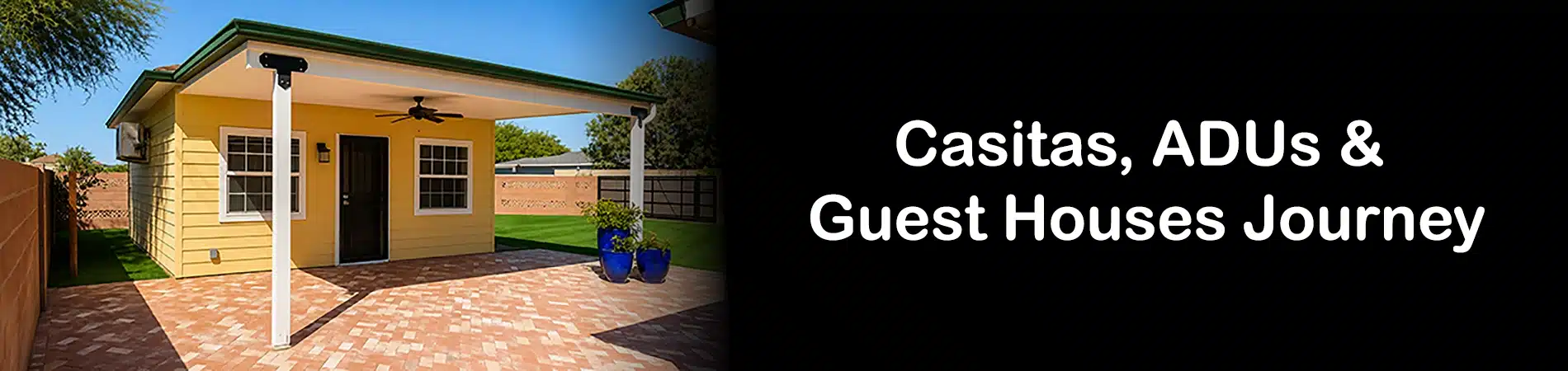
Our North Encanto casita project began with an aging garage and the homeowners’ wish for independent guest space. Investigation revealed deteriorating walls, a sinking floor, and foundation concerns, so a new structure provided an open living area, kitchenette, bathroom, storage, and a reclaimed-brick patio.
This guide focuses mainly on detached spaces, but an accessory dwelling unit can also be attached to a home or created through a conversion. A marketing name or kitchenette does not establish legal ADU status. Confirm the intended use and required approvals for the property. An office or guest room is not automatically approved for later conversion to a dwelling.
Why Independent Space Has Become So Valuable
Few residential remodeling trends have gained momentum as quickly as casitas, accessory dwelling units, and guest houses. What was once considered a specialized project pursued by a relatively small group of homeowners has become one of the most versatile ways to enhance a property’s everyday functionality. Across the country, homeowners are increasingly exploring detached living spaces not because they simply need another building, but because they are searching for greater flexibility in a world that continues changing around them.
One reason for this shift is that modern life rarely follows a predictable path. Families evolve in ways that previous generations often did not anticipate. Adult children may remain at home longer while pursuing education or establishing careers. Aging parents may wish to remain close to family support while preserving independence. Remote work has created opportunities that blur the traditional boundaries between professional and personal life. Homeowners increasingly find themselves navigating situations that do not fit neatly within the assumptions around which many homes were originally designed.
These changes have encouraged people to think differently about space. In previous generations, homeowners often evaluated properties by the number of bedrooms, bathrooms, and gathering areas in a single structure. Today, many homeowners are beginning to recognize that flexibility may be even more valuable than square footage. A property that can adapt to changing circumstances often provides greater long-term satisfaction than a property that merely offers additional rooms.
Detached living spaces respond directly to this reality by creating opportunities that traditional room additions often cannot. A guest room within the primary residence may accommodate visitors for a few days, but it does not necessarily provide independence. A home office carved out of an existing bedroom may function adequately, but it does not always provide separation. A detached structure introduces a different dynamic, allowing homeowners to create distinct environments that remain connected to the property while supporting entirely different activities and lifestyles.
This distinction helps explain why so many homeowners are attracted to casitas and ADUs even when they do not have an immediate need for them. The value frequently lies in possibility rather than necessity. Homeowners understand that circumstances will continue changing over time. They may not know exactly how those changes will unfold, but they appreciate having a property that can adapt when they do.
Perhaps more importantly, independent space offers something many people find increasingly difficult to create within modern life: choice. The ability to gather when desired and retreat when necessary. The ability to remain connected while preserving privacy. The ability to support family members without fundamentally altering the primary household’s routines. These qualities often prove more meaningful than the structure itself because they influence how people experience everyday life.
The strongest detached living space projects begin with this understanding. The conversation is not primarily about buildings. It is about relationships, flexibility, independence, and future possibilities. The structure is valuable for the opportunities it creates rather than for the square footage it contains.
As homeowners begin viewing detached spaces through this lens, the project often takes on a different meaning. What initially appeared to be an additional building becomes a way of preparing the property for future chapters that have not yet been written. The focus shifts away from construction and toward adaptability. The detached space becomes less about accommodating a single need and more about creating an environment that supports many possibilities over time.
This broader perspective is one of the primary reasons detached living spaces continue growing in popularity. Homeowners are not simply looking for more room. They are looking for greater freedom to adapt as life changes. A thoughtfully planned casita, guest house, or ADU creates that freedom by expanding what the property can do for the people who call it home.
Homeowners exploring detached living spaces often begin by evaluating how greater flexibility might support future needs. Our Casitas & ADUs Guide explores planning considerations, design opportunities, regulations, and the many ways detached living spaces can enhance a property. Homeowners seeking inspiration may also enjoy browsing our collection of Casita, Guest House & ADU Ideas.
The Balance Between Connection and Independence
One of the most interesting realities of human relationships is that people generally desire two things that can sometimes seem to conflict. They want connection, and they want independence. Families want to remain close to one another. Parents want meaningful relationships with children. Adult children want support as they establish their own lives. Aging parents want proximity to family while preserving autonomy. Homeowners enjoy hospitality and welcome extended visits from friends and relatives. At the same time, nearly everyone values privacy, personal routines, and the ability to maintain a space that feels distinctly their own.
The challenge is that traditional housing arrangements do not always make this balance easy to achieve. Homes are often designed around a single household operating according to a relatively consistent set of routines. When multiple generations, guests, caregivers, or changing lifestyle needs enter the picture, the home may begin experiencing pressures it was never intended to accommodate. The issue is rarely a lack of goodwill among family members. More often, it is a matter of the physical environment struggling to support the realities of how people need to live.
Many homeowners encounter this tension gradually. An aging parent may need occasional assistance but still value independence. An adult child may be navigating a career transition while seeking greater autonomy. Visiting family members may stay longer and more frequently than they once did. Homeowners may appreciate having loved ones nearby while also recognizing that everyone benefits from maintaining personal space. These situations rarely involve a choice between togetherness and separation. Instead, they involve finding a healthy balance between the two.
Detached living spaces offer a unique response because they allow both goals to coexist. Family members remain physically close while maintaining the independence that contributes to dignity, comfort, and healthy relationships. Guests enjoy privacy without feeling isolated. Homeowners can provide support without fundamentally restructuring the rhythms of their own household. The result is not simply additional square footage. The result is a living arrangement capable of supporting both connection and autonomy simultaneously.
This balance often creates benefits that extend beyond convenience. Relationships tend to function differently when people can choose how and when they engage with one another. Shared experiences become more intentional. Family gatherings feel more natural. Personal routines remain intact. Independence is preserved without creating distance. Many homeowners discover that proximity becomes more enjoyable when it is paired with the freedom to maintain individual lifestyles.
The same principle applies beyond family relationships. Remote workers frequently seek environments that allow them to remain connected to home life while preserving professional focus. Creative individuals often desire dedicated spaces that support concentration without separating them entirely from the household. Homeowners pursuing wellness, fitness, or personal interests appreciate having places to retreat without leaving the property. In each case, the goal is remarkably similar. People want the ability to engage and withdraw as circumstances require.
This flexibility helps explain why detached living spaces often remain valuable even as their uses change. The structure itself may evolve from a guest house to a home office, from a home office to a caregiver suite, or from a caregiver suite to accommodations for visiting family. The specific function may change repeatedly over time, yet the underlying benefit remains consistent. The space continues to support a healthy balance between connection and independence, regardless of who occupies it or how it is used.
Homeowners are often surprised to discover that independence can actually strengthen relationships rather than weaken them. Conventional thinking sometimes suggests that keeping people under one roof automatically creates stronger connections. In practice, however, relationships frequently thrive when everyone has access to appropriate personal space. Privacy reduces friction. Autonomy preserves dignity. Shared time becomes more meaningful because it occurs by choice rather than necessity. The detached structure serves as a tool to create healthier long-term dynamics rather than simply providing additional accommodations.
This understanding shifts the conversation away from buildings and toward people. A casita, ADU, or guest house is not valuable merely because it exists. It becomes valuable because it supports the way people want to live. The architecture provides a framework, but its true purpose is to create an environment where relationships can flourish without requiring anyone to sacrifice independence.
Ultimately, the growing popularity of detached living spaces reflects a broader recognition that connection and independence need not be mutually exclusive. With thoughtful planning, homeowners can create properties that support both. Family members remain close. Guests feel welcome. Personal routines remain intact. Future flexibility is preserved. The detached space becomes more than an additional structure on the property. It becomes a way of creating healthier, more adaptable, and more sustainable ways of living together while still respecting the individuality of the people involved.
Many homeowners discover that detached living spaces become most valuable when they support changing family relationships over time. Homeowners interested in long-term planning may also benefit from exploring our Aging in Place & Universal Design Journey, which examines how homes can adapt to changing needs while preserving independence and dignity.
Why Families Are Living Differently Than They Once Did
Homes have always reflected the assumptions of the era in which they were built. Architecture is not merely a collection of walls, roofs, and rooms. It is a physical response to the way people expect life to unfold. The size of rooms, the relationships between spaces, the number of bedrooms, and the overall organization of a home all reveal something about how previous generations understood family life, work, privacy, hospitality, and daily routines.
For much of the twentieth century, many homes were designed around a relatively predictable household structure. Parents lived with children. Children eventually moved away. Grandparents often lived elsewhere. Work occurred outside the home. Guests visited periodically but rarely stayed for extended periods. While every family was unique, the overall pattern remained sufficiently common that homes could be designed around a fairly consistent set of expectations.
Modern life has become more complex.
Families now experience transitions that occur more frequently and often last longer than previous generations anticipated. Adult children may remain at home while pursuing education, launching careers, or navigating economic realities. Parents may provide support for longer periods while still encouraging independence. Grandparents increasingly seek arrangements that allow them to remain connected to family without sacrificing autonomy. Careers evolve in ways that frequently blur the distinction between home and workplace. Households adapt to circumstances that were uncommon when many existing homes were originally constructed.
These changes do not necessarily indicate that families are weaker or stronger than they once were. They simply reflect a different reality. The traditional progression from one life stage to the next is often less linear than it once appeared. People move forward, pause, adapt, and sometimes return to earlier stages before continuing onward. Families remain connected across those transitions, and homes are increasingly being asked to support that complexity.
As a result, homeowners often discover that their homes no longer align perfectly with the assumptions around which they were originally designed. A spare bedroom may not provide the independence needed for an adult child. A guest room may not adequately support an aging parent. A kitchen table may not function effectively as a long-term workspace. Temporary solutions may work for a season, but they often become strained when circumstances extend over years rather than months.
Detached living spaces have gained popularity in part because they acknowledge this new reality. Rather than forcing homeowners to choose between separation and togetherness, they create opportunities for more nuanced living arrangements. Family members can remain connected while preserving independence. Different generations can maintain their own routines while remaining part of a larger household network. Homeowners gain flexibility without abandoning the communities and neighborhoods they value.
The growing interest in these spaces also reflects a broader shift in how people think about housing itself. Increasingly, homeowners view their properties as resources that can evolve over time rather than as static environments designed for a single stage of life. The goal is no longer simply owning enough space for today’s needs. The goal is creating an environment capable of adapting to tomorrow’s opportunities and challenges as well.
This adaptability becomes particularly valuable because few homeowners can accurately predict what the next ten or twenty years will bring. Family structures may change. Professional responsibilities may evolve. Health considerations may emerge. New priorities may develop. The homeowners who benefit most from detached living spaces are often not responding to a single event. They are responding to the recognition that flexibility itself has become one of the most valuable qualities a home can possess.
Interestingly, this flexibility often strengthens the role of the home within family life. Instead of becoming obsolete as circumstances change, the property remains relevant because it can continue to support the people who live there. New chapters unfold without requiring the family to abandon the place where previous chapters occurred. The home becomes more adaptable and, in doing so, often more meaningful.
Perhaps this is why discussions about casitas, ADUs, and guest houses frequently evolve beyond construction. Homeowners may begin by talking about detached buildings, but they often end up talking about relationships, responsibilities, opportunities, and future possibilities. The structure itself matters, yet its significance is rooted in what it allows families to do rather than what it physically contains.
Ultimately, the growing popularity of detached living spaces reflects a simple truth: families are living differently than they once did. Homes that recognize and support that reality are often better equipped to remain useful, comfortable, and relevant over time. By creating flexibility for evolving lifestyles, detached spaces allow properties to adapt alongside the people who call them home, ensuring that the home remains a source of support rather than a limitation as life continues to change.
As homeowners evaluate changing family dynamics, many also begin considering whether their existing home can evolve rather than relocating elsewhere. Our Home Additions Guide explores another approach to creating flexibility while remaining rooted in the neighborhoods, communities, and relationships homeowners value most.
The Most Flexible Spaces Often Create the Most Value
One of the most interesting patterns homeowners discover after completing a casita, ADU, or guest house is that the structure rarely spends its entire life serving the purpose for which it was originally created. The detached office eventually hosts visiting family members. The guest house becomes a caregiver suite. The multigenerational living space transitions into a creative studio. Years later, the same structure may support an entirely different chapter of life.
This evolution is not unusual. In many ways, it reflects the reality that life changes more quickly than buildings do.
Most homeowners begin planning with a specific need in mind because immediate challenges naturally attract attention. A parent may require nearby accommodations. A homeowner may need a dedicated workspace. Guests may visit frequently enough to justify independent living quarters. These motivations are important because they provide direction and purpose. Yet when viewed over the lifespan of a property, they often represent only one chapter in a much longer story.
The challenge is that needs rarely remain fixed. Family dynamics shift. Careers evolve. Children grow older. Parents require different levels of support. Health considerations emerge. Priorities change. A detached structure designed around a single, narrowly defined objective can eventually feel limited when circumstances move in a different direction. By contrast, a flexible space often continues creating value because it adapts as new opportunities arise.
This is one reason thoughtful planning extends beyond immediate functionality. The strongest projects ask not only how the space will be used today, but also how it might be used ten or twenty years from now. The objective is not predicting the future with precision. The objective is creating an environment capable of responding to a variety of possible futures. Flexibility becomes a form of preparation, allowing homeowners to adapt without repeatedly undertaking major construction projects.
Interestingly, flexibility is not necessarily created through larger buildings. Many homeowners assume that more square footage automatically creates greater adaptability, yet thoughtful design often proves more valuable than size alone. A well-organized structure with efficient circulation, practical storage, adaptable room relationships, and thoughtful infrastructure can frequently accommodate a wider range of future uses than a much larger space designed around a single function. The value lies not in how much space exists, but in how many possibilities the space supports.
This perspective changes the way homeowners evaluate success. Instead of asking whether the structure perfectly fulfills its original purpose, they begin asking whether it remains useful as circumstances evolve. A detached office that later becomes guest accommodations is not a compromise. It is evidence that the design succeeded. A caregiver suite that eventually serves as a wellness retreat or creative studio has not lost its value. It has demonstrated its ability to adapt.
Many homeowners discover that this adaptability provides something even more valuable than convenience. It provides peace of mind. Life becomes less intimidating when the home possesses the capacity to respond to change. Family transitions feel more manageable. New opportunities feel more accessible. Unexpected challenges feel less disruptive because the property already contains resources capable of supporting different needs. The detached space becomes a source of resilience rather than simply a source of square footage.
This resilience is particularly meaningful because uncertainty is a normal part of life. Homeowners cannot know exactly how careers, family relationships, health considerations, or lifestyle priorities will evolve over the coming decades. What they can do is create environments that remain useful across a wide range of possibilities. Flexible detached spaces support this approach by providing options without requiring homeowners to commit every future decision in advance.
The strongest projects often feel remarkably natural years after construction is complete because they continue finding new ways to serve the household. The building remains relevant. The investment continues creating opportunities. The structure quietly adapts alongside the people who use it, supporting needs that may not have existed when the project was first conceived. This ongoing usefulness is often one of the most appreciated aspects of the investment.
Ultimately, the greatest value of a casita, ADU, or guest house is rarely found in a single use. It is found in the freedom to evolve. A detached space that can support multiple chapters of life often delivers benefits far beyond what homeowners initially imagine. The structure becomes more than a building. It becomes a flexible resource that adapts to changing circumstances, preserves options, and helps the property remain relevant through whatever transitions the future may bring.
Flexibility is often one of the defining characteristics of successful remodeling projects. Homeowners interested in broader strategies for creating adaptable living environments may also benefit from reviewing our Whole-Home Remodeling Guide, which explores how homes can evolve to support changing lifestyles over time.
Designing for Life Changes Before They Arrive
Most major remodeling projects begin in response to a present circumstance. A family needs additional space. A parent requires support. A homeowner wants a dedicated office. Guests visit frequently enough to justify independent accommodations. These needs motivate action and often shape the early stages of planning. Yet many homeowners discover that the greatest value of a detached living space emerges not from the problem it solves today, but from the opportunities it creates for tomorrow.
Life has a way of introducing changes long before people feel fully prepared for them. Careers evolve unexpectedly. Children grow up faster than anticipated. Parents age. Health circumstances shift. Family relationships expand through marriage, grandchildren, and new responsibilities. While homeowners recognize that change is inevitable, the specific form that change will take often remains unclear. This uncertainty can make planning difficult because people naturally focus on what they know rather than what they cannot yet see.
Detached living spaces provide a unique opportunity because they allow homeowners to prepare for possibilities without needing to predict them precisely. A thoughtfully designed casita, guest house, or ADU creates flexibility that can accommodate a wide range of future circumstances. The structure becomes valuable not because it is tied to a single purpose, but because it remains useful across many different stages of life.
This perspective often changes how homeowners approach planning. Instead of asking only what the space needs to do immediately, they begin considering how it might serve the property years into the future. The conversation expands beyond current occupants and present-day routines. Questions about accessibility, adaptability, privacy, circulation, storage, and independence take on greater significance because they influence how easily the space can evolve over time.
Many homeowners find this especially important when considering family relationships. An ADU may initially serve as a guest house while children are young and family visits are frequent. Years later, the same structure may support an aging parent who desires both independence and proximity. Later still, it may become a home office, a caregiver suite, a creative studio, or a retreat space. None of these possibilities need to be fully defined during the initial planning process. What matters is creating a structure capable of supporting them if needed.
This ability to adapt often creates a sense of confidence that extends beyond the physical building itself. Homeowners gain reassurance knowing that their property contains options. They are less dependent upon finding a new home every time circumstances change. They are less likely to feel constrained by a floorplan that no longer supports their lifestyle. Instead, they possess a flexible resource that can respond to new challenges and opportunities as they emerge.
The planning process becomes particularly meaningful when homeowners begin viewing the project through a long-term lens. Decisions that might seem minor during construction can significantly influence future usability. A wider doorway may improve accessibility in decades to come. Thoughtful circulation may allow different occupants to use the space comfortably as life stages change. Flexible layouts may support uses that no one currently anticipates. These decisions rarely draw attention after construction is complete, yet they often contribute greatly to the project’s long-term success.
Interestingly, designing for the future does not require sacrificing present enjoyment. The most successful detached living spaces perform both roles simultaneously. They address current needs while quietly preparing for future possibilities. Homeowners enjoy immediate benefits while knowing the structure can continue evolving alongside changing circumstances. The space serves today’s priorities without limiting tomorrow’s opportunities.
This balance reflects a broader truth about homeownership itself. The strongest homes are rarely designed around a single season of life. They are designed to support multiple seasons. They acknowledge that people, relationships, responsibilities, and priorities change. Rather than resisting that reality, they embrace it by creating environments that adapt gracefully over time.
Perhaps that is what makes detached living spaces so appealing to homeowners who plan to remain rooted in their communities for the long term. The project becomes more than a response to a current challenge. It becomes a form of preparation. The property gains the ability to respond to future circumstances without requiring dramatic changes every time life takes an unexpected turn. The home becomes more resilient because it contains options that did not previously exist.
Ultimately, designing for life changes before they arrive is not about predicting the future. It is about respecting the fact that the future will be different from the present. Casitas, ADUs, and guest houses provide homeowners with a practical way to prepare for that reality. By creating flexible spaces that support evolving needs, homeowners invest not only in today’s comfort but also in tomorrow’s possibilities. The detached structure becomes a quiet form of readiness, helping the property remain useful, adaptable, and supportive through whatever chapters lie ahead.
When a Property Begins Supporting More Than One Lifestyle
Most homes are designed around a single household and a relatively unified way of living. The layout assumes that the people sharing the property will follow similar routines, maintain similar schedules, and occupy the same spaces throughout the day. For many homeowners, this arrangement works well because the home was designed to support exactly the lifestyle it contains.
As life becomes more complex, however, households often begin accommodating people whose needs, schedules, priorities, and routines differ significantly from one another. An aging parent may value quiet mornings and independent living. Adult children may maintain entirely different schedules while pursuing careers or education. Remote professionals may require focused work environments during hours when the rest of the household is active. Guests may stay for extended periods while hoping to maintain privacy and independence. The traditional structure of a single household can begin feeling stretched as these realities accumulate.
Detached living spaces offer a unique response by allowing a single property to accommodate multiple lifestyles without requiring everyone to live the same way.
This distinction is subtle but important. Many homeowners initially pursue a casita or ADU because they believe they need more space. What they often discover is that the true benefit comes from creating environments where different people can live according to their own rhythms while remaining connected to one another. The detached structure does not simply add square footage. It creates flexibility for different ways of living to coexist on the same property.
Consider how dramatically this can change the experience of everyday life. A remote professional may enjoy a focused work environment while remaining close to family. An aging parent may maintain independence without feeling isolated. Adult children may enjoy privacy while benefiting from family support. Guests may feel welcomed without feeling intrusive. Each person gains the ability to maintain routines that support their own needs while remaining part of a larger household network.
What makes this dynamic particularly valuable is that it reduces the pressure placed on any single space within the primary residence. Rooms no longer need to perform multiple conflicting functions simultaneously. The guest room does not need to become a permanent residence. The dining room does not need to function as an office. Shared living spaces can return to their original purposes. The detached structure absorbs responsibilities that might otherwise create tension within the primary home.
This often leads to a surprising outcome. Homeowners frequently report that the entire property feels more peaceful after adding a detached living space. The improvement is not necessarily caused by the structure itself. It is caused by the fact that everyone now has greater freedom to live comfortably according to their own needs. Household routines become easier to manage. Privacy becomes easier to preserve. Relationships often benefit because fewer compromises are required on a daily basis.
The concept extends beyond family living arrangements as well. Some homeowners use detached spaces to support professional activities, creative pursuits, wellness practices, or personal interests that would be difficult to accommodate within the primary residence. The property begins functioning as a collection of complementary environments rather than a single structure attempting to satisfy every need simultaneously. Different activities have appropriate places to occur, and the entire property becomes more adaptable as a result.
Over time, many homeowners stop thinking about the detached structure as a separate building. Instead, they begin to view the entire property as a flexible ecosystem capable of supporting different people, priorities, and stages of life. The value is no longer measured by the size of the ADU or guest house. It is measured by the opportunities the property now provides.
This broader perspective helps explain why detached living spaces often remain relevant long after their original purpose has changed. The office becomes a guest suite. The guest suite becomes a caregiver residence. The caregiver residence later supports a different family need. The specific use evolves, but the underlying benefit remains consistent. The property continues supporting multiple lifestyles because it was designed to accommodate flexibility from the beginning.
Perhaps this is one of the most significant shifts occurring in residential design today. Homeowners are increasingly recognizing that homes do not need to serve only one household pattern or one stage of life. Properties can evolve. They can support different generations, routines, forms of work, and family structures without sacrificing comfort or independence. Detached living spaces make that adaptability possible in ways that traditional floorplans often cannot.
Ultimately, a casita, ADU, or guest house becomes far more than an additional building when viewed through this lens. It becomes a tool for expanding what the property can do for the people who live there. The detached structure creates room for independence, flexibility, privacy, hospitality, productivity, caregiving, and future possibilities to exist simultaneously. In doing so, it allows a single property to support multiple lifestyles while preserving the sense of connection that makes a house feel like home.
Many detached living spaces eventually support entertaining, hospitality, and extended family gatherings as well. Homeowners interested in creating environments that encourage connection may also enjoy the Designing for Entertaining Journey, which explores how thoughtful design supports meaningful experiences with family and friends.
Creating Possibilities for the Future
Most homeowners begin exploring a casita, guest house, or ADU because of a specific need. A parent may require nearby accommodations. A homeowner may want a dedicated office. Guests may visit frequently enough to justify independent living space. Adult children may need support during a transitional season of life. These motivations are important because they provide the initial reason to begin planning.
What many homeowners discover, however, is that the most meaningful value of the project often emerges long after the original need has changed.
Life has a remarkable way of evolving beyond the circumstances that inspired a remodeling project in the first place. Families grow and change. Careers develop in unexpected directions. Children leave home and sometimes return. Parents age. Priorities shift. Opportunities appear that could not have been anticipated when construction first began. A thoughtfully designed detached living space often remains relevant through all of these transitions because it was never truly about a single purpose.
This long-term relevance is what distinguishes detached living spaces from many other remodeling options. A kitchen may always remain a kitchen. A bathroom may always remain a bathroom. A detached structure, by contrast, can become many different things throughout its lifetime. It may serve one family member today and another tomorrow. It may support work during one season and hospitality during the next. It may respond to needs that do not yet exist while continuing to provide value in the present.
The ability to evolve often becomes one of the most appreciated aspects of the entire investment. Homeowners gain something increasingly rare in a rapidly changing world: options. Rather than being forced to react to every major life transition with a move, a new construction project, or a significant disruption to daily life, they already possess a resource that can adapt to changing circumstances. The property becomes more resilient because it has flexibility that was previously unavailable.
This flexibility frequently creates confidence as well. Homeowners may not know exactly what the future holds, but they know the property is better prepared to support it. The detached structure becomes a quiet form of readiness, standing available for opportunities and challenges that have not yet arrived. Whether the future involves caregiving, multigenerational living, remote work, extended family visits, personal pursuits, wellness goals, or entirely unforeseen possibilities, the property already has a space that can respond.
Interestingly, the greatest benefits are often not measured in square footage at all. Homeowners rarely reflect on the exact dimensions of the structure years later. Instead, they remember what the space made possible. They remember a parent remaining close to family while preserving independence. They remember the flexibility that supported a career change. They remember holidays spent with visiting family members who had a comfortable place to stay. They remember seasons of life that would have been more difficult without the opportunities the detached space provided.
This is because detached living spaces are ultimately about people rather than buildings. The architecture matters. The construction matters. The design matters. Yet those elements exist in service of something larger. They exist to support relationships, independence, hospitality, productivity, creativity, flexibility, and quality of life. The physical structure becomes meaningful because of the experiences it enables.
As homeowners begin viewing these projects through this lens, the conversation often changes entirely. The question is no longer, “What should we build?” The deeper question becomes, “What possibilities do we want our property to support?” That shift moves the focus away from construction and toward the future. The detached structure becomes a tool for shaping how life unfolds rather than simply adding another building to the property.
Perhaps this is why casitas, guest houses, and ADUs continue growing in popularity across so many different types of households. They provide something that few remodeling projects can offer so effectively: adaptability. They allow homeowners to remain rooted in the homes, neighborhoods, communities, and relationships they value while creating room for future chapters that have yet to be written. The property becomes more capable of evolving because it has been intentionally designed to support change.
Ultimately, the greatest value of a casita, ADU, or guest house is not found in the walls, rooflines, finishes, or square footage. It is found in the opportunities created over the years that follow. These structures provide independence without isolation, flexibility without uncertainty, and connection without sacrificing privacy. They help homeowners prepare for futures they cannot fully predict while improving life in the present.
When viewed in this way, a detached living space becomes far more than an addition to a property. It becomes an investment in possibility. It creates room for changing relationships, evolving lifestyles, future opportunities, and new chapters of life. Long after construction is complete, that ability to adapt may prove to be the most valuable feature of all.
Related Guides
- Casitas & ADUs Guide
- Casita, Guest House & ADU Ideas
- Home Additions Guide
- Whole-Home Remodeling Guide
- Universal Design Explained
Related Addition and Outdoor-Living Inspiration
The following projects illustrate additions and outdoor connections; they are not presented as examples of permitted ADUs.
- Arcadia Whole-Home Renovation & Addition
- Outdoor Living Space Addition
- Casita, Guest House & ADU Ideas
- Home Additions Guide
Continue the Journey
While detached living spaces focus on flexibility and future adaptability, some remodeling projects begin with a different priority: preserving architectural identity while improving the way a home functions. The next journey explores Mid-Century Modern remodeling and the unique opportunities involved in updating iconic homes while respecting the design principles that make them special.
Explore the Mid-Century Modern Remodeling Journey →
About the Authors
This guide was developed by Steve Shinn (MCR, MCKBR, UDCP, GCP) and Sheila Lanier (MCKBR, UDCP) of Homework Remodels. Together, they bring decades of residential remodeling experience, professional certifications, industry leadership, award-winning project experience, and a shared commitment to homeowner education.
Steve serves as Founder and Managing Partner of Operations & Leadership and has contributed to the remodeling industry through national NARI leadership, certification development, and professional education. Sheila serves as Managing Partner of Design & Systems and is recognized for her expertise in design, client experience, project planning, and organizational leadership, including service as a NARI chapter president and national Contractor of the Year judge.
This guide reflects the planning principles and homeowner education approach Homework Remodels uses to help clients make informed decisions before construction begins.
Learn more about Steve Shinn, Sheila Lanier, and Homework Remodels.
Ready to Take the Next Step?
Every remodeling project begins with understanding. The Remodeling Knowledge Center was created to help homeowners navigate planning, design, budgeting, and construction with greater clarity and confidence.
If you’re ready to continue learning, explore the additional Journeys, Core Guides, and Remodeling Resources available throughout the Knowledge Center. If you would like to discuss your home, goals, and project ideas directly, we’re always happy to start with a conversation.
© 2026 Homework Remodels. All rights reserved. No portion of this publication may be reproduced, republished, or distributed without written permission.