
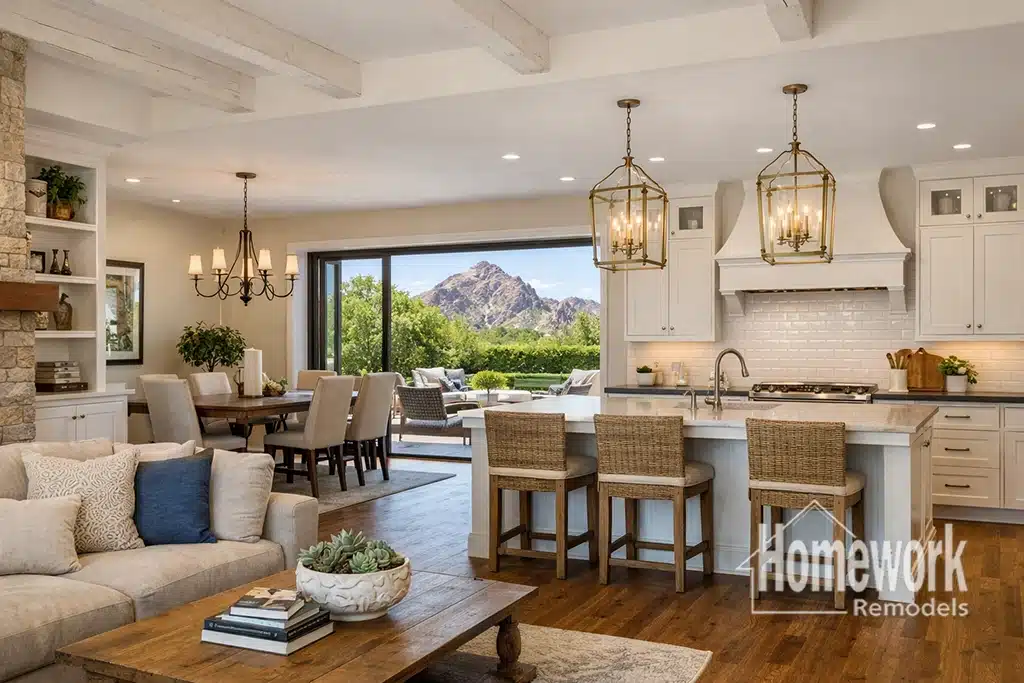
Arcadia Kitchens: Creating Backyard Connections Without Traffic Bottlenecks
Backyard living is central to life in Arcadia. Large lots, mature landscaping, and long outdoor seasons mean patios, pools, and outdoor kitchens are used daily—not occasionally. As a result, Arcadia homeowners often want kitchens that connect seamlessly to the backyard. The challenge is that many Arcadia homes were never designed for the level of traffic modern indoor-outdoor living creates.
Creating that connection without introducing congestion requires careful planning. In Arcadia kitchens, where family activity and entertaining overlap, poor flow can turn a beautiful remodel into a daily frustration.
Why Backyard Access Becomes a Kitchen Priority
In Arcadia, kitchens serve as both command centers and social hubs. Family members move through them constantly—between the garage, backyard, dining areas, and living spaces.
When backyard access routes cut directly through prep zones or seating areas, congestion follows. The goal is not just access, but managed movement.
The core decision tension is seamless flow versus functional separation.
Many Ranch Layouts Were Never Meant for Heavy Through-Traffic
Arcadia ranch homes often feature long, linear layouts with kitchens placed between living spaces and the backyard. While this placement seems convenient, it often forces all traffic through the most active part of the kitchen.
Without intervention, opening doors wider only amplifies the problem.
Door Placement Matters More Than Door Size
Homeowners often assume larger sliding or folding doors will solve flow issues. In reality, where the door is placed matters far more than how wide it opens.
Doors positioned behind islands, near ranges, or through work zones create collision points. Successful layouts route traffic around—not through—kitchen activity.
Islands Can Become Traffic Obstacles
Kitchen islands are popular in Arcadia homes, but poorly sized or positioned islands quickly become bottlenecks when backyard access is involved.
Islands should support circulation paths rather than interrupt them. Adjusting island length, offset, or orientation often improves flow more than expanding square footage.
Secondary Circulation Paths Reduce Congestion
Creating alternate routes—such as side hallways, mudroom paths, or perimeter walkways—keeps kitchen traffic from stacking up.
These paths allow family members and guests to move between indoors and outdoors without disrupting cooking or seating areas.
The decision tension shifts from openness to organization.
Indoor-Outdoor Transitions Need Hierarchy
Not every transition needs to be equal. Primary access points should align with major circulation paths, while secondary doors serve convenience needs.
Establishing hierarchy prevents crowding and improves how spaces feel during gatherings.
Flooring and Level Changes Influence Movement
Subtle level changes, material transitions, or ceiling treatments can cue movement patterns without adding walls.
These design tools help guide traffic intuitively—especially important in homes where visual openness is desired.
Kitchen Adjacency Often Needs Adjustment
In many Arcadia homes, the kitchen’s relationship to dining and living areas was designed for a different lifestyle. Improving backyard access sometimes requires rethinking these adjacencies.
Understanding how kitchen remodeling in Phoenix affects circulation beyond the kitchen itself helps homeowners target the right changes.
Outdoor Living Adds Weight to Kitchen Decisions
Outdoor kitchens, pools, and entertainment areas increase foot traffic dramatically. Kitchen layouts must anticipate this reality.
Ignoring outdoor use patterns often leads to kitchens that work well on paper but fail during real-world use.
Structural Walls Set Limits on Reconfiguration
Some Arcadia kitchens are bounded by structural walls that limit reorientation. Removing or modifying these walls requires careful planning.
Before altering layouts, homeowners should understand what is involved in removing load-bearing walls in Phoenix. Structural awareness protects both design and budget.
Whole-Home Planning Prevents Kitchen Overload
Kitchen congestion is rarely a kitchen-only problem. It reflects broader circulation issues throughout the home.
Homeowners who understand how whole-home remodeling in Phoenix evaluates traffic flow holistically avoid overbuilding kitchens to solve broader layout problems.
Why Design-Build Leads to Better Flow Outcomes
Design-build remodeling allows kitchen layouts, door placement, circulation paths, and outdoor connections to be tested together.
This integrated approach helps Arcadia homeowners achieve backyard access that feels effortless rather than chaotic.
Learning how the design-build remodeling process works supports smarter, calmer kitchen decisions.
The Core Decision Tension: Open Path or Organized Flow
In Arcadia, the best kitchens do not simply open to the backyard—they manage movement intelligently.
When circulation is planned as carefully as cabinetry and finishes, indoor-outdoor living becomes a pleasure instead of a problem.
Let’s Create Backyard Flow That Actually Works
If you’re considering a kitchen remodel in Arcadia to improve backyard access, early circulation planning is essential. With neighborhood-specific experience and a design-build approach, it’s possible to create flow that supports both daily life and entertaining.
We invite you to schedule a free remodeling consultation to explore kitchen layout strategies tailored to how your home is actually used.