
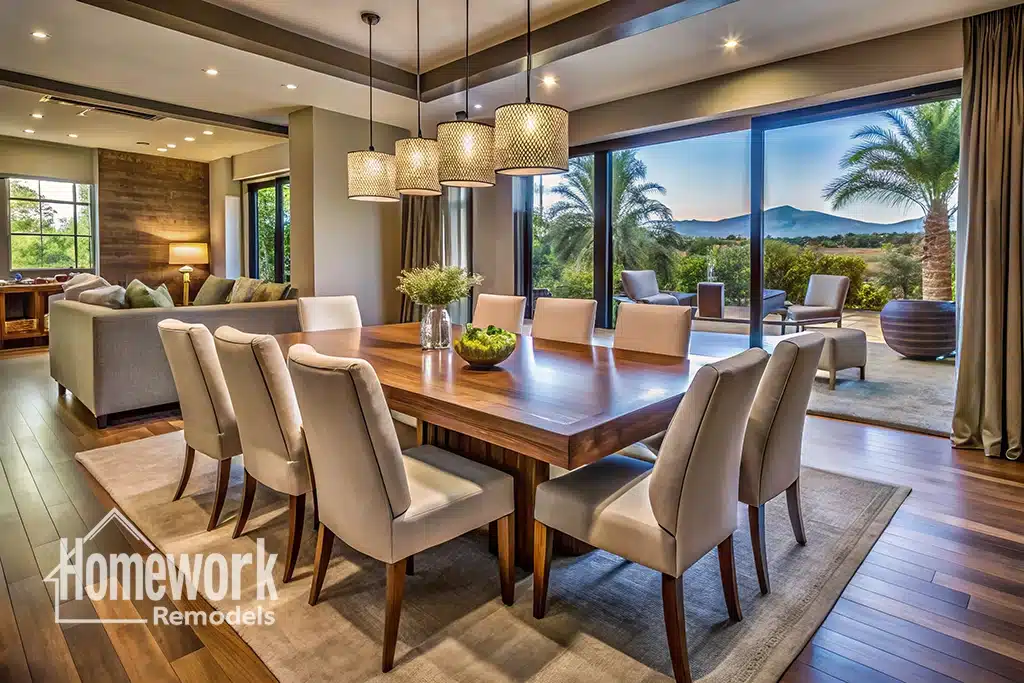
Biltmore Open-Concept Remodeling: How to Improve Flow Without Destroying Ceiling Hierarchy
Homes in the Biltmore area occupy a unique architectural middle ground. Many were designed with formal room separation, deliberate ceiling transitions, and a sense of progression as you move through the house. At the same time, today’s homeowners often want better flow, improved sightlines, and more connected living spaces.
The challenge is that in Biltmore homes, openness is not just a wall decision—it is a ceiling decision. When ceiling hierarchy is ignored, open-concept remodeling can unintentionally erase the architectural rhythm that gives these homes their presence.
Why Ceiling Hierarchy Matters More Than Walls
In many Biltmore homes, ceilings do more than cover rooms. They signal purpose. Dining rooms may have subtly lower ceilings than living spaces. Entries often compress before opening into larger rooms. Kitchens may transition between heights to define zones without walls.
When walls are removed without a ceiling strategy, these cues disappear. Spaces blend together visually, but not always functionally. The result is often a large, undefined area that feels less refined than the original layout.
The core decision tension is openness versus order. In Biltmore homes, order is what allows openness to feel intentional.
Open Concept Is Not a Single Move
Homeowners often describe wanting “open concept” as if it is one action. In reality, it is a series of coordinated decisions involving structure, ceiling planes, lighting, and circulation.
Partial openings, cased openings, or ceiling-aligned transitions frequently outperform full wall removal. These approaches allow visual connection while preserving architectural definition.
Understanding what is involved in removing load-bearing walls in Phoenix homes is essential before deciding how far to open a space.
Kitchens as Transitional Spaces
In Biltmore homes, kitchens often act as connectors rather than destinations. They bridge formal dining areas and informal living spaces.
Opening kitchens indiscriminately can flatten this transition. Instead, successful remodels treat kitchens as layered spaces—connected, but still defined. Ceiling changes, soffits, or subtle height shifts often preserve this role.
The decision tension here is visual continuity versus spatial clarity. Kitchens that maintain their transitional identity tend to function better for both daily use and entertaining.
Dining Rooms Still Serve a Purpose
One of the most common casualties of open-concept remodeling is the dining room. In Biltmore homes, dining spaces were designed as intentional pauses—rooms that balance openness with intimacy.
Eliminating dining rooms entirely often creates circulation challenges and limits hosting flexibility. Preserving these spaces—while visually connecting them—maintains the home’s original rhythm.
Ceiling hierarchy plays a key role in this balance. Even small changes in height or treatment can preserve purpose without walls.
Structural Realities Shape Design Options
Biltmore homes often include beams, dropped headers, or long spans that influence ceiling design. Ignoring these elements leads to awkward transitions or forced solutions.
Structural clarity allows designers to align openings with ceiling planes rather than fight them. This alignment is what makes open spaces feel natural rather than improvised.
The decision tension is aesthetic ambition versus structural truth. Respecting structure leads to better design.
Lighting Reinforces Ceiling Hierarchy
Lighting is one of the most powerful tools in open-concept remodeling—but only when coordinated with ceiling design.
Layered lighting can reinforce zones without walls. Recessed lighting, pendants, and indirect lighting each play different roles depending on ceiling height and purpose.
Without a ceiling strategy, lighting often becomes uniform and flat, further erasing spatial definition.
Acoustics and Comfort Are Often Overlooked
Open spaces with flattened ceilings frequently suffer from acoustic issues. Sound travels farther, echoes increase, and privacy decreases.
Biltmore homes were not designed as single-volume spaces. Preserving ceiling variation helps control sound and maintain comfort.
The decision tension is visual openness versus livability. Livability depends on acoustic balance.
Open Concept Should Improve Circulation, Not Just Sightlines
Successful open-concept remodeling improves how people move through a home—not just what they can see.
Ceiling hierarchy guides circulation subtly, signaling where to gather, pass through, or pause. When these cues are removed, circulation becomes less intuitive.
This is especially important in larger Biltmore homes, where scale can quickly feel overwhelming without architectural guidance.
Whole-Home Perspective Prevents Overcorrection
Opening one area often affects others. Removing walls may require rerouting systems, adjusting lighting plans, or redefining adjacent spaces.
Whole-home planning ensures that openness is balanced across the layout rather than concentrated in one oversized zone.
Homeowners benefit from understanding how whole-home remodeling in Phoenix approaches spatial changes holistically rather than room by room.
Why Design-Build Protects Architectural Integrity
Open-concept remodeling touches structure, systems, and design simultaneously. When these elements are handled separately, compromises multiply.
A design-build approach allows ceiling hierarchy, structural feasibility, and budget to be evaluated together. This alignment protects architectural intent while delivering modern flow.
Learning how the design-build remodeling process works helps homeowners understand why it is especially effective for architecturally sensitive homes like those in the Biltmore area.
The Core Decision Tension: Bigger Space or Better Space
In Biltmore remodeling, the goal should not be the biggest open space possible. It should be the best space possible.
When ceiling hierarchy is respected, open-concept living enhances flow without sacrificing elegance. When it is ignored, even large spaces can feel flat and unfinished.
A Note for Homeowners…
Many of the questions raised in this article—around planning, cost, timing, and long-term outcomes—are part of a broader remodeling system that most homeowners aren’t shown upfront.
Our Core Guides were created to explain why remodeling often feels unpredictable and what actually brings clarity and stability before construction begins.
Let’s Create an Open Layout That Still Feels Like a Biltmore Home
If you are considering open-concept remodeling in the Biltmore area, preserving architectural order is key. With neighborhood-specific experience and a coordinated design-build approach, it is possible to improve flow while maintaining the sophistication your home was designed to express.
We invite you to schedule a free remodeling consultation to explore options that enhance openness without erasing character.