
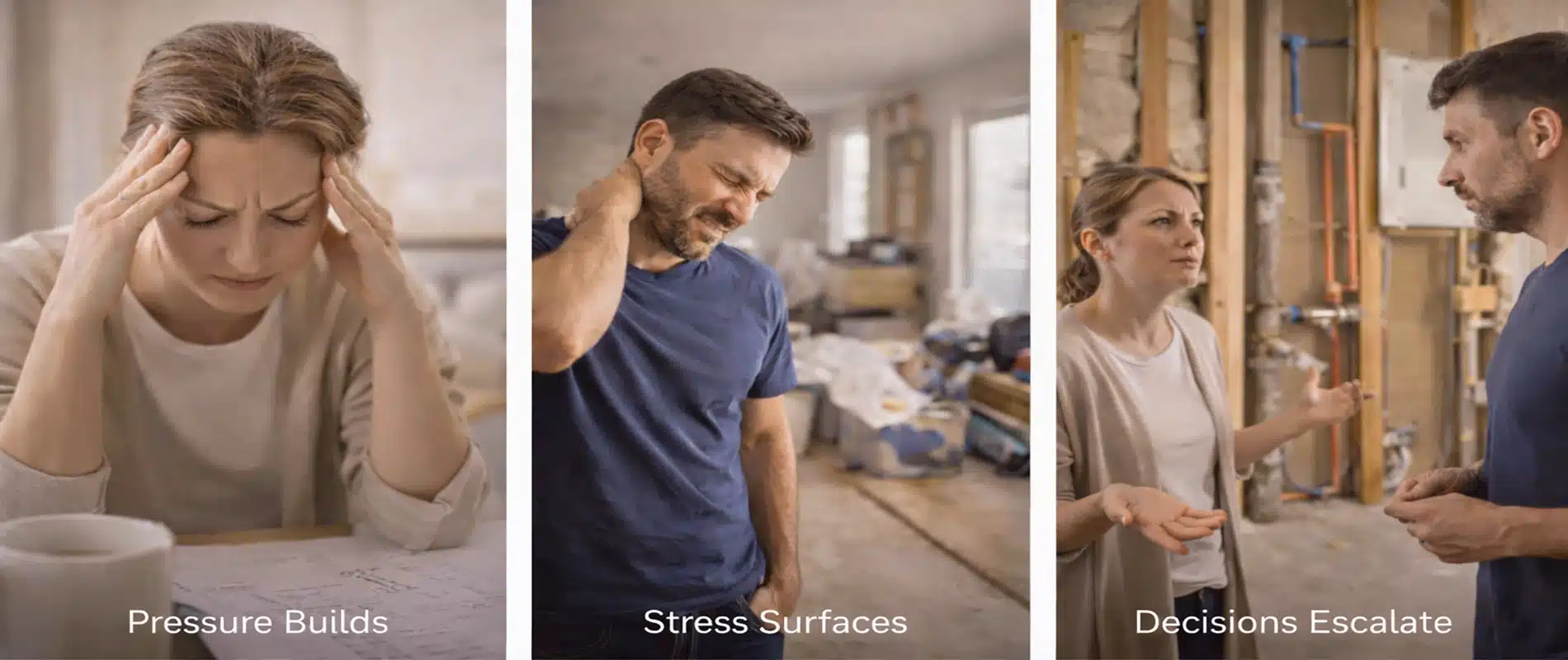
Why Problems Feel Bigger During Construction
Why Small Issues Feel Like Big Threats
During construction, homeowners often experience a heightened sense of alarm over issues that would normally feel manageable. A delayed delivery, a missed detail, or a quiet day on site can feel like evidence that the entire project is veering off course. This reaction is not irrational—it is psychological.
Construction removes the visual cues of stability. Walls are open. Rooms are incomplete. Daily routines are disrupted. In that environment, the brain is primed to interpret uncertainty as danger. Small deviations register as threats because the surrounding context already feels unsettled.
What makes this particularly difficult is that many construction issues are normal. Delays occur. Materials arrive late. Sequencing shifts. But without a stable reference point, homeowners lack the information needed to gauge whether a problem is minor or meaningful. The result is amplification: ordinary issues feel existential.
Understanding this dynamic helps homeowners separate emotional intensity from actual risk. Problems feel bigger not because they are bigger—but because the environment magnifies them.
The “Unfinished Home” Effect
An unfinished home creates constant visual noise. Exposed framing, temporary surfaces, and incomplete transitions make it difficult to see progress. Instead of perceiving forward movement, homeowners often see absence—what is missing rather than what is being accomplished.
This visual chaos distorts perception. Even when work is proceeding according to plan, the space can look worse before it looks better. The mind struggles to reconcile effort with appearance, which leads to the false conclusion that nothing is happening or that something has gone wrong.
The “unfinished home” effect also strips away familiar anchors. Spaces no longer function as expected, which removes comfort and predictability. In that state, homeowners naturally search for reassurance. When reassurance is not immediately visible, concern fills the gap.
Progress during construction is often structural, logistical, or preparatory rather than cosmetic. Until finishes return, progress can feel invisible. Recognizing this mismatch between effort and appearance helps homeowners interpret the phase more accurately—and with less anxiety.
Why Silence Feels Worse Than Bad News
Silence during construction is rarely intentional, but it is often damaging. When homeowners are not receiving updates, they fill the void with speculation. The absence of information allows fears to grow unchecked.
Bad news, when communicated clearly, provides structure. It explains what happened, why it happened, and what happens next. Silence provides none of that. Without context, homeowners assume the worst because uncertainty feels unsafe.
This is why communication cadence matters more than perfection. Regular updates—even when there is little visible progress—signal control. They remind homeowners that someone is actively managing the project, even if the work is not immediately apparent.
Strong teams understand that silence is interpreted as loss of control. They communicate not only when problems arise, but also when work is proceeding normally behind the scenes. Information stabilizes perception. Without it, problems feel larger than they are.
Why Timing Issues Trigger Fear, Not Just Frustration
Delays during construction often provoke fear rather than simple irritation. This reaction stems from how homeowners interpret time during disruption. When life is already unsettled, time feels more expensive.
A delayed cabinet delivery is not just a scheduling inconvenience—it threatens the return to normalcy. Homeowners worry that delays will compound, costs will rise, and the project will stretch indefinitely. The fear is not about the cabinet; it is about losing the end in sight.
Construction timelines are inherently interdependent. One delay can affect sequencing, inspections, or trade availability. Without understanding these relationships, homeowners interpret any shift as the beginning of a cascade — the same dynamic explored in
Why Remodeling Timelines Feel So Uncertain.
When teams explain how a delay fits into the broader schedule—and whether it affects the critical path—timing issues regain proportion. The fear subsides when homeowners understand what changed and what did not.
The Difference Between a Hiccup and a Systemic Issue
Not all problems are equal, but homeowners are rarely given the framework to distinguish between them. Without that framework, every issue feels potentially catastrophic.
A hiccup is a localized disruption: a backordered item, a missed detail, a short pause. These issues are common and often resolved without affecting the overall outcome. A systemic issue, by contrast, affects structure, scope, or coordination in a way that requires re-evaluation.
The stress comes from not knowing which type of issue is occurring. When homeowners cannot tell whether a problem is isolated or structural, they assume the latter.
Well-run projects classify issues internally before presenting them to the homeowner. They explain whether an issue is routine or consequential, and what safeguards are in place. This context prevents overreaction and preserves trust.
Problems feel bigger when their category is unclear. Clarity shrinks them back to size.
How Strong Teams Contain Problems Before Homeowners Feel Them
Experienced remodeling teams understand that many issues can be resolved internally before they ever affect the homeowner. Coordination between trades, sequencing adjustments, and contingency planning often absorb disruptions quietly.
When teams lack this containment ability, issues surface directly to the homeowner in raw form. Questions arrive without context. Decisions feel urgent. Homeowners are pulled into problem-solving without preparation.
Containment does not mean concealment. It means evaluation first, communication second. Strong teams assess impact, explore options, and then present the homeowner with a clear explanation and path forward.
This containment ability is built during planning, not during construction — a distinction clarified in
Pre-Construction Explained: What Happens Before Construction Starts.
Problems still occur—but they feel managed instead of threatening. The difference is not the absence of issues, but the presence of structure.
Questions Homeowners Should Ask When Something Feels Off
When something feels wrong during construction, homeowners often default to emotionally loaded questions: Is this normal? Did we make a mistake? Is this going to get worse? These questions are understandable, but they rarely produce clarity.
More stabilizing questions focus on structure instead of outcome:
- What specifically changed?
- Why did it change?
- What does this affect immediately, and what does it not affect?
Another critical question is: Is this issue on the critical path? Many problems feel urgent simply because they are visible. Understanding whether they affect completion reframes their importance.
Finally, asking How is this being managed? reveals preparedness and process — the same qualities that ultimately determine peace of mind, as explored in
How Remodeling Decisions Create (or Destroy) Peace of Mind.
Communication Rhythms That Stabilize the Nervous System
During construction, communication is not just informational—it is regulatory.
Predictable communication rhythms reduce anxiety even when circumstances are imperfect. Regular updates create continuity and reassurance. Homeowners feel steadier when they know when they will hear from the team and what that communication will include.
Inconsistent communication creates emotional whiplash. Long silences followed by bursts of information amplify stress. Structured updates flatten those spikes and restore equilibrium.
Decision Fatigue and Stress Stacking During Mid-Project Weeks
The middle of a remodel is where stress accumulates fastest. Early optimism fades, completion feels distant, and decision volume often peaks.
This creates stress stacking. Each new issue lands on an already taxed system, making minor problems feel overwhelming. Decision fatigue erodes confidence and increases second-guessing.
Projects that front-load decisions reduce this burden. When choices are resolved before construction, execution replaces negotiation. Stress still exists—but it no longer compounds.
What Progress Looks Like When It’s Invisible
Some of the most important progress during construction leaves no physical trace. Inspections are coordinated. Trades are resequenced. Conflicts are resolved on drawings instead of on site.
To homeowners, this can feel like inactivity. Without explanation, stillness feels like stagnation.
Invisible progress is preventative. It removes future failure points before they surface. When explained clearly, stillness transforms from threat into reassurance.
Staying Engaged Without Micromanaging
Construction disruption can trigger a desire for control. Daily monitoring feels stabilizing, but it often increases stress and blurs responsibility.
Healthy engagement is structured. Defined update points, clear decision boundaries, and agreed communication channels preserve clarity without emotional overload.
Control comes from preparation and understanding—not surveillance.
The Real Sign of Control During Construction
The absence of problems is not the standard. Remodeling is complex. Issues are inevitable.
Control is measured by intelligibility. When homeowners understand what happened, why it happened, and what happens next, anxiety subsides—even if the answer is inconvenient.
Construction becomes tolerable not because it is easy, but because it is navigable.
That navigability — built through planning, communication, and process — is what keeps problems from feeling bigger than they are.