
Why Square-Foot Pricing Fails in Remodeling
Square-foot pricing feels like it should bring clarity. It promises a simple way to compare projects, evaluate bids, and understand whether a remodel is “reasonable” before committing. For many homeowners, it feels like the most objective tool available.
And yet, the moment square-foot pricing enters a remodeling conversation, confusion usually increases rather than decreases. Similar-sized projects produce wildly different numbers. Bids that look comparable on paper behave very differently once construction begins. Numbers that felt reassuring early on begin to lose meaning as decisions are made and conditions are uncovered.
When square-foot pricing fails to deliver the certainty homeowners expect, the problem is not that anyone is doing the math wrong. The problem is that remodeling does not behave in a way that square-foot math can reliably describe.
Why Square-Foot Pricing Feels Logical at First
Square-foot pricing appeals to homeowners because it simplifies complexity into something familiar. Most people have encountered price-per-square-foot logic in real estate listings, appraisals, or new construction conversations. It creates a sense of comparability and control before details are overwhelming.
Early in a remodel, homeowners are often searching for boundaries. They want to know whether a project is even feasible before investing emotionally or financially. Square-foot pricing appears to offer a quick filter: multiply size by a rate, and the result feels like a reasonable planning number.
Homeowners are often drawn to square-foot pricing because it creates the illusion of objectivity. A number tied to size feels neutral, mathematical, and immune to sales pressure. It suggests that cost is governed by a rule rather than by judgment, discretion, or negotiation.
There is also an emotional component. Remodeling decisions often carry anxiety about overspending or being taken advantage of. Square-foot pricing appears to offer a defense against that fear. The problem is not that this instinct is wrong—it is that the tool does not measure what homeowners think it measures.
Why Remodeling Does Not Behave Like New Construction
Square-foot pricing works best in environments where conditions are controlled and repetition is possible. New construction benefits from cleared sites, coordinated system design, standardized assemblies, and predictable sequencing.
Remodeling operates inside an existing structure with a history. Walls conceal plumbing, wiring, and framing installed under different codes and standards. Previous renovations may have altered systems without documentation. Structural paths may differ from assumptions. These realities cannot be fully known until investigation occurs.
This same discovery-driven environment is what also makes budgets feel unstable over time — a relationship explained in
Why Remodeling Costs Feel So Unpredictable.
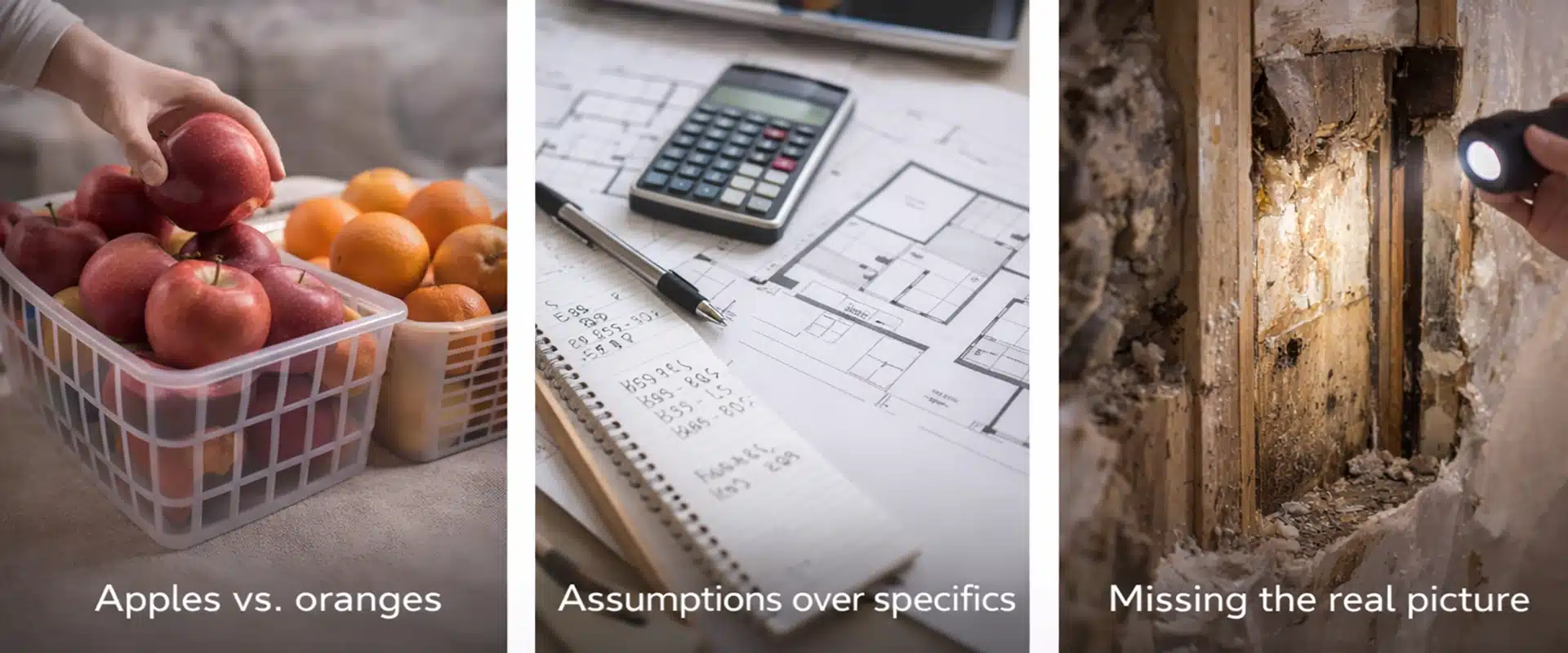
Because remodeling is shaped by discovery and adaptation rather than repetition, cost behavior is inherently uneven. Two homes with the same square footage can require dramatically different levels of intervention. When square-foot pricing is applied to an environment built on uncertainty, the math produces confidence that reality cannot support.
The Non-Linear Nature of Remodeling Costs
One of the most confusing aspects of remodeling cost is that it does not increase smoothly as square footage increases. Many costs are triggered by conditions, not size.
Small projects often activate expensive thresholds. A kitchen remodel may require upgrading an electrical panel, reinforcing framing, relocating plumbing, or improving ventilation to meet current codes. Once triggered, these costs apply regardless of whether the space is 150 square feet or 400 square feet.
These same thresholds are most visible when walls are moved or removed — conditions explored further in
Structural Remodeling: What Homeowners Need to Understand.
Larger projects may avoid these thresholds entirely if existing systems are already adequate. This is why square-foot pricing creates expectations that reality cannot satisfy.
Systems and Structure Drive Cost More Than Square Footage
In remodeling, infrastructure determines cost far more reliably than visible finishes. Electrical capacity, plumbing configuration, HVAC performance, and structural integrity all determine whether a project can proceed as envisioned.
When systems are undersized or outdated, they must be addressed to support modern layouts and loads. These corrections often represent a significant portion of the budget even though they add no visible square footage.
Because these systems are evaluated and resolved during planning, their cost behavior directly connects to
Pre-Construction Explained: What Happens Before Construction Starts
rather than to square footage itself.
Why Similar Projects Produce Very Different Price-Per-Foot Numbers
Wide variation in price-per-square-foot figures often alarms homeowners, but these differences usually reflect assumptions rather than competence or intent.
One remodeler may assume existing systems are adequate. Another may assume upgrades are required. One may include engineering and contingency. Another may defer those costs.
This is why price comparison alone rarely reveals preparedness — a distinction expanded in
How to Choose the Right Remodeling Contractor (Without Regret).
Price variation is not evidence of dishonesty. It is evidence of different approaches to uncertainty.
How Square-Foot Pricing Masks Risk Instead of Explaining It
Square-foot pricing often feels reassuring because it appears definitive. In reality, it hides uncertainty rather than resolving it.
This is the same mechanism that creates timeline instability later, as described in
Why Remodeling Timelines Feel So Uncertain.
Risk is not removed; it is postponed. When postponed risk surfaces during construction, it feels adversarial rather than anticipated.
What Homeowners Should Use Instead of Square-Foot Pricing
Replacing square-foot pricing does not mean abandoning numbers entirely. It means shifting focus from formulas to clarity.
Scope definition, decision readiness, and risk visibility matter more than rate comparisons. This is why outcomes are shaped less by math and more by structure, as outlined in
Design-Build vs. Traditional Remodeling: Why the Process Changes Everything.
Why Square-Foot Pricing Persists Despite Its Limitations
Square-foot pricing persists because it satisfies early-stage pressure. Homeowners want immediate answers. Remodelers want to remain competitive. Marketing favors simplicity over nuance.
Its persistence is not a failure of intelligence or ethics. It is a response to demand for certainty before certainty is possible.
How Understanding This Changes Homeowner Decisions
When homeowners understand why square-foot pricing fails, their decision-making changes. They stop searching for the “right” rate and start evaluating readiness, assumptions, and process.
This mirrors how homeowners regain confidence across the entire remodel — a theme reinforced in
How Remodeling Decisions Create (or Destroy) Peace of Mind.
The Real Role of Numbers in Remodeling
Numbers in remodeling are not inputs that dictate outcomes. They are outputs that reflect decisions, evaluation, and risk management.
Square-foot pricing reverses that relationship. When homeowners release that expectation, numbers regain their usefulness — supported by process, transparency, and shared understanding rather than simplified formulas.