
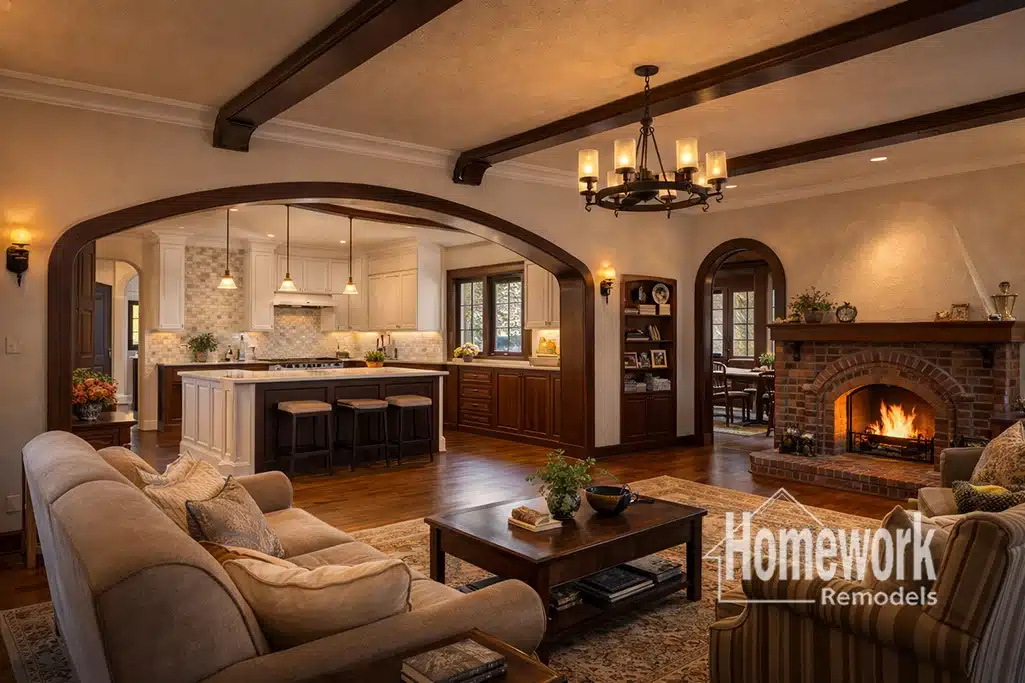
F.Q. Story Living Rooms: When Every Wall Shapes How the Home Lives
Living rooms in F.Q. Story Historic District homes carry more responsibility than their square footage suggests. With compact floor plans and limited secondary gathering spaces, the living room often serves as the home’s social hub, circulation core, and visual anchor. In houses where every wall was placed intentionally, even small changes can dramatically alter how the home lives.
For F.Q. Story homeowners, the challenge is not whether to improve the living room—it’s how to do so without disrupting the delicate balance that makes these modest homes work.
Why F.Q. Story Living Rooms Feel Constrained
Most F.Q. Story homes were built in the 1930s with efficiency as a guiding principle. Living rooms were sized to support conversation, not entertainment systems or flexible furniture arrangements.
As lifestyles evolved, expectations grew. Larger seating groups, media integration, and informal gatherings all compete for space that was never designed to stretch.
The core decision tension is furniture flexibility versus wall preservation.
Walls Do More Than Divide Space
In small historic homes, walls are structural, spatial, and psychological. They guide circulation, anchor furniture, and define room identity.
Removing a wall may create visual openness, but it can also remove the only viable location for seating, art, or storage. In F.Q. Story homes, fewer walls often mean fewer usable layouts.
Furniture-First Planning Changes the Conversation
Rather than starting with walls, successful living room remodels in F.Q. Story begin with furniture. Mapping how people actually sit, walk, and gather reveals whether walls are obstacles—or assets.
Sometimes the best solution is not removing walls, but repositioning openings or adjusting proportions to support better layouts.
The decision tension shifts from openness to usability.
Selective Openings Often Outperform Full Removal
When connection to adjacent spaces is desired, selective openings can provide relief without collapse. Wider doorways, cased openings, or partial-height separations preserve structure while improving flow.
These strategies maintain room definition while reducing the boxed-in feeling many homeowners want to address.
Structure Sets Firm Boundaries
Many interior walls in F.Q. Story homes carry loads or provide lateral stability. Removing them may require beams or posts that intrude into the living space.
Before considering wall changes, homeowners should understand what is involved in removing load-bearing walls in Phoenix historic homes. Structural awareness prevents design reversals later.
Light Distribution Matters More Than Size
Small living rooms often feel tight because light is uneven. Strategic changes—new openings, borrowed light, or window reconfiguration—can dramatically improve comfort without expanding walls.
In historic neighborhoods, exterior changes must remain subtle and appropriate to the home’s character.
Circulation Should Be Protected, Not Compromised
Living rooms in F.Q. Story homes often double as passageways. Removing walls without considering circulation can force traffic through seating areas, reducing comfort.
Preserving clear circulation paths keeps the living room usable during daily life—not just gatherings.
Storage and Media Need Intentional Placement
Modern living rooms require storage and media integration, but historic layouts rarely account for them. Walls often provide the only practical locations.
Eliminating walls can create visual openness while creating functional headaches. Integrating storage thoughtfully often improves livability more than increasing openness.
Cost Discipline Depends on Clarity of Goals
Living room remodels can escalate when goals are vague. Knowing whether the priority is seating flexibility, visual connection, or improved light keeps scope controlled.
Clear priorities reduce the risk of making changes that don’t deliver meaningful improvement.
Whole-Home Context Prevents Overreach
The living room interacts with every adjacent space. Changes ripple outward, affecting dining rooms, hallways, and kitchens.
Homeowners who understand how whole-home remodeling in Phoenix evaluates layout decisions holistically avoid solving one problem by creating another.
Why Design-Build Is Especially Valuable in Small Homes
Design-build remodeling allows structure, layout, furniture, and cost to be evaluated together before walls move.
In F.Q. Story homes, where margins for error are small, this integration ensures changes improve daily life rather than complicate it.
Learning how the design-build remodeling process works helps homeowners make confident, informed layout decisions.
The Core Decision Tension: Openness or Livability
In F.Q. Story, the best living rooms aren’t the most open—they’re the most usable.
When every wall matters, thoughtful restraint often delivers better results than dramatic change.
Let’s Improve How Your Living Room Actually Works
If you’re considering changes to a living room in an F.Q. Story Historic District home, planning around structure and use is essential. With neighborhood-specific experience and a design-build approach, it’s possible to improve comfort without sacrificing balance.
We invite you to schedule a free remodeling consultation to explore layout strategies tailored to your home.