
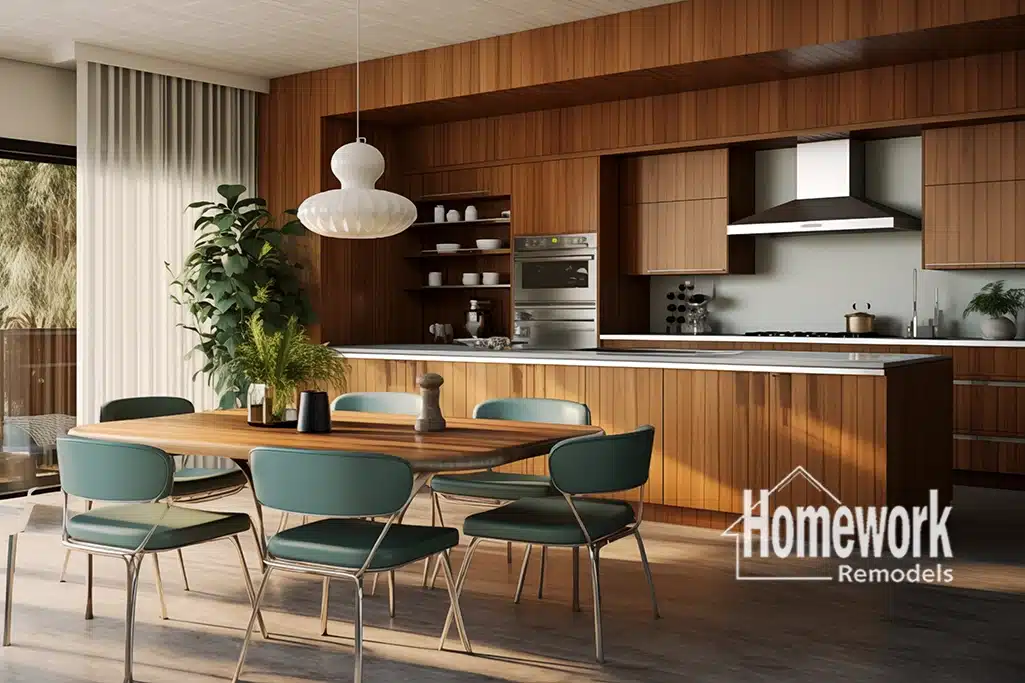
Mid-Century Modern Homes: Creating Open Concept Without Erasing Original Design Intent
Open-concept living is one of the most requested remodeling goals in mid-century modern homes—and one of the easiest ways to unintentionally destroy what makes these homes special. Many homeowners assume that removing walls automatically modernizes a space. In mid-century architecture, however, openness was already intentional, just expressed differently than today’s fully blended floor plans.
The challenge is not whether to open a mid-century home, but how to do so without erasing its original logic.
Why Mid-Century Homes Already Feel “Open”
Mid-century modern homes were designed around visual continuity rather than complete spatial blending. Low partitions, ceiling changes, built-ins, and glass walls created openness without collapsing every function into a single room.
Sightlines mattered. Flow mattered. Boundaries existed—but they were purposeful.
The core decision tension is modern openness versus architectural clarity.
Why Full Wall Removal Often Backfires
When homeowners remove every interior wall, mid-century homes can lose scale and definition. Rooms blur together, ceiling planes lose meaning, and circulation becomes ambiguous.
What was once intentional openness becomes visual noise.
Understanding the Original Spatial Hierarchy
Mid-century homes typically organize space horizontally. Living, dining, and kitchen areas relate to one another through alignment rather than enclosure.
Respecting this hierarchy allows openness to increase while preserving structure.
Partial Separation Is a Mid-Century Strength
Low walls, casework, clerestory glazing, and ceiling transitions allow spaces to connect without dissolving completely. These elements are not obstacles—they are design tools.
Reintroducing or preserving partial separation often results in better flow than total openness.
Ceiling Planes Matter More Than Walls
In mid-century homes, ceiling height and direction define space. Removing walls without addressing ceiling transitions can flatten the entire interior.
Maintaining or enhancing ceiling articulation preserves the home’s original rhythm.
Kitchens Should Connect—Not Dominate
Many mid-century kitchens were designed to be efficient and visually connected, but not fully exposed. Opening kitchens too aggressively can overpower adjacent living spaces.
Thoughtful openings, sightlines, and pass-throughs often achieve better balance than full removal.
Structural Walls Are Often Architectural
Walls in mid-century homes are frequently structural—and intentionally placed. Removing them may require beams that disrupt clean lines and proportions.
Before pursuing open-concept changes, homeowners should understand what’s involved in removing load-bearing walls in Phoenix homes. Structural solutions should support—not fight—the architecture.
Indoor-Outdoor Flow Was Always Central
Mid-century design prioritizes connection to the outdoors. Opening interior walls while ignoring exterior relationships can weaken this connection.
Sometimes the best “open concept” move is enhancing doors, glazing, or patios rather than removing interior walls.
Built-Ins Preserve Order
Built-in cabinetry, shelving, and seating define zones while maintaining openness. These elements prevent open spaces from feeling undefined.
Built-ins are not constraints—they are organizing principles.
Lighting Should Follow Architecture
Mid-century lighting emphasizes rhythm and restraint. Flooding open spaces with uniform lighting can erase spatial nuance.
Layered lighting reinforces zones and supports architectural intent.
Whole-Home Thinking Prevents Over-Simplification
Open-concept decisions affect circulation, acoustics, storage, and privacy. Evaluating the home as a system prevents one change from undermining another.
Homeowners who understand how whole-home remodeling in Phoenix approaches spatial relationships tend to achieve more authentic results.
Why Design-Build Is Critical for Mid-Century Homes
Design-build remodeling allows homeowners to test multiple openness strategies—partial openings, aligned sightlines, ceiling transitions—before committing to demolition.
In mid-century homes, this approach preserves design intent while meeting modern lifestyle needs.
Learning how the design-build remodeling process works helps homeowners avoid irreversible mistakes.
The Core Decision Tension: Bigger Space or Better Space
In mid-century modern homes, more open does not automatically mean better.
When openness is shaped by the home’s original design language, spaces feel calm, intentional, and timeless—rather than generic.
Let’s Open Your Home the Right Way
If you’re considering open-concept remodeling in a mid-century modern home, thoughtful planning can increase connection without erasing character. With architectural sensitivity and a design-build approach, openness and authenticity can coexist.
We invite you to schedule a free remodeling consultation to explore open-concept strategies tailored to your home.