
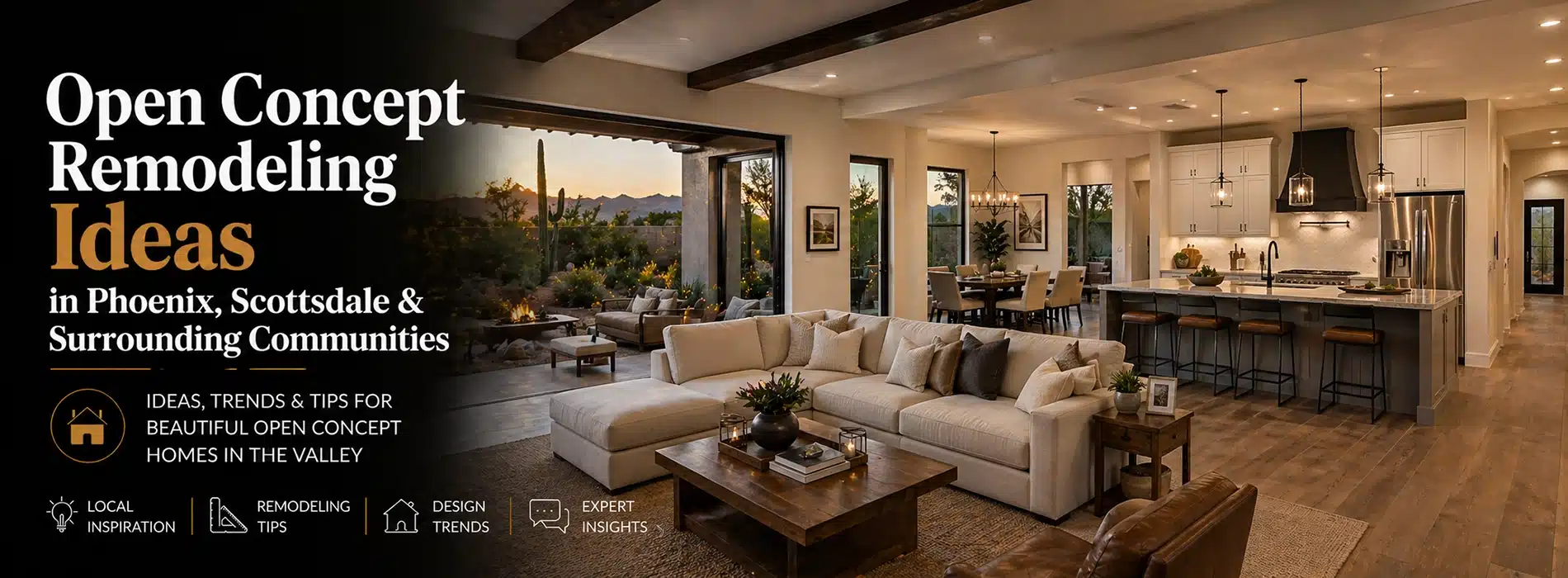
Open Concept Remodeling Ideas in Phoenix, Scottsdale & Surrounding Communities
Rethinking Layout, Light, and How Your Home Feels to Live In
Many homes in Phoenix and Scottsdale were designed for a different way of living.
Kitchens were separated from living areas. Dining rooms were formal and enclosed. Hallways divided spaces that today might feel more connected. At the time, those layouts made sense.
But for many homeowners today, those same walls create a feeling that the home is more confined than it needs to be.
Open concept remodeling often begins with that realization—not a desire to remove walls for the sake of it, but a desire to make the home feel more connected, more usable, and more aligned with everyday life.
At Homework Remodels, these projects are rarely about making a home feel bigger. They’re about making it feel better.
If you’re beginning to explore what that could look like, understanding the Design-Build Remodeling Process can help you see how layout ideas evolve into real structural changes.
Why Open Concept Remodeling Has Become So Popular
The way homes are used has changed.
Kitchens are no longer isolated workspaces. They’re gathering areas. Living rooms are no longer separate destinations—they’re part of a continuous experience. Natural light is valued more, and visual connection between spaces plays a larger role in how a home feels.
Open concept remodeling responds to those changes.
Instead of dividing rooms, the focus shifts toward creating continuity. Sightlines extend further. Movement becomes easier. Conversations happen more naturally across spaces that once felt separate.
The result isn’t just a visual change—it’s a different experience of the home.
Opening a Layout Without Losing Definition
One of the biggest misconceptions about open concept design is that everything becomes one large, undefined room.
In reality, the most successful open layouts still create a sense of structure.
Spaces are defined through subtle transitions rather than walls. Ceiling treatments, flooring continuity, cabinetry placement, and lighting all play a role in shaping how each area functions.
The kitchen may still feel like a kitchen. The living area still feels like a place to gather. But instead of being separated, they relate to each other in a more natural way.
This balance between openness and definition is what makes the design feel intentional.
The Role of Structural Changes
In many Phoenix homes, creating an open concept layout requires more than surface-level changes.
Walls that divide kitchens and living spaces are often load-bearing, meaning they support the structure above. Removing them requires careful planning, engineering, and execution.
This is where the project shifts from a design idea to a structural solution.
Beams may be introduced to carry loads across wider spans. Ceiling heights may be adjusted. Mechanical systems like ductwork and electrical lines often need to be rerouted.
If you’re considering this type of transformation, understanding Structural Remodeling and Load-Bearing Walls can help clarify what’s involved.
Light, Sightlines, and the Feeling of Space
One of the most immediate benefits of opening a layout is how it changes light.
Natural light that was once confined to a single room begins to travel across the home. Windows that once served one space now influence multiple areas. The entire interior can feel brighter without adding a single new opening.
Sightlines also expand.
Instead of looking into a wall, you begin to see through the home. From the kitchen, you might see into the living room, through the dining space, and out to the backyard. That visual continuity creates a sense of openness that goes beyond square footage.
It’s one of the reasons open concept remodeling can make a home feel dramatically different without changing its size.
Improving Flow Instead of Just Removing Walls
While wall removal often gets the attention, the real value of open concept remodeling is in how it improves flow.
Movement through the home becomes more intuitive. Bottlenecks disappear. Transitions between spaces feel smoother.
This is especially important in homes where entertaining is part of daily life. Guests can move naturally between the kitchen, living areas, and outdoor spaces without interruption.
The kitchen, in particular, often becomes the anchor of the home—connected rather than isolated.
Connecting Indoor and Outdoor Living
In Phoenix and Scottsdale, outdoor living is an extension of the home.
Open concept remodeling often strengthens that connection by aligning interior spaces with patios, pools, and outdoor seating areas. Large openings, sliding glass doors, and aligned sightlines can transform how the home interacts with its surroundings.
Instead of separate zones, the interior and exterior begin to feel like part of the same experience.
This is where layout changes can have an impact far beyond the walls that are removed.
Adapting Open Concept Design to Different Home Styles
Not every home is suited to the same type of openness.
In mid-century modern homes, open layouts are often already part of the design language. Remodeling focuses on restoring and enhancing those connections rather than creating them from scratch.
In historic homes, the approach is more nuanced. Preserving architectural character while improving flow requires careful planning and restraint.
In more traditional homes built in the 1980s and 1990s, open concept remodeling often involves more significant structural changes, but it also presents some of the greatest opportunities for transformation.
Each home requires a different approach, even when the goal is similar.
Seeing What’s Possible in Real Homes
Every open concept project is shaped by the home it begins with.
The best way to understand what might be possible is to see how similar challenges have been solved in real spaces. Structural limitations, layout constraints, and design goals all come together differently in each project.
You can explore real transformations in the Homework Remodels portfolio, where layout changes and structural remodeling have redefined how homes function.
Open Concept Remodeling by Area
The way these projects are approached often reflects the surrounding community.
In Scottsdale, open concept remodeling frequently emphasizes views, indoor-outdoor flow, and entertaining. In central Phoenix neighborhoods, projects may focus on balancing openness with architectural preservation. Other communities may present opportunities for more dramatic transformations based on the original home design.
If you’re exploring ideas, you can see how these projects are approached locally:
Why the Process Matters in Structural Remodeling
Open concept remodeling requires coordination between design, engineering, and construction.
Decisions made early in the process influence how structural changes are handled, how systems are relocated, and how the final space performs.
A design-build approach brings these elements together from the beginning, helping ensure that the vision for the space is carried through to construction.
If you’re comparing approaches, you can explore Design-Build vs Traditional Remodeling.
What a Well-Designed Open Concept Home Feels Like
When everything comes together, the change is immediate.
The home feels more connected. Light moves more freely. Spaces that once felt separate begin to work together.
It doesn’t feel like something was removed.
It feels like something was revealed.
Start Exploring Open Concept Remodeling Ideas
If you’re considering opening up your home in Phoenix, Scottsdale, or a surrounding community, the most valuable step is understanding what’s possible within your existing structure.
Once you see how layout, structure, and design come together, the direction becomes much clearer.
👉 Schedule your free consultation to begin exploring your open concept remodeling ideas with clarity.