
Bathroom Remodeling, Comfort & Wellness
What this page covers
This guide explores how bathroom remodeling can improve comfort, functionality, wellness, and daily routines. You’ll learn how layout, storage, lighting, accessibility, and material selections influence the way a bathroom performs and supports long-term living.
Who this is for
Homeowners who want to improve comfort, safety, storage, accessibility, or everyday enjoyment while creating a bathroom that better supports their lifestyle today and in the future.
Key Takeaways
- Bathroom remodeling affects comfort, wellness, and daily routines.
- Layout and storage significantly influence functionality.
- Lighting, ventilation, and material selections impact long-term performance.
- Accessibility features can improve safety without sacrificing design.
- Well-designed bathrooms add value to both the home and homeowner experience.
Why Bathrooms Have Become Personal Retreats
Few rooms in the home have changed more dramatically than the bathroom.
For much of the last century, bathrooms were designed primarily around necessity. They provided the functions homeowners needed, but little attention was given to how those spaces affected comfort, organization, relaxation, or daily well-being. The expectation was simple: the room should work. Whether it contributed positively to the homeowner’s experience was rarely part of the conversation.
Over time, however, the way people think about their homes began to change. Homes gradually became more than places where families ate meals and slept at night. They became workplaces, gathering places, entertainment spaces, and environments where people spent a greater percentage of their lives. As homeowners began paying closer attention to how their surroundings influenced daily routines, rooms that were once considered purely functional began to take on greater significance.
The bathroom sits in a unique position within that evolution because it participates in some of the most personal moments of the day. Morning routines often begin there. Evening routines frequently end there. It is one of the few spaces within the home where people can step away from responsibilities, distractions, conversations, screens, schedules, and obligations, even if only for a few minutes. Unlike kitchens and living areas, which serve multiple people simultaneously, bathrooms often offer a degree of privacy that has become increasingly valuable in modern life.
This helps explain why bathroom remodeling has become about far more than replacing outdated fixtures or worn finishes. Homeowners may initially focus on visible problems such as limited storage, poor lighting, cramped showers, aging materials, or inefficient layouts, yet those frustrations often point toward something larger. The room no longer supports the way they want to experience daily life. What appears to be a remodeling project is frequently a search for greater comfort, better organization, reduced stress, and a more enjoyable start and end to each day.
The cumulative effect of these improvements is often underestimated because no single frustration feels significant on its own. A crowded countertop may seem like a minor inconvenience. Poor lighting may feel manageable. Limited storage may simply become something homeowners learn to tolerate. Yet when these conditions occur every day, their influence accumulates. Small frustrations repeated hundreds of times each year eventually become part of the overall experience of living in the home.
The opposite is equally true. A bathroom designed around the way homeowners actually live delivers benefits just as often. Storage works naturally. Lighting supports daily routines. Circulation feels comfortable. Showers become more enjoyable. Organization requires less effort. None of these improvements dramatically change a homeowner’s life in a single day, yet together they create an experience that feels noticeably better over time.
This is why successful bathroom remodeling is rarely measured solely by appearance. Beautiful finishes contribute to the experience, but homeowners often discover that the features they appreciate most are the ones they stop noticing because they work so well. The room becomes easier to use. Daily routines become smoother. Frustrations disappear. The bathroom quietly supports everyday life without demanding attention.
In many ways, that is what transforms a bathroom from a functional space into a personal retreat. The room no longer serves merely as a place where routines occur. It becomes a place that improves those routines. Comfort increases. Stress decreases. Daily life becomes slightly easier, calmer, and more enjoyable than before. Over the years, those small improvements often become among the most appreciated benefits of the entire remodeling project.
Homeowners exploring bathroom remodeling often begin with visible frustrations, but many ultimately discover that the project is really about improving daily life. Our Bathroom Remodeling Guide explores planning, design, functionality, and the decisions that shape successful bathroom transformations. Homeowners seeking inspiration may also enjoy browsing our collection of Bathroom Remodeling Ideas.
Designing Daily Life Around Comfort
When homeowners begin planning a bathroom remodel, conversations often focus on features. They discuss larger showers, double vanities, improved storage, better lighting, updated finishes, and more spacious layouts because these are the most visible aspects of the room. Homeowners live with their existing bathrooms every day, and the limitations of those spaces frequently serve as reminders that change is needed. A crowded countertop, inadequate storage, poor lighting, or a cramped shower can make the room’s shortcomings feel obvious. Less obvious is that most homeowners are not actually pursuing the features themselves. They are pursuing the experience those features create.
A larger shower is rarely desired simply because it occupies more square footage. Homeowners value it because it feels more comfortable to use. Better storage is not attractive because of the cabinetry itself. It is attractive because it reduces clutter and simplifies routines. Improved lighting matters because it makes daily activities easier and more enjoyable. Even aesthetic improvements often carry a deeper purpose. Homeowners are usually seeking an environment that feels calmer, more organized, and better suited to their way of life. The visible features matter, but their true value lies in how they influence everyday life.
This distinction becomes important because comfort is often misunderstood. Many people associate comfort with luxury, yet some of the most comfortable bathrooms contain relatively simple features. The common thread is not extravagance but thoughtful planning. Spaces feel comfortable when they function naturally, when routines require less effort, and when homeowners are no longer forced to work around frustrations that have existed for years. A bathroom does not need to feel like a luxury resort to improve quality of life. It simply needs to support its users more effectively than before.
Consider how often a bathroom is used throughout the course of a week. Morning routines establish the pace of the day, while evening routines often provide a transition away from responsibilities and obligations. Because these experiences occur repeatedly, even modest improvements are experienced repeatedly as well. A drawer that keeps essential items organized may save only a few moments each day, but those moments accumulate. Better lighting may seem like a small upgrade until homeowners realize how much easier grooming tasks have become. Improved circulation may go unnoticed precisely because it feels natural, quietly removing friction from everyday life without demanding attention.
This is one reason homeowners frequently describe successful bathroom remodels differently than they expected. Before construction begins, discussions tend to revolve around products, finishes, and design selections. After construction is complete, homeowners often speak about how the room feels. They describe easier mornings, more organized spaces, greater comfort, and a sense that daily routines simply flow better than they did before. The products contributed to those outcomes, but the outcomes are what remain memorable.
Comfort also looks different from one household to another. A busy family may prioritize efficiency and organization. Empty nesters may value relaxation and personal space. Homeowners planning for long-term livability may focus on accessibility and ease of use. Others may simply want a room that feels less stressful than the one they have today. While the goals vary, the underlying principle remains remarkably consistent. People want environments that support daily life rather than complicate it.
The most successful bathroom remodels begin with that understanding. Rather than asking which products are popular or which trends are receiving attention, they focus on how homeowners want to experience the space. Once that objective becomes clear, decisions about storage, lighting, layout, materials, accessibility, and organization become easier because each choice can be evaluated according to whether it contributes to the desired experience. The room stops being a collection of products and begins becoming a carefully designed environment.
This is why thoughtful bathroom remodeling has such a lasting impact. The benefits are not reserved for special occasions. They are experienced every morning, every evening, and countless times in between. Over the course of years, those small improvements often contribute more to daily satisfaction than the most dramatic visual features ever could. The room becomes easier to use, maintain, and enjoy, creating a sense of comfort that extends well beyond its physical boundaries.
The Importance of Personal Space
Modern life places constant demands on attention.
Work follows people home through phones, laptops, emails, text messages, and virtual meetings. Family schedules compete for time and energy. Homes often serve multiple functions simultaneously, operating as workplaces, gathering spaces, classrooms, entertainment centers, and centers of daily activity. While these changes have created new opportunities and conveniences, they have also increased the value of something many homeowners rarely considered in previous generations: personal space.
The primary suite occupies a unique position within the home because it provides an opportunity to step away from those demands without leaving the house. Unlike kitchens, family rooms, dining areas, and other shared spaces, the primary suite exists primarily for its occupants. It is often the first environment homeowners experience in the morning and the last environment they experience before ending the day. As a result, the quality of that space influences daily life in ways that extend far beyond its physical dimensions.
Many older homes were designed during a time when expectations for primary suites were very different. Bedrooms were often treated as functional sleeping spaces rather than comprehensive personal environments. Bathrooms tended to be smaller, storage was frequently limited, closets were undersized, and circulation patterns reflected priorities that no longer align with how many homeowners live today. These spaces may continue functioning adequately, yet they often require daily compromises that homeowners have gradually learned to accept.
Over time, those compromises can become surprisingly influential. Limited storage contributes to clutter. Inadequate lighting makes routine activities more difficult. Tight circulation creates congestion during busy mornings. Small showers, crowded vanities, and poorly organized closets introduce minor frustrations that repeat day after day. Individually, none of these challenges may seem significant. Collectively, however, they shape the overall experience of using the space.
This is one reason homeowners frequently begin a primary suite remodeling project believing they need a larger bathroom, only to discover that the greater opportunity involves improving the entire suite experience. The relationship between the bedroom, bathroom, closet, storage areas, natural light, and circulation often has a greater influence on comfort than any individual feature. When those elements begin working together, the suite starts functioning as a unified environment rather than a collection of separate rooms.
The most successful primary suite remodels rarely focus exclusively on adding features. Instead, they focus on creating a better daily experience. Homeowners want spaces that feel organized rather than cluttered, comfortable rather than cramped, and supportive rather than demanding. They want routines to require less effort. They want privacy without isolation. They want environments that help them begin and end each day with a greater sense of calm than the spaces they replaced.
Interestingly, achieving these goals does not always require substantial increases in square footage. Additional space can certainly create opportunities, but thoughtful planning often yields equally meaningful improvements within the home’s existing footprint. Better organization, improved circulation, enhanced lighting, more effective storage, and stronger relationships between spaces frequently deliver benefits that far exceed their physical size. Homeowners are often surprised by how dramatically a suite can improve when the design begins responding to the way they actually live.
This perspective changes how success is measured. Homeowners rarely spend years admiring the dimensions of a shower or the specifications of a vanity. What they remember is how the space feels. They remember whether mornings became easier, whether clutter became easier to manage, whether the environment felt more relaxing, and whether the suite supported their daily routines more effectively than before. Those experiences become part of everyday life, quietly influencing comfort and well-being long after construction is complete.
At its best, a primary suite provides more than privacy. It provides restoration. It creates a place where homeowners can step away from the demands of the outside world and enjoy an environment designed around their needs, routines, and priorities. That is why primary suite remodeling continues to be one of the most appreciated investments homeowners make. The project may begin with a bathroom, a closet, or a bedroom, but the lasting value comes from creating a personal environment that improves daily life for years to come.
Many bathroom remodels eventually evolve into broader conversations about primary suites, comfort, organization, and whole-home livability. Homeowners evaluating larger transformations may also benefit from exploring our Whole-Home Remodeling Guide, which examines how multiple spaces can work together to support changing lifestyles and long-term goals.
Why Comfort Feels Different From Luxury
One of the most common misconceptions in bathroom remodeling is the belief that creating a relaxing, spa-like environment requires extravagant features or an unlimited budget. Homeowners often encounter photographs of stunning bathrooms featuring luxury finishes, expansive showers, freestanding tubs, and custom details, leading them to assume that comfort is primarily a matter of spending. While investment certainly influences what is possible, the bathrooms homeowners enjoy most are often distinguished by something far less visible than cost.
They are distinguished by how the space feels to use.
This distinction becomes apparent when comparing bathrooms that appear equally impressive in photographs but perform very differently in everyday life. One bathroom may contain expensive materials and dramatic design features yet still feel awkward, crowded, or difficult to maintain. Another may rely on relatively simple materials while feeling calm, organized, spacious, and welcoming. The difference rarely comes from individual products alone. It comes from how thoughtfully the space has been planned around the people who use it.
Comfort often begins with proportion. Older bathrooms were frequently designed around minimum functional requirements rather than the user’s experience. Showers were sized to fit available space. Vanities were selected to meet basic needs. Storage was often treated as secondary. As a result, many homeowners live with spaces that technically function but never feel particularly comfortable. Modern remodeling frequently seeks to correct this imbalance by giving greater attention to circulation, usability, openness, and the relationship between the various elements within the room.
This is why homeowners are often surprised by the impact of changes that seem relatively modest on paper. A slightly larger shower may feel dramatically more comfortable because movement becomes easier. Better lighting may transform the room by making daily activities less demanding. Improved storage may create a sense of calm because clutter no longer dominates visual attention. None of these changes are inherently luxurious, yet together they can completely change how the room is experienced.
The relationship between comfort and simplicity is especially important. Many of the most relaxing bathrooms are not filled with features competing for attention. Instead, they feel organized, cohesive, and purposeful. Materials work together harmoniously. Lighting supports the mood of the room. Storage allows everyday items to remain accessible without creating visual clutter. The environment feels intentional because every element contributes to the overall experience rather than demanding recognition for itself.
This principle extends beyond aesthetics. Homeowners often associate relaxation with what they see, yet relaxation is just as heavily influenced by what they do not see. Effective ventilation helps maintain air quality and comfort. Thoughtful storage reduces visual noise. Proper lighting minimizes strain. Well-designed layouts reduce unnecessary movement and frustration. These elements rarely become the centerpiece of a remodeling project, yet they frequently have a greater influence on long-term satisfaction than many of the more dramatic design features homeowners initially focus on.
A useful way to think about spa-like design is to view it as the removal of friction. A relaxing environment does not constantly ask something of the homeowner. It does not require workarounds, accommodations, or compromises. The room functions naturally. Daily routines unfold comfortably. Organization feels manageable. Movement feels easy. The space quietly supports the user rather than drawing attention to itself.
This is one reason homeowners often struggle to explain exactly why they love a well-designed bathroom. They may mention the shower, the lighting, or the finishes, but those features are usually expressions of a larger experience. What they are really describing is a room that feels peaceful, functional, and restorative. The physical elements matter because they contribute to that outcome, yet the outcome itself is what creates lasting satisfaction.
At its best, spa-inspired bathroom design is not about recreating a luxury resort inside the home. It is about creating an environment that supports everyday well-being. When thoughtful planning, comfort, organization, lighting, and functionality come together, homeowners gain something far more valuable than a collection of attractive features. They gain a space that helps them begin and end each day in a way that feels calmer, more comfortable, and more aligned with the life they want to live.
The Details Homeowners Appreciate Years Later
One of the most interesting aspects of bathroom remodeling is how homeowners’ priorities often change over time. During the planning process, attention naturally gravitates toward visible features. Tile selections, plumbing fixtures, cabinetry styles, countertops, mirrors, and decorative details receive significant discussion because they help shape the appearance of the finished room. These choices matter, and they contribute meaningfully to the overall experience. Yet when homeowners reflect on their remodel several years later, they often discover that the features they appreciate most are not always the ones they spent the most time discussing during the design phase.
The reason is simple. A bathroom is not experienced primarily as a visual composition. It is experienced in everyday life. Homeowners interact with the room repeatedly throughout the day, often without consciously thinking about it. The aspects of the design that make routines easier, more comfortable, and more intuitive gradually become more valuable because they are encountered so often. What initially seemed like a practical detail can ultimately have a greater influence on satisfaction than a dramatic design feature.
Storage provides one of the clearest examples. During planning, homeowners often focus on the appearance of cabinetry, yet daily life quickly reveals the importance of organization. A well-designed vanity drawer, a thoughtfully located linen cabinet, or storage that places frequently used items exactly where they are needed can quietly improve routines for years. These improvements rarely attract attention once they become part of everyday life, but that is precisely why they are appreciated. The room functions naturally because homeowners are no longer working around limitations that once felt unavoidable.
Lighting creates a similar effect. Homeowners often notice new lighting immediately after construction is complete because the room looks brighter and more inviting. What they may not fully appreciate until later is how much easier daily activities become. Grooming tasks require less effort. Mirrors become more functional. The room feels more comfortable at different times of day. Natural light, when available, contributes to an atmosphere that feels welcoming rather than utilitarian. The value of good lighting is experienced repeatedly, which allows its benefits to accumulate over time.
The same principle applies to circulation and layout. A bathroom that allows people to move comfortably through the space rarely draws attention to itself, yet homeowners immediately notice when circulation is poor. Tight clearances, awkward door swings, crowded vanities, and inefficient arrangements create small frustrations that repeat day after day. Conversely, a well-planned layout feels effortless because movement occurs naturally. Homeowners may never pause to admire the circulation pattern, but they experience its benefits every time they use the room.
Organization often plays an equally important role in long-term satisfaction. Clutter has a way of competing for attention. Countertops filled with everyday items can make even a beautiful bathroom feel chaotic. Thoughtful organizational systems help create a sense of calm by reducing visual noise and making routines more predictable. Drawers designed around specific uses, accessible storage locations, recessed niches, and practical cabinet configurations all contribute to an environment that feels easier to maintain over time.
What makes these details so valuable is that they support daily life without demanding recognition. A dramatic shower may impress visitors. Beautiful tile may attract compliments. Elegant fixtures may contribute to the overall character of the room. Yet the details homeowners often appreciate most are the ones that quietly perform their roles every day. They reduce effort. They simplify routines. They eliminate frustrations. They make the room feel comfortable in a way that becomes almost invisible because it works so well.
This pattern reveals an important truth about successful remodeling. Long-term satisfaction is rarely determined by a single feature. It is usually the result of dozens of thoughtful decisions working together. The storage supports the organization. The lighting supports the routines. The layout supports the movement through the space. The materials support durability and maintenance. Each decision contributes something meaningful, and together they create an experience that feels noticeably better than what existed before.
Years after construction is complete, homeowners rarely remember every product selection or design meeting from the planning process. What they remember is how the room functions. They remember whether mornings became easier, whether the space remained organized, whether routines felt more comfortable, and whether the bathroom continued supporting the way they lived. Those experiences become the true measure of success because they represent the benefits that endure long after the excitement of the remodel has faded.
In many ways, the details homeowners appreciate years later are the details that quietly improve everyday life. They may not be the most dramatic elements in the room, but they often become the most valuable because they continue delivering benefits every single day. That is the difference between a bathroom that simply looks beautiful and a bathroom that remains deeply satisfying to use for years to come.
Designing for the Future Without Sacrificing Beauty
One of the most significant shifts in modern remodeling has been the growing recognition that homes should not only serve homeowners well today but also continue to do so as life changes occur. This idea sounds obvious when stated directly, yet many homes were designed around the immediate needs of a particular moment in time. As families grow, children leave home, careers evolve, and physical needs change, homeowners often discover that spaces that once worked comfortably now require more effort.
Bathrooms frequently reveal these challenges first because they are among the most heavily used spaces in the home. Small shower curbs that once seemed insignificant become daily obstacles. Poor lighting becomes more noticeable. Storage that was merely inconvenient begins feeling frustrating. Tight circulation paths require greater attention. None of these conditions necessarily make a bathroom unusable, yet they can gradually make everyday routines less comfortable than they should be.
What makes thoughtful planning so valuable is that many of these challenges can be addressed long before they become problems. The goal is not to predict every future circumstance or redesign a bathroom around limitations that may never occur. The goal is to create an environment that remains comfortable, functional, and adaptable throughout a wide range of life stages. Homeowners are often surprised to discover that the features supporting long-term livability are frequently the same features that improve daily life immediately.
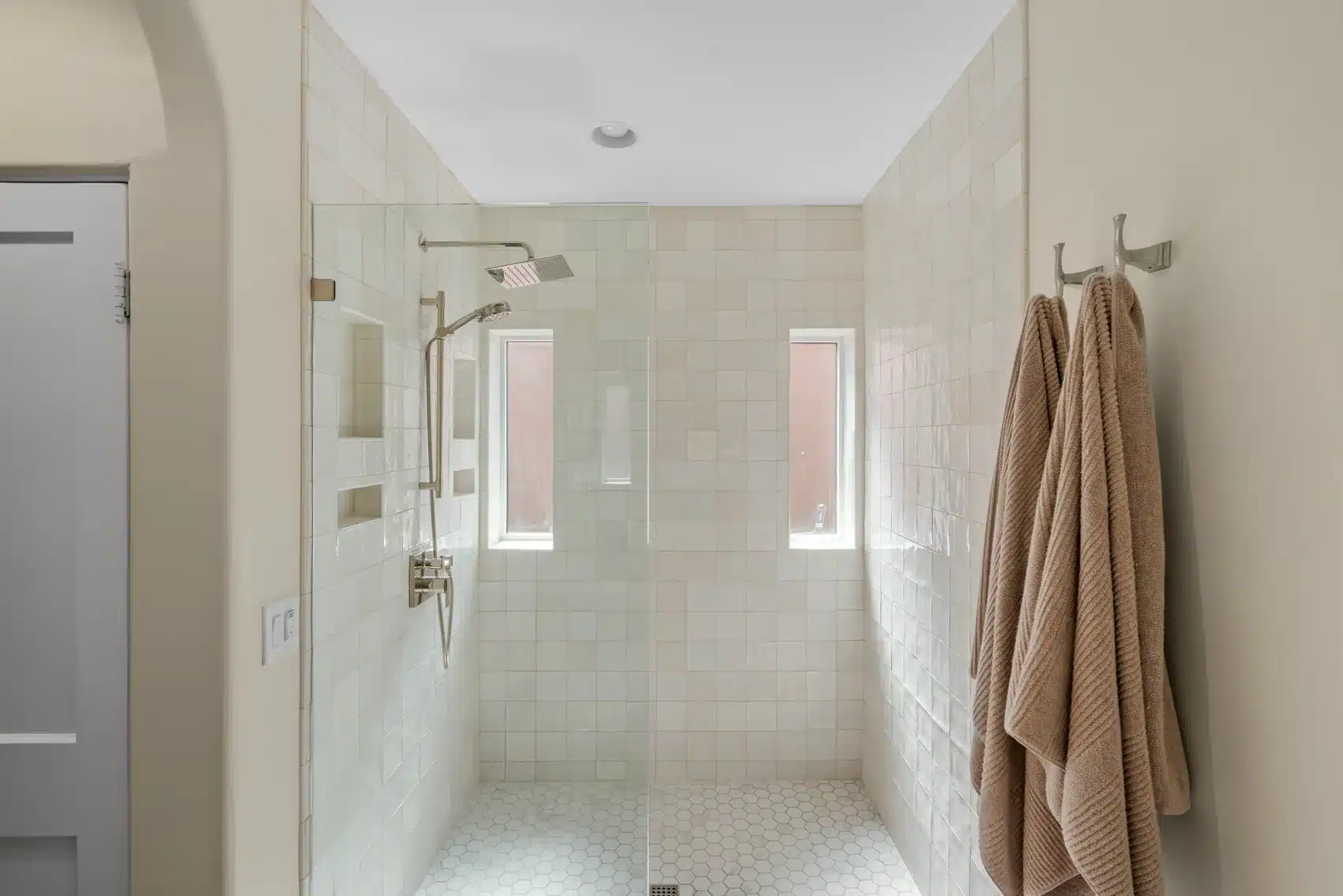
A curbless shower provides a good example. Many homeowners are initially drawn to curbless designs because they feel open, spacious, and contemporary. The visual transition from the bathroom floor to the shower creates a sense of continuity, making the room feel larger and more refined. At the same time, the absence of a curb reduces tripping hazards and improves accessibility. The feature succeeds not because it looks accessible, but because it combines beauty, comfort, and practicality within a single design decision.
A curbless entry alone does not make a shower suitable for every user. Plan around the intended users’ movement, reach, controls, seating and support needs, along with drainage and water containment. Evaluate these details together with the design and construction team.
The same principle applies throughout the bathroom. Improved lighting enhances safety while also making grooming tasks easier and more comfortable. Wider circulation paths create flexibility while making the room feel more spacious. Thoughtfully organized storage reduces physical strain while simplifying daily routines. Reinforcement installed within shower walls may never be visible, yet it creates opportunities for future modifications without disrupting finished surfaces. These improvements rarely draw attention to themselves because they are integrated into the overall design rather than added as separate accommodations.
This integration is what distinguishes modern universal design from the institutional environments that many homeowners still imagine when they hear the term “accessibility”. The objective is not to create a special bathroom for a specific stage of life. The objective is to create a better bathroom that works comfortably for a wider range of people, abilities, and circumstances. When approached thoughtfully, universal design principles often disappear into the design itself. Visitors notice the spacious shower, attractive lighting, comfortable layout, and beautiful finishes. What they may not realize is that those same features are also contributing to safety, usability, and long-term flexibility.
Many homeowners eventually reach a point where they begin thinking differently about remodeling decisions. Rather than asking whether a feature will be valuable today, they begin considering whether it will remain valuable ten or fifteen years from now. This perspective does not require sacrificing current enjoyment for future planning. In fact, the strongest remodeling decisions often accomplish both objectives simultaneously. They improve the homeowner’s experience immediately while preserving options for whatever the future may bring.
Perhaps that is why universal design has become such an important part of modern bathroom remodeling. At its core, it is not about preparing for decline. It is about preserving independence, comfort, and confidence. It reflects the belief that homeowners should be able to enjoy beautiful spaces without being forced to choose between aesthetics and functionality. When planning is approached with that philosophy, the result is a bathroom that feels just as welcoming years from now as it does on the day construction is completed.
The most successful bathroom remodels rarely announce that they were designed for the future. Instead, they simply continue serving homeowners exceptionally well as life evolves. The room remains comfortable. The layout remains practical. Daily routines remain manageable. What initially appeared to be thoughtful design gradually reveals itself as thoughtful foresight, allowing homeowners to enjoy the benefits of both beauty and long-term livability without ever feeling that one came at the expense of the other.
Many of the concepts discussed in this section are rooted in universal design principles that support comfort, independence, and long-term livability. Homeowners interested in learning more about these ideas may wish to explore our Universal Design Explained guide and the Aging in Place & Universal Design Journey.
The Regrets Homeowners Never Planned For
One of the advantages of experience is that it allows people to look backward and recognize lessons that were difficult to see while moving forward. Remodeling is no different. Homeowners often begin a bathroom project focused on solving immediate frustrations, improving appearance, and creating a space that better supports daily life. Those are worthwhile goals, and they frequently lead to successful outcomes. Yet when homeowners reflect on their projects years later, the regrets they describe are often surprisingly consistent.
Most regrets do not involve choosing the wrong tile, faucet, or paint color.
More often, homeowners wish they had spent more time understanding how they would actually live in the space after construction was complete.
This distinction matters because remodeling decisions tend to feel very different before and after a project is finished. During planning, it is natural to focus on products, finishes, and visual inspiration. These elements are easy to compare because they are tangible and immediately visible. Daily routines, long-term functionality, storage needs, lighting quality, and future flexibility can feel more abstract because their benefits are experienced gradually over time. Ironically, those less visible decisions often have the greatest influence on long-term satisfaction.
Storage is one of the most common examples. Homeowners frequently underestimate how much storage they will need because they focus on how the room will look rather than how it will function every day. A bathroom may feel spacious and uncluttered immediately after construction simply because everything is new and organized. Years later, however, personal care products, linens, grooming tools, medications, cleaning supplies, and countless everyday items begin competing for space. Homeowners rarely regret having too much storage. They often regret not planning for enough.
Lighting creates a similar pattern. Many homeowners recognize the importance of lighting during design, yet some still view it primarily as a finishing detail rather than a foundational element of the room. After living with a remodeled bathroom for several years, they often discover that lighting influences nearly every aspect of the experience. Good lighting supports grooming tasks, improves comfort, enhances safety, and contributes to the overall atmosphere of the space. Poor lighting creates small frustrations that repeat daily. Because those frustrations occur so frequently, their cumulative effect can become surprisingly significant.
Another common source of regret involves preserving existing layouts without fully exploring alternatives. Maintaining plumbing locations and familiar configurations can sometimes reduce costs, and in many situations it is the appropriate decision. Yet some homeowners later realize they focused so heavily on minimizing change that they overlooked opportunities for meaningful improvement. A larger shower, improved circulation, better storage placement, or a more thoughtful relationship between fixtures may have delivered benefits that far exceeded the value of preserving the original arrangement.
Long-term planning is another area where hindsight often provides clarity. Bathroom remodels frequently remain in service for fifteen, twenty, or even thirty years. Decisions made today may influence comfort and usability for decades. Homeowners occasionally discover that features supporting accessibility, organization, and long-term livability would have been relatively easy to incorporate during remodeling but far more difficult to add later. These regrets rarely stem from poor decisions. More often, they result from focusing so intensely on current needs that future possibilities were never fully considered.
Trends can create similar challenges. Inspiration is valuable, and contemporary design often introduces exciting ideas. Yet homeowners who remain happiest with their remodels tend to balance current preferences with long-term livability. The goal is not avoiding trends altogether. The goal is to ensure that major decisions continue to support the homeowner’s lifestyle long after a particular design movement has faded from popularity. Timeless solutions often age more gracefully because they are rooted in functionality and comfort rather than novelty alone.
Perhaps the most common regret of all involves planning itself. Many homeowners finish their remodel wishing they had explored more options, asked more questions, or spent additional time understanding how different decisions would influence daily life. The irony is that planning can sometimes feel slow even as it happens. Homeowners are eager to see progress and naturally look forward to construction. Yet once the project is complete, the value of thoughtful planning often becomes obvious, as many long-term outcomes can be traced back to decisions made before demolition began.
What makes these observations encouraging is that they are largely preventable. Most remodeling regrets do not result from bad intentions or poor workmanship. They result from opportunities that were never fully evaluated. The more thoughtfully homeowners examine how they live, how they want the space to function, and how their needs may evolve over time, the more likely they are to create a bathroom that continues serving them well for years to come.
The most successful bathroom remodels are not the ones that generate the most compliments on the day construction is completed. They are the ones that homeowners continue to appreciate long after the excitement of the project has faded. Those bathrooms remain organized, comfortable, functional, and supportive of daily life because the decisions shaping them were guided not only by what looked appealing in the moment, but by what would remain valuable for years to come.
Many of these lessons become easier to understand when homeowners recognize how planning influences outcomes. Our Planning a Remodel Guide and Pre-Construction Planning Guide explore how thoughtful preparation helps homeowners avoid common remodeling regrets before construction begins.
When a Bathroom Remodel Improves More Than a Bathroom
Most homeowners begin a bathroom remodeling project with a fairly specific objective in mind. They want a larger shower, better storage, improved lighting, updated finishes, or a more functional layout. These goals provide a natural starting point because they address frustrations that homeowners experience every day. The room may feel crowded, outdated, disorganized, or less comfortable than it once was. Remodeling appears to offer a straightforward solution to a clearly defined problem.
As planning progresses, however, many homeowners discover that the project is about more than the room itself.
The bathroom may be the focus of construction, but the benefits often extend into daily routines, household organization, personal comfort, long-term livability, and overall quality of life. What initially appears to be a project centered on fixtures, cabinetry, and finishes gradually reveals itself as an opportunity to enhance the living experience in the home.
This shift occurs because bathrooms occupy a unique place within everyday life. Unlike rooms used occasionally, bathrooms are woven into the rhythm of nearly every day. Morning routines begin there. Evening routines often end there. Homeowners interact with the space repeatedly throughout the week, month, and year. Improvements made within the room therefore have an opportunity to influence countless experiences that occur long after construction has been completed.
A better-organized bathroom can reduce daily stress because homeowners spend less time searching for items and managing clutter. Improved lighting can make routine activities more comfortable and enjoyable. A thoughtfully designed shower can transform an ordinary part of the day into a more relaxing experience. Enhanced accessibility can create greater confidence and independence. Individually, these benefits may appear modest. Collectively, they can significantly change how homeowners experience their homes.
Many homeowners are surprised by what they remember most after a remodel is complete. During planning, they may have focused heavily on product selections, finishes, and design details. Years later, those specifics often fade into the background. What remains is the experience the room creates. Homeowners remember how easy mornings became. They remember how much more organized the space felt. They remember the comfort of a larger shower, the convenience of better storage, the confidence that comes from thoughtful design, and the sense that the room simply worked better than before.
This pattern reveals an important truth about remodeling in general. The most successful projects are rarely defined solely by the physical changes that occur during construction. Their lasting value comes from how those changes influence everyday life. A remodeled bathroom is not simply a collection of products assembled within a room. It is an environment that either supports or complicates the routines, habits, and priorities of the people who use it. When the design aligns with those needs, the room begins contributing value every day.
This is one reason bathroom remodeling consistently remains among the most appreciated home improvements homeowners undertake. The benefits are experienced frequently enough that they become part of daily life. Unlike features that may be enjoyed only occasionally, a well-designed bathroom quietly contributes to comfort, organization, wellness, and functionality year-round. The room does not need to be extravagant to create meaningful value. It simply needs to serve its occupants thoughtfully and consistently.
Viewed through this lens, bathroom remodeling becomes less about creating a beautiful room and more about creating a better experience. Beautiful finishes certainly matter, and thoughtful aesthetics contribute to enjoyment, but appearance alone rarely creates lasting satisfaction. Lasting satisfaction comes from a space that supports its users. The room feels comfortable. The routines feel easier. The environment feels more organized. Daily life becomes slightly less demanding and slightly more enjoyable than it was before.
Perhaps that is the real measure of a successful bathroom remodel. Years after construction is complete, homeowners are no longer thinking about the project itself. They are simply enjoying the benefits it continues to provide. The room has become part of the natural rhythm of life, quietly supporting comfort, wellness, organization, and long-term livability without demanding attention. What began as a remodeling project has become something far more valuable: an investment in the everyday experience of living at home.
Related Guides
- Bathroom Remodeling Guide
- Bathroom Remodeling Ideas
- Universal Design Explained
- Whole-Home Remodeling Guide
- Planning a Remodel
Featured Bathroom Remodeling Projects
- Paradise Valley Master Bath Remodel
- Luxury Gainey Ranch Bathroom Transformation
- Simple Sophistication Bathroom Remodel
- Spanish Colonial Bathroom Remodel in Willo
About the Authors
This guide was developed by Steve Shinn (MCR, MCKBR, UDCP, GCP) and Sheila Lanier (MCKBR, UDCP) of Homework Remodels. Together, they bring decades of residential remodeling experience, professional certifications, industry leadership, award-winning project experience, and a shared commitment to homeowner education.
Steve serves as Founder and Managing Partner of Operations & Leadership and has contributed to the remodeling industry through national NARI leadership, certification development, and professional education. Sheila serves as Managing Partner of Design & Systems and is recognized for her expertise in design, client experience, project planning, and organizational leadership, including service as a NARI chapter president and national Contractor of the Year judge.
This guide reflects the planning principles and homeowner education approach Homework Remodels uses to help clients make informed decisions before construction begins.
Learn more about Steve Shinn, Sheila Lanier, and Homework Remodels.
Continue the Journey
A bathroom that works well today can also make daily life easier as needs change. Explore how thoughtful layouts, accessible features, and adaptable design can support comfort and independence throughout the home.
Explore the Aging-in-Place & Universal Design Journey →
Ready to Take the Next Step?
Every remodeling project begins with understanding. The Remodeling Knowledge Center was created to help homeowners navigate planning, design, budgeting, and construction with greater clarity and confidence.
If you’re ready to continue learning, explore the additional Journeys, Core Guides, and Remodeling Resources available throughout the Knowledge Center. If you would like to discuss your home, goals, and project ideas directly, we’re always happy to start with a conversation.
© 2026 Homework Remodels. All rights reserved. No portion of this publication may be reproduced, republished, or distributed without written permission.