
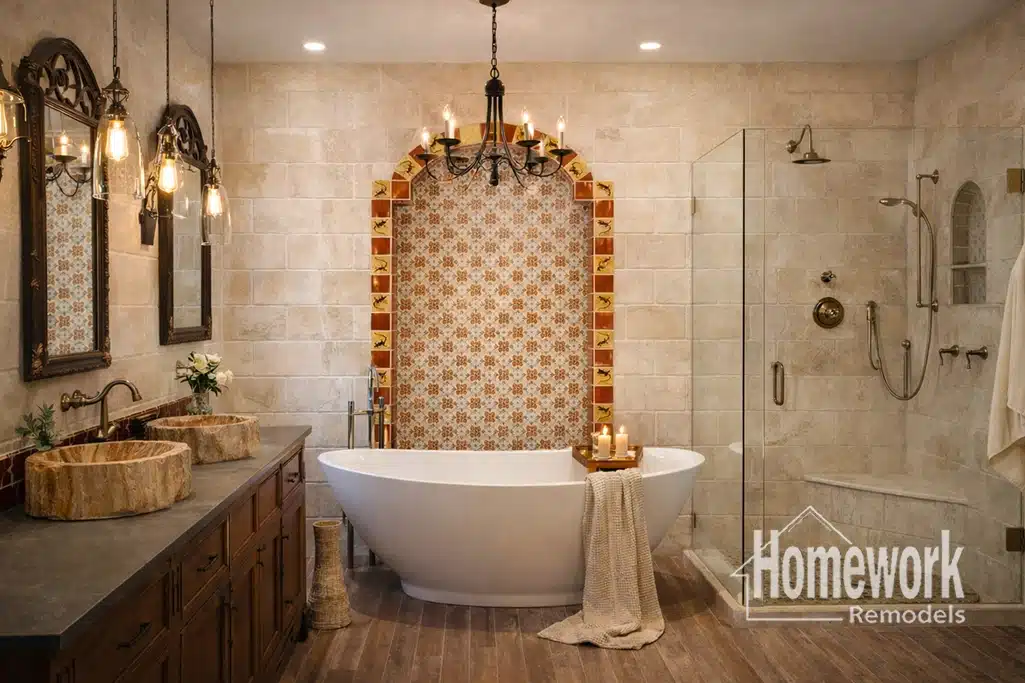
Willo Bathrooms: Expanding Comfort When Hallways Can’t Move
Bathrooms in Willo homes often feel undersized—not because of neglect, but because of how these houses were originally organized. Central hallways act as structural and spatial spines, tying bedrooms, baths, and living spaces together. When homeowners want more comfortable bathrooms, that spine can’t simply shift to make room.
In Willo, the most successful bathroom remodels don’t move hallways. They work around them.
Why Willo Hallways Are Effectively Fixed
Willo homes were designed with clear circulation paths. Hallways provide separation between public and private spaces, maintain symmetry, and often carry structural loads.
Moving or narrowing these corridors can disrupt flow, compromise structure, and diminish historic clarity. For most homes, hallways are immovable boundaries.
The core decision tension is bathroom comfort versus circulation integrity.
Why Bathrooms Feel Especially Constrained
Original bathrooms were utilitarian. Tubs were small, vanities were shallow, and storage was minimal. Over time, expectations expanded—larger showers, double vanities, linen storage, and better lighting.
When hallways can’t move, bathrooms must become more efficient rather than simply larger.
Borrowing Space Without Breaking Flow
Some bathrooms can gain space by borrowing from adjacent closets or secondary rooms without altering hallway width. These subtle reallocations improve function while preserving circulation.
The key is identifying spaces that can give without creating new problems elsewhere.
Fixture Reconfiguration Delivers Immediate Gains
Replacing tubs with showers, reorienting fixtures, or selecting wall-hung vanities can dramatically improve usability without expanding the room.
In compact bathrooms, layout decisions often matter more than square footage.
Storage Strategy Reduces Spatial Pressure
Bathrooms often feel small because storage is poorly placed. Vertical storage, recessed cabinetry, and integrated niches free up floor space and reduce clutter.
Better storage can make existing dimensions feel generous.
Door Swing and Entry Placement Matter
Door placement often wastes usable wall space. Adjusting door swings or relocating entries—without touching the hallway itself—can unlock new layout options.
These changes are subtle but impactful.
Structural Walls Define the Limits
Some bathroom walls provide structural support. Removing or shifting them may require beams or posts that intrude into limited space.
Before changing layouts, homeowners should understand what is involved in removing load-bearing walls in Phoenix historic homes. Structural awareness often points toward smarter, less invasive solutions.
Light and Ventilation Improve Perception
Small bathrooms benefit disproportionately from improved lighting and ventilation. Brighter, well-ventilated spaces feel larger and more comfortable without expanding walls.
Skylights, transoms, and layered lighting often outperform physical expansion.
Cost Control Comes From Targeted Improvements
Trying to force expansion around fixed hallways can escalate cost quickly. Targeted improvements—fixtures, storage, lighting—deliver meaningful upgrades with less disruption.
Clear priorities keep projects focused and predictable.
Whole-Home Balance Prevents Tradeoff Regret
Bathroom changes affect bedrooms, storage, and circulation. Evaluating these impacts holistically prevents solving one problem while creating another.
Homeowners who understand how whole-home remodeling in Phoenix approaches layout tradeoffs tend to achieve better outcomes.
Why Design-Build Is Especially Valuable in Willo Bathrooms
Design-build remodeling integrates layout exploration, structural constraints, and cost analysis early.
In Willo homes, this integration allows homeowners to test multiple bathroom configurations within fixed boundaries—selecting solutions that deliver comfort without compromising flow.
Learning how the design-build remodeling process works supports confident decision-making when hallways can’t move.
The Core Decision Tension: Bigger Bath or Better Use
In Willo, the best bathroom remodels don’t fight the hallway—they respect it.
When comfort improves through smarter layouts rather than forced expansion, bathrooms feel more generous and the home retains its historic balance.
Let’s Improve Bathroom Comfort Without Disrupting Your Home’s Flow
If you’re planning a bathroom remodel in a Willo Historic District home, thoughtful design can deliver comfort without moving hallways or compromising circulation. With neighborhood-specific experience and a design-build approach, clarity comes early.
We invite you to schedule a free remodeling consultation to explore bathroom strategies tailored to your home.