
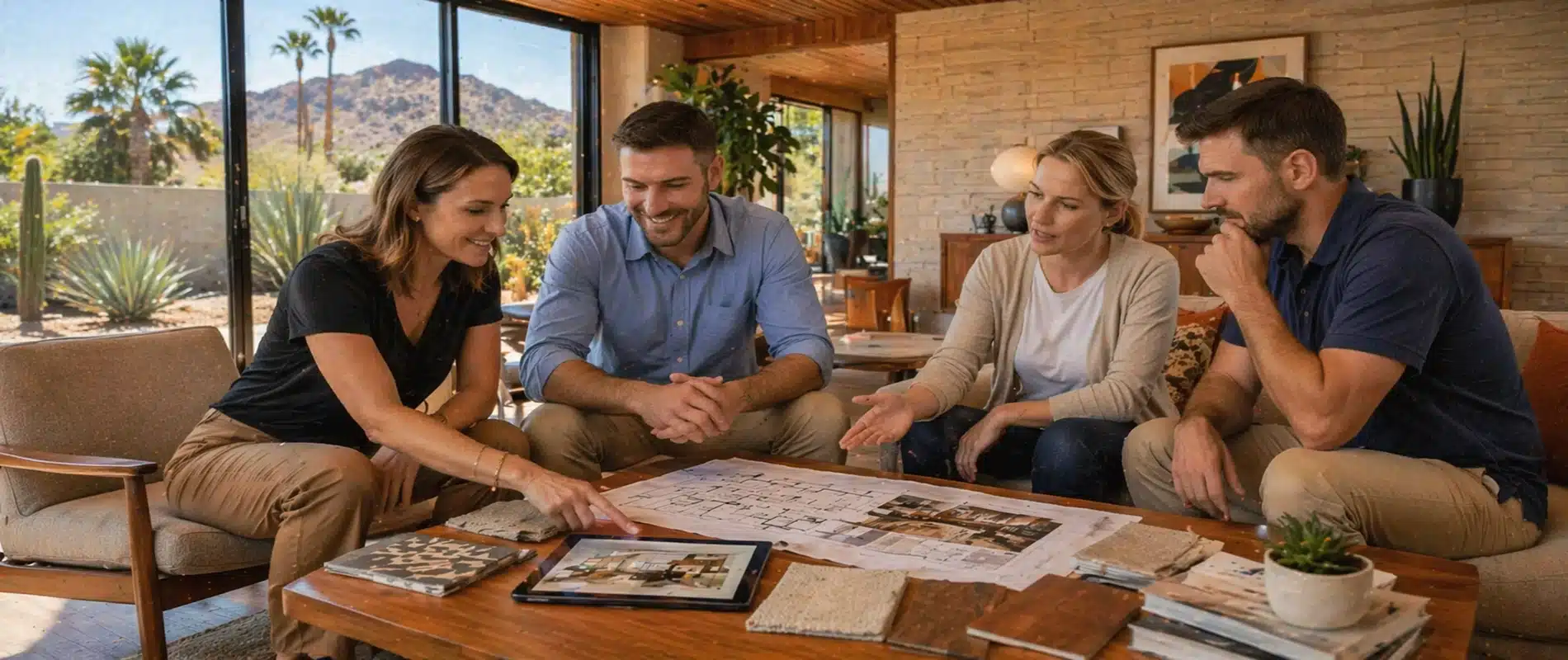
 Mid-Century Modern Home Remodeling Guide
On This Page
Remodeling Begins with Respect for the Architecture
What Defines a Mid-Century Modern Home?
Layout Transformation Without Losing Intent
Preserving Architectural Features That Matter
Kitchen Remodeling in Mid-Century Homes
Bathroom Remodeling in Mid-Century Homes
Indoor-Outdoor Living Integration
Systems and Performance Upgrades
Cost Considerations for Mid-Century Remodeling
The Design-Build Advantage for Mid-Century Modern Homes
What a Successful Mid-Century Remodel Actually Feels Like
Remodeling Begins with Respect for the Architecture
Mid-century modern homes in Phoenix are not simply older houses—they are intentional architectural compositions. Every line, proportion, material, and connection to the outdoors was designed with purpose. That is why remodeling these homes begins with a different mindset. It is not about updating a structure. It is about understanding it first.
At their core, mid-century modern homes are defined by clarity. Horizontal lines, low-slung rooflines, expansive glass, and open yet structured layouts work together to create a balanced environment. These homes were designed to feel effortless, even though the design itself is highly disciplined. When remodeling ignores that discipline, the result often feels disjointed—spaces may be newer, but the home loses the quiet cohesion that made it special.
Respecting the architecture means recognizing that the home already has a language. In neighborhoods like Village Grove Scottsdale mid-century modern remodeling, Marion Estates mid-century remodeling, and Windsor Square mid-century modern remodeling, that language extends beyond a single property. It defines entire communities. Rooflines align, materials repeat, and proportions create a consistent visual rhythm. Remodeling within these contexts requires sensitivity—not just to the home itself, but to its surroundings.
One of the most common mistakes in mid-century remodeling is overcorrection. Homeowners often attempt to “modernize” by introducing elements that conflict with the original design—overly complex finishes, dramatic vertical features, or materials that feel disconnected from the home’s natural palette. These changes may be well-intentioned, but they disrupt the simplicity that defines mid-century architecture. The goal is not to make the home feel new. It is to make it feel right.
This is especially important when making structural or layout changes. Mid-century homes already lean toward openness, but that openness is carefully controlled. Removing walls or expanding spaces without understanding how they affect proportion and flow can create imbalance. Successful projects, like those seen in Arcadia Lite mid-century modernization and mid-century ranch home remodeling Phoenix Scottsdale, show that structural changes can enhance a home—but only when they are guided by the original design intent.
Material selection reinforces this respect. Mid-century homes rely on a restrained palette—wood, masonry, glass, and simple finishes that create warmth without excess. Introducing materials that feel overly polished or decorative can shift the tone of the home. Instead, updates should extend the existing material language, improving durability and performance while maintaining visual consistency.
Another key aspect is the relationship between indoor and outdoor spaces. Mid-century homes were designed to connect with their environment. Large windows, sliding doors, and extended rooflines blur the boundary between inside and outside. Remodeling should strengthen this connection, not diminish it. Aligning interior changes with exterior views and access points helps preserve one of the style’s defining characteristics.
This approach requires patience and structure. Decisions must be made in the right order—understanding the home first, defining what should be preserved, and then determining how improvements can be integrated. This philosophy aligns with the broader approach to remodeling older homes without losing character, where respect for the original design guides every step of the process.
For homeowners exploring projects like Phoenix AZ mid-century modern home remodels or broader concepts in mid-century modern home remodeling, the pattern becomes clear. The most successful remodels do not compete with the architecture—they work with it.
Ultimately, remodeling begins with restraint, observation, and understanding. When the architecture is respected, every improvement feels intentional. The home evolves, but it does not lose its identity.
This is what defines a successful mid-century remodel—not how much is changed, but how well the original design is honored as the home is brought forward into modern living.
What Defines a Mid-Century Modern Home?
In Phoenix, mid-century modern homes are more than a recognizable style—they are the result of a specific architectural philosophy that prioritizes simplicity, function, and connection to the environment. Built primarily between the 1940s and 1970s, these homes reflect a shift toward modern living, where design supports everyday life without excess or ornamentation.
At the core of mid-century modern design is clarity. These homes are defined by clean lines, horizontal emphasis, and an absence of unnecessary detail. Rooflines are often low and extended, creating a strong visual connection to the landscape. Walls are used purposefully, not decoratively, and spaces are arranged to feel open while still maintaining structure and proportion.
One of the most recognizable features is the connection between indoor and outdoor living. Large windows, sliding glass doors, and open sightlines allow natural light to move freely through the home while visually extending the interior into the surrounding environment. In Phoenix’s climate, this relationship is particularly meaningful. Homes are often oriented to take advantage of views, shade, and airflow, creating spaces that feel both open and comfortable.
Layout is another defining characteristic. Many mid-century homes introduced early forms of open-concept living, where kitchens, dining areas, and living spaces are connected rather than fully separated. However, this openness is intentional and controlled. Spaces flow together, but each still has a clear purpose. This balance between openness and structure is one of the reasons these homes continue to feel relevant today.
Material selection also plays a central role. Mid-century homes typically use natural, honest materials—wood, masonry, glass, and simple finishes that emphasize texture and warmth. These materials are not used solely for decoration; they contribute to the overall composition of the home. When combined with clean lines and open layouts, they create an environment that feels both modern and grounded.
In neighborhoods such as Village Grove Scottsdale mid-century modern remodeling, Marion Estates mid-century remodeling, and Windsor Square mid-century modern remodeling, these characteristics are not limited to individual homes—they define entire communities. Consistent architectural language across these neighborhoods reinforces the importance of proportion, material, and layout.
Another defining element is how these homes prioritize function. Mid-century design is rooted in the idea that form follows function. Spaces are arranged based on how they are used, and design decisions support daily life rather than compete with it. This principle is especially evident in projects like mid-century ranch home remodeling Phoenix Scottsdale and Arcadia Lite mid-century modernization, where thoughtful updates enhance usability without altering the home’s core identity.
It is also important to recognize what mid-century modern homes are not. They are not defined by trend-driven finishes, excessive ornamentation, or dramatic visual statements. Their strength lies in restraint. Every element has a purpose, and the overall composition is designed to feel balanced and intentional.
Understanding these defining characteristics is essential before any remodeling begins. Without this foundation, updates can unintentionally conflict with the original design. With it, homeowners can make decisions that enhance their homes while preserving their architectural integrity. This perspective aligns with the broader principles found in the Homeowner Core Guides, where clarity and sequence guide successful remodeling outcomes.
Ultimately, a mid-century modern home is defined not by a single feature but by how all its elements work together. Structure, layout, materials, and light are all part of a cohesive system.
This is what gives these homes their lasting appeal—and what makes them worth preserving as they are thoughtfully adapted for modern living.
Layout Transformation Without Losing Intent
In Phoenix, transforming the layout of a mid-century modern home is often a primary goal of remodeling. Homeowners want more openness, better flow, and spaces that align with how they live today. But mid-century homes already contain a carefully considered layout—one that balances openness with structure, connection with definition. The challenge is not creating a new layout from scratch. It is evolving the existing one without losing the architectural intent that makes the home work.
Mid-century layouts were never random. Even when rooms feel separated, there is usually a logic behind their placement. Living areas are oriented toward light and views. Kitchens are positioned for efficiency. Circulation paths are designed to move people through the home without interruption. When these relationships are understood, layout changes can build on them rather than disrupt them.
One of the most common goals is creating a stronger connection between the kitchen and living spaces. In some homes, this may involve widening openings or removing walls to improve flow. However, not every wall should be removed. Mid-century design often uses subtle transitions—partial walls, ceiling changes, or shifts in material—to define space without fully enclosing it. Preserving or reinterpreting these transitions can maintain the home’s character while improving usability.
Structural changes must be approached with precision. Removing load-bearing walls can create dramatic openness, but it also changes how the home feels. When done without regard to proportion, these changes can flatten the space, removing the sense of rhythm that mid-century layouts rely on. Successful projects, such as those seen in Arcadia Lite mid-century modernization and mid-century ranch home remodeling Phoenix Scottsdale, demonstrate that openness works best when it is balanced with structure.
In many cases, layout transformation is less about removing elements and more about refining them. Adjusting circulation paths, improving sightlines, and aligning spaces with natural light can have a significant impact without requiring major structural changes. These refinements allow the home to function better while preserving the qualities that define mid-century design.
Neighborhood context also influences how layouts should evolve. In areas like Village Grove Scottsdale mid-century modern remodeling and Windsor Square mid-century modern remodeling, homes often share similar layouts and architectural characteristics. Maintaining consistency with these patterns helps ensure that changes feel appropriate not just within the home, but within the broader community.
Another important consideration is how spaces are defined after walls are removed. Open layouts still require organization. Furniture placement, ceiling lines, lighting, and material transitions all help define zones within the space. Without these elements, the home can feel undefined rather than open. The goal is to create continuity while maintaining clarity.
This is where sequencing becomes critical. Structure must be understood first, because it defines what can be changed. Layout decisions follow, shaping how the space will function. Finishes come last, reinforcing the design rather than dictating it. This approach aligns with the broader framework in the Homeowner Core Guides, where decisions are made to support both clarity and outcomes.
Ultimately, transforming a mid-century layout is not about making the home more modern—it is about making it more usable while preserving its identity. The best results feel effortless. Spaces connect naturally. Movement flows without interruption. The home feels open, but not empty. Updated, but not altered beyond recognition.
This is what defines a successful layout transformation—one that respects the original intent while allowing the home to fully support modern living.
Preserving Architectural Features That Matter
In Phoenix, mid-century modern homes are defined less by decoration and more by composition. Their value comes from how a handful of essential elements—lines, proportions, materials, and light—work together. When remodeling begins, the most important question is not what to change, but what must remain. Preserving the right architectural features is what allows a home to evolve without losing its identity.
One of the most defining characteristics of mid-century homes is their horizontal emphasis. Low rooflines, long overhangs, and extended planes create a visual connection to the landscape. These elements should be protected whenever possible. Altering rooflines or interrupting horizontal continuity can fundamentally change how the home is perceived. Even interior changes should respect this principle by maintaining clean ceiling lines and avoiding unnecessary vertical disruption.
Windows are another critical feature. Expansive glass, clerestory windows, and carefully placed openings are central to how mid-century homes interact with light and the outdoors. These windows are not just functional—they are compositional elements that shape the experience of the home. Preserving their size, placement, and rhythm is essential. When upgrades are needed, they should maintain the original proportions and sightlines rather than replace them with incompatible alternatives.
Material authenticity also plays a major role. Mid-century homes rely on a restrained palette—wood, masonry, and glass—used in a way that feels natural and intentional. These materials create warmth without excess. Replacing them with overly polished finishes or stylistically unrelated ones can disrupt the balance of the home. Instead, updates should extend the existing material language to improve performance while maintaining consistency. This approach is evident in projects like Arcadia Lite mid-century modernization, where materials are carefully selected to align with the original design.
Built-in elements are often overlooked but are integral to mid-century architecture. Cabinetry, shelving, and storage were frequently designed as part of the home rather than added later. These features contribute to both function and aesthetic continuity. Preserving or thoughtfully updating built-ins helps maintain the integrity of the design while improving usability.
Fireplaces, feature walls, and other focal points also deserve attention. In many mid-century homes, these elements anchor the main living space. Their scale, material, and placement are carefully considered. Altering or removing them without a clear understanding of their role can leave the space feeling unbalanced. When updates are necessary, they should reinforce the original intent rather than replace it.
Neighborhood context reinforces the importance of preservation. In areas such as Village Grove Scottsdale mid-century modern remodeling, Marion Estates mid-century remodeling, and Windsor Square mid-century modern remodeling, architectural consistency contributes to the character of the community. Preserving key features within individual homes helps maintain that collective identity.
It is also important to recognize that preservation does not mean avoiding change. Many architectural features can be adapted to meet modern needs. Windows can be improved for energy efficiency, materials can be updated for durability, and built-ins can be refined for better function. The goal is not to freeze the home in time, but to carry its design forward in a way that remains true to its origins.
This requires thoughtful decision-making. Every change should be evaluated in relation to the whole. Removing a feature or introducing a new element should be done with an understanding of how it affects proportion, balance, and flow. This aligns with the broader framework found in the Homeowner Core Guides, where successful remodeling is guided by clarity and sequence rather than isolated decisions.
Ultimately, preserving architectural features that matter is about focus. Not every detail needs to remain unchanged, but the defining elements must be respected. When those elements are preserved, the home retains its character even as it evolves.
This is what allows a mid-century remodel to feel authentic—because the features that define the architecture remain, supporting a home that is both timeless and functional.
Kitchen Remodeling in Mid-Century Homes
In Phoenix, kitchen remodeling in mid-century modern homes is rarely just about updating finishes. It is about rethinking how one of the most important spaces in the home functions—while preserving the architectural clarity that defines the era. Mid-century kitchens were originally designed for efficiency, often compact and partially separated from living areas. Today, homeowners want more openness, better workflow, and a stronger connection to adjacent spaces. The challenge is achieving those improvements without disrupting the balance of the home.
Mid-century kitchens were never intended to be isolated from the rest of the home, but they were also not designed to be fully exposed. They often sit at the edge of the main living space, connected but defined. Remodeling requires understanding that relationship. Opening the kitchen too aggressively can flatten the layout, while leaving it unchanged can limit functionality. The goal is to refine the connection—creating better flow while maintaining the subtle structure that mid-century design relies on.
Layout is the first priority. Before selecting materials or appliances, the kitchen’s workflow must be defined. Circulation, prep space, and appliance placement all need to support daily use. In many cases, this involves widening openings or reconfiguring adjacent spaces. Structural changes, when appropriate, can significantly improve flow, as seen in projects like the Arcadia Lite mid-century modernization and mid-century ranch home remodeling in Phoenix and Scottsdale. However, these changes must be carefully integrated to preserve proportion and sightlines.
Cabinetry plays a central role in defining the kitchen’s character. Mid-century design favors clean lines, flat or simple door profiles, and a sense of horizontal continuity. Cabinet layouts often emphasize function over ornamentation, with integrated storage and minimal visual clutter. Updating cabinetry should reinforce these principles rather than replace them with overly detailed or contemporary styles that conflict with the home’s architecture.
Material selection should follow the same approach. Wood tones, natural finishes, and understated surfaces align with mid-century design. Countertops, backsplashes, and flooring should complement the existing material palette, creating continuity between the kitchen and the rest of the home. The goal is not to introduce contrast for its own sake, but to maintain cohesion while improving durability and performance.
Appliances introduce another layer of complexity. Modern appliances require more space, power, and integration than those originally designed for these homes. Planning their placement is essential to maintaining workflow and avoiding disruption. Built-in appliances can help preserve clean lines, while careful positioning ensures that the kitchen remains functional without becoming visually dominant.
Lighting is particularly important in mid-century kitchens. These homes rely heavily on natural light, and kitchen remodeling should enhance rather than block that light. Windows should be preserved or emphasized, and artificial lighting should be layered to support both task and ambient needs. The goal is to create a space that feels open and connected to its surroundings.
Neighborhood context also influences design decisions. In areas such as Village Grove Scottsdale mid-century modern remodeling and Windsor Square mid-century modern remodeling, kitchens are part of a broader architectural language. Maintaining consistency with that language ensures that updates feel appropriate not just within the home, but within the community.
Process matters as much as design. Kitchen remodeling involves structure, systems, and finishes, all of which must be coordinated. Decisions made out of sequence can lead to compromises that affect both function and appearance. This is why a structured approach—guided by the principles in the Homeowner Core Guides—is essential. Layout and structure must be defined first, followed by systems and finishes.
Ultimately, remodeling a mid-century kitchen is about balance. It is about improving how the space works while preserving how it feels. When done correctly, the kitchen becomes more functional, more connected, and more aligned with modern living—without losing the simplicity and clarity that define mid-century design.
This is what transforms a kitchen remodel from an update into an extension of the home’s original architecture.
Bathroom Remodeling in Mid-Century Homes
In Phoenix, bathroom remodeling in mid-century modern homes is less about reinvention and more about refinement. These bathrooms were originally designed with efficiency in mind—compact layouts, simple fixtures, and minimal ornamentation. While they often lack the space and features homeowners expect today, they do reflect the same design principles found throughout the home: clarity, proportion, and restraint. The goal of remodeling is to improve comfort and functionality while preserving that underlying simplicity.
Most mid-century bathrooms are smaller than modern standards, which makes layout especially important. Expanding the space is not always necessary—or even desirable. In many cases, the better solution is to reorganize what is already there. Reconfiguring fixtures, improving circulation, and optimizing storage can significantly enhance usability without altering the footprint. When expansion is appropriate, it must be done carefully to maintain the balance of the surrounding spaces, as seen in projects like Arcadia Lite mid-century modernization and mid-century ranch home remodeling Phoenix Scottsdale.
Fixtures and layout should support daily use while remaining visually consistent with mid-century design. Walk-in showers, streamlined vanities, and integrated storage can improve function, but they should be executed with restraint. Oversized features or overly complex configurations can overwhelm the space and disrupt its proportions. The best designs feel efficient and intentional, with every element serving a purpose.
Material selection plays a significant role in maintaining authenticity. Mid-century bathrooms often feature tile, simple surfaces, and natural textures. Updating these materials should focus on durability and performance while preserving the clean, understated aesthetic. Neutral tones, subtle patterns, and matte finishes tend to align well with the original design language. Introducing overly decorative or stylistically inconsistent materials can make the space feel disconnected from the rest of the home.
Lighting is another critical factor. Many mid-century bathrooms rely on limited natural light, so artificial lighting must be carefully planned. Layered lighting—combining ambient, task, and accent sources—can improve both function and atmosphere. The goal is to create a space that feels bright and comfortable without losing the calm simplicity that defines mid-century interiors.
Plumbing and electrical systems often require updates in these homes. Older infrastructure may not support modern fixtures or performance expectations. Addressing these systems during remodeling ensures that the bathroom functions reliably while accommodating new features. These updates are typically integrated into the broader planning process, where structure and systems are aligned before construction begins.
Neighborhood context also influences design decisions. In areas such as Village Grove Scottsdale mid-century modern remodeling and Windsor Square mid-century modern remodeling, maintaining architectural consistency is important. Bathrooms, while more private, still contribute to the overall integrity of the home. Updates should feel consistent with the design language found throughout the property.
Another important consideration is long-term usability. Bathrooms are spaces that must adapt over time, and thoughtful design can improve accessibility without compromising style. Features such as curbless showers, wider clearances, and well-placed fixtures can enhance usability while remaining aligned with mid-century aesthetics. This approach supports both current needs and future flexibility.
Process plays a key role in achieving the right result. Bathroom remodeling involves coordination between layout, systems, and finishes. Making decisions in the correct sequence ensures that the final design works as intended. This structured approach aligns with the principles found in the Homeowner Core Guides, where clarity and planning guide successful outcomes.
Ultimately, remodeling a mid-century bathroom is about balance. It is about improving comfort and function while preserving the simplicity that defines the home. When done correctly, the space feels more usable, more refined, and more aligned with modern living—without losing its connection to the original architecture.
This is what transforms a bathroom update into a cohesive part of the home’s overall design.
Indoor-Outdoor Living Integration
In Phoenix, indoor-outdoor living is not an upgrade to mid-century modern homes—it is part of their original DNA. These homes were designed to dissolve the boundary between inside and outside, using glass, overhangs, and thoughtful orientation to create a continuous living experience. Remodeling should not introduce this idea; it should strengthen it.
One of the defining elements is transparency. Large windows, sliding glass doors, and clerestory openings allow light to move freely while visually extending interior spaces into the landscape. Preserving and enhancing these openings is essential. When window sizes, proportions, or placements are altered without care, the connection is weakened. When they are respected—or expanded thoughtfully—the home feels larger, brighter, and more connected to its surroundings. Projects like Phoenix AZ mid-century modern home remodels and Arcadia Lite mid-century modernization demonstrate how maintaining these visual connections transforms the way a home is experienced.
Thresholds matter just as much as openings. The transition between interior and exterior spaces should feel seamless. Floor levels, door tracks, and material continuity all contribute to this experience. When flooring extends visually—or physically—from inside to outside, the boundary between spaces becomes less defined. This creates a sense of flow that is central to mid-century design. Even subtle misalignments can interrupt that flow, making the connection feel forced rather than natural.
Overhangs and shade structures are another critical component. Mid-century homes often use extended rooflines to provide shade, reduce heat gain, and create comfortable outdoor living areas. In Phoenix’s climate, this is especially important. Remodeling should preserve these elements and, when appropriate, extend them to enhance usability. Covered patios, pergolas, and shaded courtyards allow outdoor spaces to function as true extensions of the home rather than seasonal additions.
Landscape design also plays a role in indoor-outdoor integration. Mid-century homes were often designed with simple, intentional landscaping that complements the architecture. Hardscape, plant selection, and sightlines should align with the home’s geometry and materials. When landscape elements feel disconnected, the transition between inside and outside becomes less cohesive. When they are aligned, the entire property reads as a single composition.
Layout decisions inside the home should support this connection. Living spaces, kitchens, and primary rooms should be oriented toward outdoor areas whenever possible. Removing barriers, widening openings, or reconfiguring circulation can strengthen this relationship. In neighborhoods such as Village Grove Scottsdale mid-century modern remodeling and Windsor Square mid-century modern remodeling, this alignment is often a defining characteristic of the homes themselves.
Material continuity reinforces the connection. Using similar tones, textures, or finishes across interior and exterior surfaces helps unify the spaces. This does not mean using identical materials, but rather selecting materials that feel related. The goal is to create a visual language that carries through the entire environment.
Comfort must also be considered. In Phoenix, outdoor spaces must be designed to handle heat, sun exposure, and seasonal variation. Proper shading, ventilation, and orientation ensure that these areas are usable year-round. When outdoor spaces are comfortable, they become an integral part of daily living rather than an occasional feature.
Achieving this level of integration requires a structured approach. Indoor and outdoor elements must be designed together, not separately. This is why planning is essential. Decisions about structure, layout, and materials should all support the goal of connection. This approach aligns with the principles found in the Homeowner Core Guides, where successful remodeling is guided by clarity and sequence.
Ultimately, indoor-outdoor integration is what gives mid-century homes their distinctive character. It creates a sense of openness that goes beyond walls and rooms, extending the living experience into the landscape.
When this connection is preserved and enhanced, the home does not just feel larger—it feels complete, with every space working together as part of a unified whole.
Systems and Performance Upgrades
In Phoenix, mid-century modern homes were built with durable materials and thoughtful design—but the systems behind the walls were not intended to meet today’s performance expectations. Electrical capacity, plumbing layouts, insulation, and HVAC systems were all designed for a different era. As a result, remodeling these homes is not just about aesthetics. It is about upgrading the systems that allow the home to function comfortably and efficiently in a modern context.
Electrical systems are often the first area that requires attention. Many mid-century homes were built with limited circuits and lower electrical capacity, reflecting the needs of the time. Today’s homes rely on significantly more power for appliances, lighting, technology, and climate control. Upgrading the electrical panel, adding circuits, and improving the wiring distribution ensure that the home can safely support these demands. These upgrades are typically integrated into the broader planning process, where system requirements are aligned with layout and design decisions.
Plumbing systems also present challenges. Original piping may be outdated or configured in ways that do not support modern layouts. Remodeling kitchens and bathrooms often requires rerouting supply and drain lines, especially when fixtures are relocated. In slab-on-grade homes, which are common in Phoenix, this can involve working within or around the foundation. Addressing these changes early ensures that the new layout functions as intended without unexpected complications during construction.
HVAC performance is particularly important in Phoenix’s climate. Many mid-century homes rely on older systems that struggle to maintain consistent temperatures, especially after layout changes. Removing walls or opening up spaces can alter airflow patterns, necessitating ductwork redesign and system rebalancing. In some cases, upgrading to more efficient equipment or adding zoning can significantly improve comfort. These changes not only enhance daily living but also reduce energy consumption over time.
Insulation and air sealing are often overlooked but play a critical role in performance. Many mid-century homes have minimal insulation, which affects both comfort and efficiency. Adding insulation in attics or walls—where feasible—and sealing gaps around windows, doors, and structural connections can improve temperature control and reduce energy loss. These improvements are especially valuable in Phoenix, where heat gain is a constant factor.
Windows and glazing systems are another key consideration. While large windows are essential to mid-century design, they can also contribute to heat gain if not properly addressed. Updating glazing, improving seals, or incorporating shading strategies can enhance performance while preserving the home’s visual character. The goal is to maintain transparency and connection to the outdoors without sacrificing comfort.
Lighting systems also evolve during remodeling. Mid-century homes often rely heavily on natural light, but artificial lighting must support both function and atmosphere. Upgrading to energy-efficient fixtures, integrating layered lighting, and aligning placement with the new layout ensure that the home remains both practical and visually consistent.
These system upgrades must be coordinated carefully. Structure, layout, and systems are interconnected, and changes in one area affect the others. This is why they are typically addressed during the planning phase, where all elements are considered together. A structured approach, such as that outlined in the Homeowner Core Guides, helps ensure that decisions are made in the right order and that the final result performs as intended.
Neighborhood context can also influence system upgrades. In areas such as Village Grove Scottsdale mid-century modern remodeling and Windsor Square mid-century modern remodeling, maintaining the home’s architectural character is just as important as improving performance. System upgrades should be integrated in a way that does not disrupt the visual integrity of the design.
Projects like Arcadia Lite mid-century modernization demonstrate how performance improvements can be achieved without compromising architectural intent. By aligning system upgrades with the original design principles, the home becomes more comfortable and efficient while remaining true to its mid-century identity.
Ultimately, systems and performance upgrades are what allow a mid-century home to function at a modern level. They are not always visible, but they are felt every day—in comfort, efficiency, and reliability.
This is what transforms a well-designed home into one that not only looks timeless but also performs that way.
Cost Considerations for Mid-Century Remodeling
In Phoenix, mid-century modern remodeling projects often begin with a simple question: What will it cost? The more accurate question is: What defines the cost? Unlike newer homes, mid-century properties carry a level of complexity that makes cost less about size and more about alignment—alignment between structure, systems, design intent, and the realities of the existing home.
One of the biggest factors is condition. Many mid-century homes have gone through decades of partial updates, repairs, or unpermitted changes. What appears straightforward on the surface may conceal outdated wiring, aging plumbing, or structural modifications that were never properly integrated. These unknowns are not exceptions—they are part of the process. This is why cost clarity begins with evaluation, not estimation. Understanding the home as it exists today is the first step toward defining the true scope of work.
Structure also plays a major role. Mid-century homes often rely on specific framing methods and load paths that were designed for their original layouts. When homeowners want to open spaces, expand kitchens, or reconfigure living areas, structural changes may be required. Removing or modifying walls, adding beams, and reinforcing support points all influence cost. These elements are not optional—they are what make the design possible.
Systems are equally important. Electrical, plumbing, and HVAC systems in mid-century homes were not designed for modern demands. Upgrading these systems is often necessary to support new layouts and features. While these upgrades are not always visible, they represent a significant portion of the investment. They also contribute directly to comfort, safety, and long-term performance.
Design intent is another defining factor. Mid-century remodeling is not about replacing everything with new materials. It is about preserving the architectural language while improving function. This often requires more thoughtful design and more precise execution. Materials must be carefully selected, details must align with the original style, and transitions must feel intentional. This level of care influences both labor and material costs.
Homeowners often look for a simple pricing model, such as cost per square foot. However, this approach does not reflect the complexity of mid-century remodeling. Two projects with the same square footage can have dramatically different costs depending on their structures, systems, and design requirements. This is why many homeowners find clarity in understanding why square-foot pricing fails in remodeling.
Planning is where cost becomes predictable. During the early stages of a project, decisions about layout, structure, and systems are defined. This process—often referred to as preconstruction—allows homeowners to see how each decision affects the overall investment. Instead of reacting to changes during construction, the project is shaped in advance, creating alignment between goals and budget.
Timeline also influences cost. Delays, changes, or unexpected conditions can increase labor and coordination requirements. Many of these challenges stem from decisions made too late in the process, which is why homeowners often find remodeling costs feel so unpredictable. When planning is thorough, cost becomes more stable because fewer adjustments are needed during construction.
Neighborhood context can also play a role. In areas such as Village Grove Scottsdale mid-century modern remodeling and Windsor Square mid-century modern remodeling, maintaining architectural consistency is important. This can influence material selection, design decisions, and overall scope, all of which contribute to cost.
Projects like Arcadia Lite mid-century modernization illustrate how thoughtful planning and alignment can create a balanced investment. By addressing structure, systems, and design together, the project moves forward with clarity rather than uncertainty.
Ultimately, cost considerations in mid-century remodeling come down to understanding. When the home is evaluated properly, when decisions are made in the right order, and when design is aligned with structure and systems, cost becomes a reflection of the project—not a moving target.
This is what transforms cost from a source of uncertainty into a tool for making informed decisions—allowing homeowners to invest in their homes with confidence.
The Design-Build Advantage for Mid-Century Modern Homes
In Phoenix, remodeling a mid-century modern home is not a typical renovation. It is a coordination challenge between architecture, structure, systems, and design intent. Every decision affects multiple layers of the home at once. This is why the process for delivering the project matters just as much as the design itself—and why the design-build approach offers a clear advantage.
Mid-century homes were designed as complete compositions. Structure, layout, materials, and light all work together. When remodeling is approached in a fragmented way—separating design from construction—those relationships can be lost. A designer may create a layout that looks right on paper, but without early structural and systems input, that design may not align with how the home is actually built. When those realities surface during construction, changes are required. This leads to shifting costs, timeline delays, and compromises in the final result.
The design-build approach eliminates that disconnect by bringing all disciplines together from the beginning. Design, engineering, and construction are developed as a unified process rather than separate phases. This ensures that every decision reflects both the vision for the home and the realities of its execution. Homeowners exploring mid-century modern home remodeling often find that this alignment enables complex projects to move forward with clarity.
Planning is where this advantage becomes most visible. During the early stages of the project, the structure is evaluated, the systems are assessed, and the design concepts are developed together. Instead of designing first and solving problems later, the design evolves alongside structural and system considerations. This integrated approach is especially important in mid-century homes, where even small changes can affect proportion, balance, and architectural integrity.
Structural modifications are a good example. Removing walls, adjusting layouts, or expanding spaces requires precise coordination between design intent and engineering requirements. In a design-build system, these elements are aligned early, ensuring that structural solutions support both function and aesthetics. Projects like Arcadia Lite mid-century modernization and mid-century ranch home remodeling Phoenix Scottsdale demonstrate how this coordination leads to results that feel intentional rather than forced.
Cost clarity is another major benefit. In a traditional process, cost is often introduced after design is complete, creating a gap between expectations and reality. In design-build, cost is developed alongside design decisions. As structural solutions and system upgrades are defined, their impact on the budget is understood in real time. This reduces the uncertainty many homeowners experience and allows for informed decisions before construction begins. These principles are explored further in the Homeowner Core Guides, where planning and sequencing are emphasized as key to successful outcomes.
Timeline also becomes more predictable. Because construction considerations are integrated early, scheduling aligns with design and engineering from the start. Permitting, material procurement, and construction sequencing are all coordinated within a single process. This reduces delays caused by late-stage changes and helps keep the project moving forward smoothly.
Communication is simplified as well. Instead of coordinating between separate designers, engineers, and contractors, homeowners work with a single team. This creates a clear line of communication and ensures that decisions are consistent throughout the project. Questions are answered within the same system that is responsible for execution, reducing the risk of misalignment.
Neighborhood context adds another layer to this process. In areas such as Village Grove Scottsdale mid-century modern remodeling and Windsor Square mid-century modern remodeling, maintaining architectural integrity is essential. A design-build approach allows these considerations to be integrated from the beginning, ensuring that updates feel appropriate both within the home and within the community.
Ultimately, the design-build advantage comes down to alignment. It aligns structure with design, systems with layout, cost with scope, and timeline with planning. In mid-century modern homes—where every element is interconnected—that alignment is not optional. It is what allows the home to evolve without losing its identity.
This is what transforms a complex remodeling project into a clear, guided process—one where every decision supports the architecture, and the final result feels both authentic and complete.
What a Successful Mid-Century Remodel Actually Feels Like
A successful mid-century modern remodel in Phoenix is not defined by what was added—it’s defined by what still feels intact. When the work is done well, the home doesn’t feel like it’s been remodeled. It feels clarified. Spaces make sense. Light moves the way it should. Materials feel consistent. And nothing calls attention to itself.
The first thing homeowners notice is ease. Movement through the home feels natural. Circulation paths are intuitive, without dead ends or awkward transitions. The kitchen connects to living spaces without overpowering them. Rooms feel open, but still defined. This is not accidental—it’s the result of decisions made in the right sequence, often during the preconstruction process, where layout, structure, and systems are aligned before construction begins.
There is also a strong sense of proportion. Mid-century homes rely on balance—between ceiling height and room width, between openings and solid walls, between interior and exterior. A successful remodel preserves that balance. Even when walls are removed or spaces are expanded, the home still feels grounded. Projects like Arcadia Lite mid-century modernization and mid-century ranch home remodeling Phoenix Scottsdale show how structural changes can improve function while maintaining the original proportions that define the architecture.
Material continuity is another defining quality. Wood tones, masonry elements, and simple finishes carry through the home without interruption. Nothing feels overly polished or out of place. Updates are present, but they don’t compete with the original design. In neighborhoods such as Windsor Square and Village Grove Scottsdale, mid-century modern remodeling, this consistency is what allows remodeled homes to feel authentic within their surroundings.
Light plays a major role in how the home feels. Natural light is preserved and often enhanced, moving deeper into the home through expanded sightlines and thoughtful layout adjustments. Artificial lighting supports this without overpowering it. The result is a space that feels calm and balanced throughout the day.
There is also a sense of quiet. Mid-century design is not about visual noise. When a remodel is successful, there are no competing elements—no overly complex finishes, no unnecessary features, no abrupt transitions. Everything feels intentional. This restraint is what allows the home to feel timeless rather than updated.
Functionality improves in ways that are immediately noticeable but not intrusive. Storage works better. Kitchens support daily use. Bathrooms feel more comfortable. Systems perform more efficiently. These improvements are integrated into the design rather than added onto it. They support how the home is used without changing how it feels.
Emotionally, the home feels settled. It is easier to live in. Spaces invite use rather than require adjustment. This sense of calm is directly connected to the decisions made during the project. When those decisions are aligned early, the result reflects the principles outlined in how remodeling decisions create or destroy peace of mind.
There is also confidence in the outcome. The home feels solid, complete, and well-resolved. There are no lingering questions about whether something could have been done differently. This confidence comes from a process that addressed structure, systems, and design together, rather than in isolation.
Ultimately, what a successful mid-century remodel feels like is alignment.
The architecture is respected.
The layout works.
The materials belong.
The systems perform.
Nothing feels forced. Nothing feels missing.
The home simply feels right—because every decision supported that outcome from the beginning.
Start Your Mid-Century Remodeling Project with Clarity
Starting a mid-century modern remodeling project in Phoenix is not about choosing finishes or opening walls first. It begins with clarity—clarity about the home, your goals, and the process that will guide every decision. Without that foundation, even well-intentioned projects can drift away from what makes these homes special.
The first step is understanding the architecture you already have. Mid-century homes are not blank canvases. They are composed systems of proportion, light, and material. Before deciding what to change, it’s important to identify what should be preserved—rooflines, window relationships, built-ins, and the overall layout flow. This is especially true in neighborhoods like Village Grove Scottsdale mid-century modern remodeling and Windsor Square mid-century modern remodeling, where architectural consistency defines the character of the community.
From there, clarity comes from defining how you want the home to function. Mid-century homes were designed for a different way of living. Kitchens may feel constrained, storage may be limited, and systems may not support modern expectations. The goal is not to replace the design, but to evolve it—improving how the home works while maintaining its identity. Projects like Arcadia Lite mid-century modernization and mid-century ranch home remodeling in Phoenix and Scottsdale illustrate how thoughtful planning can align modern functionality with original design intent.
The next step is evaluation. Structure, systems, and existing conditions must be understood before design decisions are finalized. Load-bearing walls, electrical capacity, plumbing layout, and HVAC performance all influence what is possible. This is where many projects either gain clarity or begin to lose it. When evaluation is skipped or rushed, decisions are made on assumptions rather than facts.
This is why the preconstruction process is so critical. During this phase, the home is analyzed in detail, and design concepts are developed alongside structural and system considerations. Instead of reacting to issues during construction, solutions are defined in advance. This creates alignment between vision, budget, and execution.
Cost clarity follows naturally from this process. When the scope is fully defined, the cost reflects the actual work required. When it is not, cost becomes a moving target. Many homeowners experience this disconnect, which is why understanding why remodeling costs feel so unpredictable is so valuable. The goal is not to control cost after the fact—it is to define it correctly from the beginning.
Timeline is shaped in the same way. Mid-century remodeling involves multiple phases—evaluation, design, engineering, permitting, and construction—and each depends on the one before it. When these steps are aligned, the project moves forward with predictability. When they are not, delays and adjustments become more likely.
Another important aspect of starting with clarity is making decisions in the correct order. Structure comes first, because it defines what can be changed. The layout follows, shaping how the home will function. Materials and finishes come last, reinforcing the design rather than dictating it. This order ensures that each decision supports the next, creating a cohesive result.
Ultimately, starting your mid-century remodeling project with clarity is about alignment. It is about aligning your goals with the architecture, your design with the structure, and your expectations with the process. When that alignment is established early, the project becomes a guided transformation rather than a series of unknowns.
This is what allows a mid-century home to evolve without losing its identity—because every decision is made with purpose, and every step builds on a clear understanding of what the home is meant to be.
Frequently Asked Questions About Mid-Century Modern Home Remodeling
What is considered a mid-century modern home?
A mid-century modern home is typically built between the 1940s and 1970s and is defined by clean lines, horizontal emphasis, large windows, and a strong connection between indoor and outdoor spaces. These homes prioritize function, simplicity, and proportion rather than ornamentation.
Can you remodel a mid-century home without losing its character?
Yes, when the project begins with understanding the original architecture. Successful remodels preserve defining features such as rooflines, window proportions, and material palettes while improving layout and function. This approach aligns with the principles in remodeling older homes without losing character.
Should I open up the floor plan in a mid-century home?
It depends on the existing layout. Many mid-century homes already have an open-concept design. In some cases, widening openings or making targeted structural changes improves flow. Fully removing all walls, however, can disrupt proportion and balance. The best approach is to refine openness rather than overcorrect it.
How do I know if a wall is load-bearing?
Load-bearing walls cannot be identified reliably by appearance alone. Structural evaluation is required to determine how loads are carried. This is typically done during the preconstruction process, where framing and load paths are analyzed before design decisions are finalized.
How much does it cost to remodel a mid-century modern home?
Costs vary widely depending on structure, systems, and design complexity. Mid-century homes often require upgrades to electrical, plumbing, and HVAC systems, as well as structural modifications to accommodate layout changes. This is why many homeowners benefit from understanding why remodeling costs feel so unpredictable.
How long does a mid-century remodel take?
Timelines depend on scope, but most projects include planning, design, engineering, permitting, and construction phases. The planning stages often take as long as—or longer than—construction. Understanding why remodeling timelines feel so uncertain helps set realistic expectations.
Can I modernize finishes without changing the architecture?
Yes. Updating materials, fixtures, and finishes is often the best way to improve the home while preserving its identity. The key is selecting materials that align with the original design—simple, natural, and consistent with mid-century principles.
Are mid-century homes harder to remodel than newer homes?
They can be more complex because of older systems, unique structural conditions, and the need to preserve architectural integrity. However, when approached correctly, these challenges can be addressed through planning and coordination.
Do I need to upgrade the electrical and plumbing systems?
In most cases, yes. Many mid-century homes were built with systems that do not meet modern demands. Upgrading these systems improves safety, performance, and long-term reliability.
Is it worth investing in a mid-century remodel?
For many homeowners, yes. These homes have strong architectural value and remain highly desirable. When remodeled thoughtfully, they offer both improved livability and long-term value, as discussed in how remodeling adds long-term value beyond resale.
What is the biggest mistake homeowners make?
The most common mistake is making design decisions without fully understanding the home’s structure and systems. This often leads to changes during construction. Many of these challenges are explained in Why Problems Feel Bigger During Construction.
Should I work with a design-build remodeling company?
For mid-century homes, a design-build approach is often beneficial because it integrates design, structure, and construction from the beginning. This helps ensure that all decisions are aligned and reduces the risk of miscommunication or rework.
How do I start a mid-century remodeling project?
Start with planning, not construction. Define your goals, evaluate the home, and develop a clear strategy before making changes. Homeowners who explore the Homeowner Core Guides often find that this approach creates clarity and confidence from the beginning.
Can mid-century homes be expanded with additions?
Yes. Many mid-century homes can accommodate additions, but the design should respect the original architecture, proportions, rooflines, and relationship to the site. The most successful additions feel like a natural continuation of the original design rather than a separate structure attached later.
What architectural features are most important to preserve?
The answer varies by home, but key features often include horizontal rooflines, large windows, clerestory glazing, indoor-outdoor connections, built-in elements, natural materials, and the structure’s overall proportions. Preserving these defining characteristics helps maintain the home’s architectural identity.
Are original windows worth preserving?
Often, yes. Original windows are a significant part of mid-century design and contribute to the home’s character. Depending on their condition, restoration, upgraded glazing, weatherproofing, or carefully selected replacements may provide a balance between performance and preservation.
Can a mid-century home be made more energy efficient?
Absolutely. Improvements may include insulation upgrades, HVAC modernization, improved glazing systems, air sealing, lighting upgrades, and enhanced shading strategies. The goal is to improve performance while preserving the architectural features that define the home.
Why are mid-century remodels sometimes more complex than expected?
Many mid-century homes contain aging systems, hidden structural conditions, previous modifications, and construction methods that require additional evaluation. Understanding these conditions early through planning and investigation helps create a more predictable remodeling experience.
What makes a mid-century remodel successful?
A successful remodel improves functionality, comfort, and performance while preserving the architectural qualities that make the home unique. The result should feel as though the home naturally evolved rather than being transformed into something it was never intended to be.
These questions reflect what most homeowners want to know—but they also highlight an important truth: mid-century remodeling is not about changing a home. It is about understanding it well enough to improve it without losing what makes it special.
About Homework Remodels
Homework Remodels is an award-winning design-build remodeling company serving homeowners throughout Phoenix and the surrounding communities. Since 2005, we have helped homeowners transform kitchens, bathrooms, whole-home interiors, additions, historic properties, and mid-century modern homes through a planning-first approach that emphasizes education, thoughtful design, quality craftsmanship, and clear communication.
Led by Steve Shinn, MCR, MCKBR, UDCP, GCP, and Sheila Lanier, MCKBR, UDCP, our team believes successful remodeling begins with understanding the architecture before making changes. That philosophy has guided our work in some of Phoenix’s most recognized mid-century neighborhoods and inspired the creation of the Remodeling Knowledge Center, a homeowner education resource designed to help homeowners make confident remodeling decisions.
Mid-century modern homes require a unique balance between preservation and modernization. Every project must consider architectural intent, structural realities, aging systems, neighborhood context, and modern lifestyle needs. Our design-build process helps coordinate these factors before construction begins, creating a clearer path from vision to completion while preserving the qualities that make these homes special.
Our mission is simple: to create beautiful, functional homes while serving homeowners with integrity, professionalism, and Christ-centered values.
Mid-Century Modern Remodeling Key Takeaways
- Mid-century modern homes are defined by architecture, proportion, materiality, and the relationship between indoor and outdoor living.
- Successful remodeling begins with understanding the home’s original design intent before making decisions about layout, structure, finishes, or systems.
- Preservation does not mean avoiding change. It means ensuring that improvements support and respect the qualities that make the home unique.
- Open-concept modifications, kitchen transformations, bathroom updates, and additions can be successful when they align with the home’s original architectural language.
- Horizontal rooflines, expansive glazing, natural materials, built-in elements, and strong indoor-outdoor connections are often among the most important features to preserve.
- Many mid-century homes require electrical, plumbing, HVAC, insulation, and performance upgrades to meet modern expectations for comfort, efficiency, and reliability.
- Structural modifications should be guided by proportion, balance, and flow rather than by a desire to create openness at any cost.
- Neighborhood context matters. Mid-century neighborhoods often share architectural patterns that contribute to both community character and long-term value.
- Preconstruction planning helps identify structural conditions, system requirements, design opportunities, and budget considerations before construction begins.
- The most successful mid-century remodels feel authentic. The home evolves to support modern living while retaining the character, simplicity, and architectural integrity that make it special.
Related Remodeling Journeys
Mid-century modern remodeling intersects with architecture, preservation, layout transformation, structural planning, budgeting, and long-term livability. These Remodeling Knowledge Center Journeys provide additional guidance for homeowners who want to explore those topics in greater depth.
Mid-Century Modern Remodeling Journey
A comprehensive guide to preserving architectural character while adapting mid-century homes to support modern living.
Historic Home Remodeling Journey
Explore the broader principles of preservation, modernization, and respecting architectural integrity during remodeling.
Open Concept Remodeling Journey
Learn how structural modifications and layout changes can improve flow and functionality while maintaining architectural balance.
Whole-Home Remodeling Journey
Discover how larger-scale remodeling projects can transform a home’s function while preserving its defining character.
Home Addition Journey
Understand how thoughtfully designed additions can create new living space while remaining compatible with the original architecture.
Design-Build Remodeling Journey
Learn how integrated planning, design, budgeting, engineering, and construction improve outcomes in architecturally significant homes.
Remodeling Costs & Investment Planning Journey
Understand how structure, systems, preservation priorities, and project complexity influence remodeling investment.
Planning Your Remodel Journey
Build clarity and confidence before making major remodeling decisions involving architecture, design, budget, and construction.
Ready to Discuss Your Mid-Century Remodeling Project?
Mid-century modern homes offer a rare combination of architectural character, thoughtful design, and enduring appeal. Successfully remodeling these homes requires more than updating finishes or opening walls. It begins with understanding the design principles that make the home unique and creating a plan that respects them while supporting how you live today.
The decisions made before construction begins often have the greatest influence on cost, timeline, functionality, and long-term satisfaction. Evaluating structure, systems, architectural features, neighborhood context, and lifestyle goals early helps create a clearer path forward and a more predictable remodeling experience.
The most successful mid-century remodels do not compete with the original architecture. They build upon it. When planning, designing, budgeting, and construction work together, the result is a home that feels authentic, functional, and aligned with both its history and its future.
If you would like to discuss your goals, explore possibilities for your home, or better understand the planning process, we would be honored to start the conversation.