
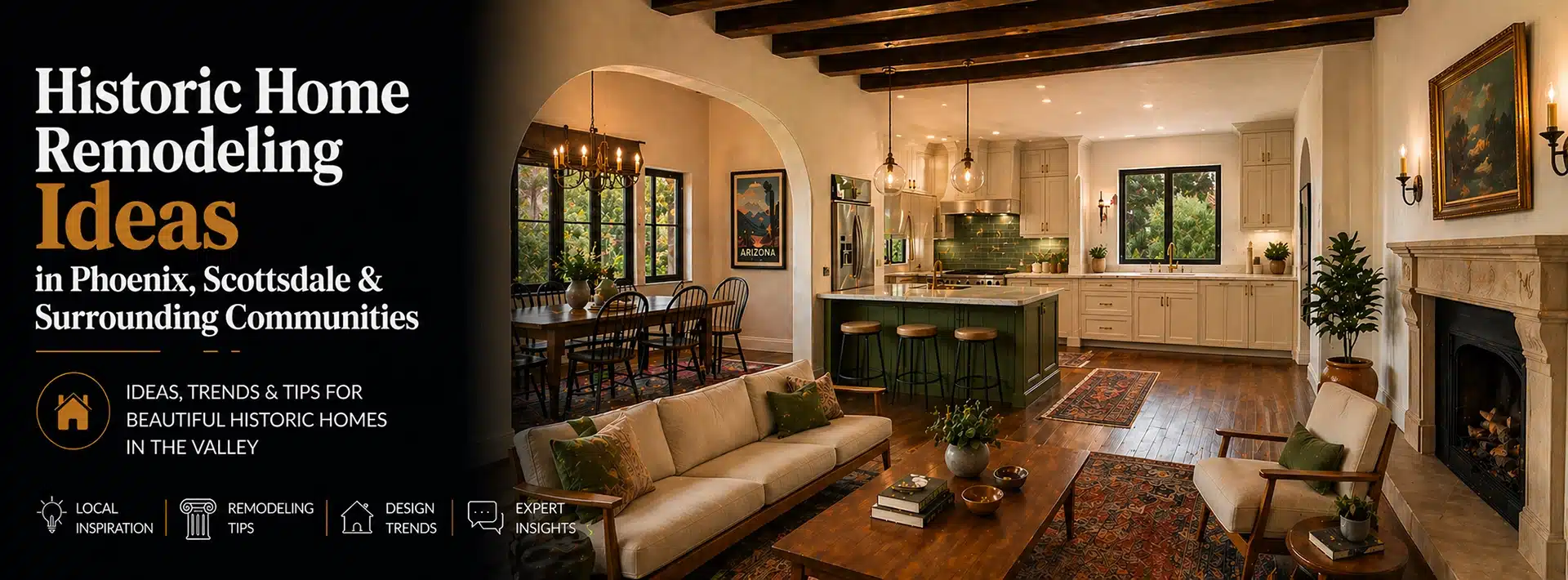
Historic Home Remodeling Ideas in Phoenix, Scottsdale & Surrounding Communities
Preserving Character While Adapting Homes for Modern Living
Historic homes in Phoenix and Scottsdale offer something that newer homes often cannot.
They carry a sense of identity.
From Spanish Colonial Revival homes in the Willo Historic District to early ranch homes and character-rich neighborhoods across central Phoenix, these homes reflect craftsmanship, proportion, and architectural intent that has endured for decades.
But living in a historic home also presents a unique challenge.
The way these homes were originally designed doesn’t always align with how people live today.
At Homework Remodels, historic remodeling is not about changing that identity. It’s about understanding it—then carefully adapting the home so it continues to function comfortably without losing what makes it special.
If you’re beginning to explore this type of project, understanding the Design-Build Remodeling Process can help you see how preservation and modernization are balanced from the very beginning.
Why Historic Remodeling Requires a Different Approach
Remodeling a historic home is fundamentally different from remodeling a newer one.
In a newer home, the focus is often on improving function or updating finishes. In a historic home, every decision carries more weight.
Walls, materials, and details are part of a larger architectural language. Changing one element can affect the entire composition.
That’s why historic remodeling begins with observation.
Understanding how the home was originally designed—its proportions, materials, and flow—creates a framework for making thoughtful changes. Without that understanding, it’s easy to introduce elements that feel out of place.
The goal is not to make the home feel new.
It’s to make it feel right.
Restoring Character Instead of Replacing It
Many historic homes have been remodeled multiple times over the years.
Each update may have solved a problem at the time, but over decades, those changes can begin to erode the original character of the home.
In many cases, the most impactful work is not adding something new—it’s removing what doesn’t belong.
This might involve restoring original materials, refining architectural details, or reintroducing elements that align with the home’s original style.
When done carefully, the home begins to feel more cohesive—as though it has been brought back into alignment with its original intent.
Updating Kitchens Without Losing Authenticity
Kitchens are often one of the most challenging spaces in historic homes.
They were typically designed as smaller, more utilitarian rooms, often separated from the main living areas. While that layout may no longer support modern living, completely reworking the space can risk losing architectural continuity.
The most successful kitchen remodels balance these two needs.
Layouts may be opened or reconfigured, but materials and detailing remain consistent with the home’s character. Cabinet profiles, finishes, and hardware are selected to feel appropriate rather than contemporary.
The result is a kitchen that functions for today while still feeling rooted in the home’s history.
If you’re exploring this balance, you can review Kitchen Remodeling Ideas for additional perspective on layout and design.
Reimagining Bathrooms with Sensitivity to the Home
Bathrooms in historic homes often present similar challenges.
They may be small, inefficient, or built with outdated systems. But like kitchens, they are part of the home’s overall architectural story.
Updating these spaces requires more than replacing fixtures.
Materials, scale, and detailing need to align with the rest of the home. At the same time, the layout must support modern comfort and usability.
When these elements are balanced, the bathroom feels both improved and appropriate.
Opening Layouts Without Losing Structure
Many homeowners consider opening up the layout of a historic home to improve flow and connection between spaces.
While this can be beneficial, it must be approached carefully.
Historic homes often rely on structural walls that also define the character of the space. Removing them without considering their role can disrupt both the structure and the architecture.
Instead of removing everything, thoughtful remodeling identifies where openness will have the greatest impact while preserving key elements that define the home.
If you’re considering structural changes, you can explore Open Concept Remodeling Ideas to understand how layout transformations can be approached responsibly.
Materials That Respect the Original Architecture
Material selection plays a critical role in historic remodeling.
Modern materials can be durable and efficient, but they must be used in a way that respects the home’s character. Texture, color, and scale all contribute to whether a material feels appropriate.
In many cases, natural materials—plaster, wood, stone, and tile—help maintain the authenticity of the space. Even when newer materials are introduced, they are chosen to complement rather than compete with the original architecture.
The goal is continuity, not contrast.
Addressing Hidden Structural and System Challenges
One of the realities of historic remodeling is that many issues remain hidden until construction begins.
Outdated electrical systems, aging plumbing, and structural inconsistencies are common in older homes. These challenges are not always visible during the early stages of planning.
Addressing them requires both flexibility and experience.
While these updates are often unseen once the project is complete, they are essential to ensuring the home functions safely and reliably moving forward.
If you’re beginning to explore these considerations, Pre-Construction Planning is where those details are evaluated.
Balancing Preservation with Modern Comfort
Historic homes were not originally designed with modern expectations in mind.
Heating and cooling systems, insulation, lighting, and overall comfort often need to be improved to meet current standards.
The challenge is integrating these upgrades without disrupting the home’s character.
When done thoughtfully, these improvements enhance the living experience while remaining largely invisible.
The home feels more comfortable, but it still feels like itself.
Historic Remodeling Across Phoenix Neighborhoods
Different neighborhoods bring different architectural styles and considerations.
In Willo and Encanto-Palmcroft, Spanish Colonial and early twentieth-century homes require careful attention to detail and preservation. In other areas, ranch-style homes may offer more flexibility while still benefiting from thoughtful design.
Understanding the context of the neighborhood helps guide design decisions.
If you’re exploring ideas in your area, you can see how remodeling is approached locally:
Seeing What’s Possible in Real Historic Homes
The most effective way to understand historic remodeling is to see how it has been done successfully.
Each home presents a different combination of architectural detail, structural condition, and homeowner goals. Seeing how these elements come together can help clarify what might be possible in your own project.
You can explore examples in the Homework Remodels portfolio, where historic homes have been thoughtfully restored and adapted for modern living.
Why the Process Matters in Historic Remodeling
Historic remodeling requires coordination between design, engineering, and construction at a deeper level than most projects.
Decisions made early influence how well the home’s character is preserved and how effectively modern updates are integrated.
A design-build approach allows these elements to be considered together from the beginning.
If you’re comparing approaches, you can explore Design-Build vs Traditional Remodeling.
What a Well-Restored Historic Home Feels Like
When everything comes together, the result is subtle.
The home feels more functional. More comfortable. More aligned with how it is used today.
But it doesn’t feel altered.
It feels as though the original intent of the home has been rediscovered—and allowed to continue forward.
Start Exploring Historic Remodeling Ideas
If you’re considering remodeling a historic home in Phoenix, Scottsdale, or a surrounding community, the most valuable step is understanding how preservation and improvement can work together.
With the right approach, your home can continue to reflect its history while supporting modern living.
👉 Schedule your free consultation to begin exploring your historic remodeling ideas with clarity.