
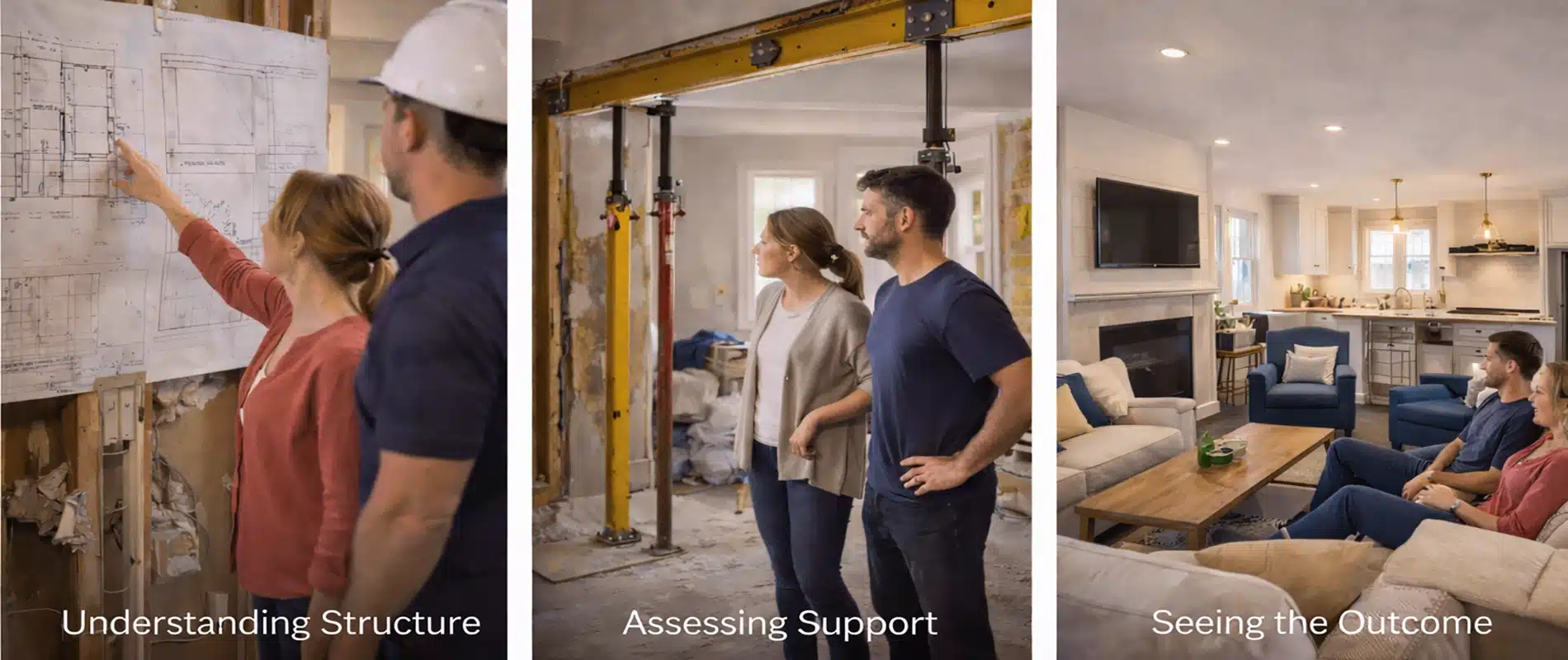
Structural Remodeling:
What Homeowners Need to Understand Before Removing Walls
Structural remodeling triggers a fundamentally different emotional response than finish-driven projects because it alters the parts of a home that quietly carry responsibility. Cabinets, flooring, and fixtures affect comfort and appearance. Structural elements affect safety, longevity, and trust in the building itself.
When homeowners hear phrases like load-bearing wall, beam sizing, or structural modification, the stakes immediately feel higher. These are not aesthetic decisions that can be adjusted later. They are interventions into systems that must work correctly every day, often without visible confirmation. The fear is not just about cost — it is about consequence.
This intimidation is rational. Structural mistakes are harder to detect, harder to reverse, and more tightly regulated because failures affect more than one room or one finish. They affect the way loads travel through the entire home. A problem introduced structurally may not reveal itself immediately, which makes the idea of “getting it wrong” feel especially dangerous.
What intensifies this anxiety is that most homeowners have never been taught how structure actually works. Without a mental model for load paths and support systems, decisions feel binary: proceed and hope for the best, or abandon the design entirely. Structural remodeling feels overwhelming not because it is unsafe, but because its logic is rarely explained in a way homeowners can evaluate calmly.
What “Load-Bearing” Actually Means (Beyond the Label)
The phrase load-bearing wall is often delivered as a warning rather than an explanation. Homeowners are told a wall is structural, but not what it is carrying, where that load originates, or how it can be redirected safely.
In reality, structural elements function as part of a system. Loads from the roof, upper floors, or lateral forces move downward through framing members until they reach the foundation. A wall may be bearing because it supports roof framing above, floor framing above, or both. Some walls carry load continuously; others only under specific conditions.
Understanding this distinction matters because removing a load-bearing wall does not mean removing support. It means replacing one support method with another. Beams, posts, headers, and footings are introduced to carry the same forces along a different path. When designed properly, the structure remains just as strong — sometimes stronger — than before.
When homeowners understand that structure is transferred rather than eliminated, the conversation shifts. Fear gives way to feasibility. The question becomes not “Can this wall come out?” but “What needs to replace it to do this correctly?”
Why Structural Changes Cannot Be Judged Visually
One of the most persistent misconceptions in remodeling is the belief that structure can be identified by appearance alone. Homeowners may assume a thick wall is load-bearing or that a thin wall is not. In practice, visual cues are unreliable.
Structural behavior depends on framing orientation, span lengths, connection points, and how loads are distributed throughout the house. A wall that appears minor may be critical, while a prominent wall may be carrying no load at all. Past renovations further complicate this, as framing may have been altered without documentation.
Because structure cannot be confirmed by sight, investigation is required. This may include attic or crawlspace evaluation, selective wall openings, plan review, or engineering analysis. These steps are not excessive caution — they are the difference between assumption and verification.
Structural remodeling becomes safer and more predictable when decisions are based on evidence rather than guesswork. Homeowners gain confidence not from reassurance, but from understanding why a conclusion was reached.
Role of Engineering in Structural Remodeling
Engineering is often misunderstood as a bureaucratic hurdle rather than a design enabler. Homeowners may worry that involving an engineer will restrict creativity or inflate costs. In reality, engineering expands what is possible by translating design intent into safe, buildable solutions.
A structural engineer evaluates loads, spans, and support conditions to determine how forces must be redirected when walls are removed. This analysis informs beam sizing, post placement, connection details, and foundation requirements. Without this work, builders are forced to rely on conservative assumptions or mid-project corrections.
Early engineering also protects homeowners from surprise. When structural requirements are defined before construction begins, budgets stabilize and timelines become more reliable. Engineering does not complicate the project — it removes ambiguity, which is what homeowners actually fear.
How Structural Changes Affect Cost in Non-Obvious Ways
Structural remodeling costs often surprise homeowners because they do not scale visually or proportionally. A single beam may cost more than an entire room of finishes, not because it is extravagant, but because it carries responsibility.
Costs are influenced by material type, span length, load requirements, access conditions, and installation complexity. Supporting posts may require new footings, which can trigger concrete work below finished floors. Temporary shoring, inspections, sequencing, and engineering all add cost without producing visible results.
These expenses are not upgrades; they are infrastructure. Understanding this helps homeowners interpret budgets realistically. Structural costs feel far less arbitrary when they are understood as the price of safety, longevity, and confidence rather than aesthetic indulgence.
Why Structural Decisions Must Be Made Early
Structural decisions create the framework around which all other decisions must align. When made early, they stabilize layouts, guide system planning, and allow accurate sequencing. When deferred, they disrupt work already in motion.
Late structural changes often force redesign of mechanical systems, permit revisions, and rework of framing or finishes. What could have been resolved deliberately during planning becomes expensive and stressful during construction.
Early structural planning also improves homeowner confidence. When people understand what is changing, why it is necessary, and how it supports their goals, decisions feel intentional rather than reactive. Structural remodeling becomes a source of clarity instead of anxiety.
Permits, Inspections, and Why Structure Is Heavily Regulated
Structural remodeling is regulated more tightly than cosmetic work because it directly affects occupant safety and long-term building performance. When loads are altered, redistributed, or newly introduced, building officials require verification that the work meets code and engineering standards.
Permits are not simply paperwork. They are checkpoints that confirm assumptions have been tested and documented. Plans must show how loads are transferred, how beams are supported, and how foundations are protected from overstress. Inspections then verify that what was designed is actually built as intended.
Homeowners sometimes fear that permitting slows projects unnecessarily. In reality, permitting protects homeowners from hidden shortcuts and future liability. Structural work performed without proper approval can create resale complications, insurance issues, and safety risks that surface years later. Regulation exists not to obstruct progress, but to ensure that progress is durable and defensible.
This regulatory layer is one reason structural decisions must be resolved during planning rather than discovered mid-build—a theme that connects directly to
Pre-Construction Explained: What Happens Before Construction Starts.
How Structural Work Interacts With Mechanical Systems
Structural changes rarely occur in isolation. Walls that carry load often also contain plumbing, electrical wiring, HVAC ducting, or all three. Removing or modifying a wall almost always requires system coordination.
Relocating a beam may affect ceiling heights, which can require duct rerouting. Structural posts may land where plumbing lines currently run. Electrical circuits may need to be reconfigured to maintain code-compliant clearances. These interactions are not exceptions—they are normal conditions in remodeling.
When structure and systems are planned together, conflicts are resolved on paper. When structure is addressed late, systems must be adjusted reactively, often at higher cost and with greater disruption. This is why structural remodeling benefits from an integrated planning approach rather than a sequential one.
Homes that feel calm during construction are not simpler; they are better coordinated. This coordination is one of the defining advantages discussed in
Design-Build vs. Traditional Remodeling: Why the Process Changes Everything.
Why Temporary Supports Matter More Than Homeowners Expect
One of the least visible yet most critical aspects of structural remodeling is temporary support, often referred to as shoring. Before a load-bearing element can be removed, its load must be safely supported elsewhere.
Temporary supports are engineered to carry full structural loads during demolition and installation. They prevent sagging, cracking, and unintended stress transfer while permanent elements are being installed. Improper shoring can damage finishes far beyond the immediate work area, including drywall cracks, door misalignment, and even foundation stress.
Homeowners may never notice temporary supports once the project is complete, but their presence is a key indicator of professionalism. Careful sequencing and adequate shoring signal that structure is being respected rather than rushed.
This is one reason timelines and costs shift when structural planning is incomplete—connections explored further in
Why Remodeling Timelines Feel So Uncertain.
Structural Remodeling in Older Homes Requires Extra Caution
Older homes introduce additional structural complexity because they were built under different codes, materials, and assumptions. Framing sizes may differ from modern standards. Load paths may be indirect. Past renovations may have altered structure without proper reinforcement.
In historic or mid-century homes, original design intent must be understood before modifications are made. Some houses rely on distributed load sharing rather than concentrated supports, which changes how walls can be removed safely.
This does not mean older homes cannot be opened up. It means they require deeper evaluation. Structural remodeling in these homes rewards patience and investigation. When handled thoughtfully, it can enhance both livability and longevity without erasing character—a balance examined in
Remodeling Older Homes Without Losing Character.
What Structural Remodeling Teaches Homeowners About Process
Structural remodeling exposes the difference between hopeful planning and disciplined preparation. It reveals whether decisions are being made proactively or reactively, whether risk is addressed early or deferred.
Homeowners often discover through structural work that clarity is not accidental. It is built through investigation, sequencing, and communication. When structure is planned early, the rest of the remodel feels more predictable. When structure is treated casually, uncertainty spreads into cost, schedule, and trust.
This realization frequently changes how homeowners evaluate their remodeling partner. Structural remodeling rewards teams who explain, document, and coordinate—not those who simply reassure. This shift in evaluation mirrors the mindset described in
Design-Build vs Traditional Remodeling
Structural Remodeling as a Confidence Builder, Not a Fear Trigger
When homeowners understand structural remodeling, fear gives way to confidence. Walls stop feeling like mysterious barriers and start feeling like components of a system that can be adapted safely.
Structural remodeling does not need to feel risky or adversarial. When approached with proper evaluation, engineering, and planning, it becomes one of the most empowering aspects of a remodel. It allows homes to evolve—opening layouts, improving flow, and supporting modern living—without sacrificing safety.
The true value of understanding structure is not just a better floor plan. It is peace of mind. When homeowners know how and why their home is supported, they move forward with clarity instead of hesitation. Structural remodeling becomes not a leap of faith, but a well-supported decision.
That confidence carries through every other choice—reinforcing the broader truth explored in
How Remodeling Decisions Create (or Destroy) Peace of Mind.