
The Remodeling System That Actually Works
How Preparation, Decisions, and Design Create Predictable Outcomes
Why Some Remodels Feel Calm and Others Feel Chaotic
Some remodeling projects feel tense from the start. Others feel steady—even when complications arise. This difference is rarely explained clearly, which leads homeowners to believe outcomes are driven by luck, personality, or contractor quality alone.
They are not.
Calm remodeling projects are not simpler, smaller, or luckier. They are structured differently. They follow a system that governs how decisions are made, how uncertainty is addressed, and when complexity is confronted rather than deferred.
Most remodeling stress does not come from construction itself. It comes from unresolved questions arriving too late, decisions being forced under pressure, and homeowners being asked to interpret chaos without context. When those patterns repeat, remodeling feels unpredictable—even when the craftsmanship is excellent.
This guide exists to clarify something the industry rarely articulates:
successful remodeling outcomes are designed, not discovered.
They are the result of a system—one that manages uncertainty deliberately instead of reacting to it mid-project.
Remodeling Is a System, Not a Series of Tasks
Homeowners are often led to think of remodeling as a sequence of tasks: design, demo, framing, finishes. This task-based thinking feels intuitive, but it is incomplete.
Remodeling is a system. Each decision affects multiple downstream conditions. Structure influences layout. Layout influences systems. Systems influence timelines. Timelines influence stress. When these relationships are treated independently, problems emerge—not because anyone is careless, but because the system is misaligned.
Task-based thinking focuses on what is happening.
System-based thinking focuses on how decisions interact.
This distinction explains why two projects with similar scope can feel radically different. One proceeds with calm adjustments. The other spirals into urgency. The difference is not the number of tasks—it is how uncertainty and decisions are managed across the system.
Where Remodeling Systems Break Down
Most remodeling breakdowns follow predictable patterns.
Decisions are deferred because committing early feels uncomfortable. Assumptions are made to allow pricing to move forward. Planning is compressed to start construction sooner. Each choice feels reasonable in isolation.
Collectively, they destabilize the project.
Deferred decisions do not disappear. They migrate into construction, where time pressure amplifies their impact. Fragmented responsibility spreads accountability across designers, contractors, and homeowners. Pricing models mask uncertainty instead of addressing it. Timelines prioritize speed over readiness.
These breakdowns are explored individually throughout the Core Guides—such as in
Design-Build vs. Traditional Remodeling.
This Guide exists to show why those issues are connected—not isolated mistakes, but systemic failures.
Uncertainty Is the Real Cost Driver
Uncertainty exists in every remodel. The difference between calm and chaos is whether that uncertainty is acknowledged early or discovered late.
When unknowns are ignored, they do not vanish. They accumulate. They compound. They surface simultaneously during construction, when changes are most disruptive and expensive.
This is why cost volatility feels personal to homeowners even when it is procedural. It is not that budgets are wrong—it is that assumptions were never verified.
Projects that feel stable treat uncertainty as a design input. Investigation happens early. Structural realities are evaluated. Systems are coordinated. Decisions are sequenced.
This approach is explored deeply in
Design-Build vs. Traditional Remodeling: What Happens Before Construction Starts
Uncertainty cannot be removed. It can only be managed or deferred.
Deferred uncertainty is what homeowners experience as surprise.
Decision Architecture Is the Foundation of Calm Projects
Remodeling stress is often blamed on difficult decisions. In reality, stress comes from decision timing, not decision difficulty.
When decisions are forced during construction, they arrive under pressure. Work is waiting. Costs feel unstable. Options are constrained. Even good choices feel wrong when made in urgency.
Well-structured projects reverse this pattern. Decisions are made when information is available, options are flexible, and consequences are visible. This creates orientation rather than anxiety.
This principle is expanded in
How Remodeling Decisions Create (or Destroy) Peace of Mind
Calm projects are not decision-light. They are decision-prepared.
Why Preparation Is the Highest-Leverage Phase
Preparation is often mistaken for delay. In reality, it is the phase where predictability is built.
Pre-construction resolves questions construction cannot. It converts assumptions into verified information. It aligns structure, systems, and sequencing before disruption begins.
Projects that rush this phase may start construction sooner, but they often pause repeatedly once work begins. Momentum feels strong early and fragile later.
Prepared projects behave differently. Construction may start later, but it proceeds with fewer stops, fewer re-decisions, and greater emotional steadiness.
This is why homeowners who understand preparation stop measuring progress by visible activity and start measuring it by stability.
Structural Thinking Changes Everything
Structure is where remodeling fear concentrates. Walls feel permanent. Loads feel mysterious. Mistakes feel irreversible.
That fear is rational.
Structural changes affect more than safety—they influence layout, systems, character, and future adaptability. When structure is treated as a late-stage obstacle rather than an early design driver, both cost and stress increase.
Structural thinking reframes the question from “Can this wall come out?” to “What role does this element play, and how do we honor it while improving function?”
This perspective connects directly to
Structural Remodeling: What Homeowners Need to Understand Before Removing Walls
and
Remodeling Older Homes Without Losing Character
When structure is addressed early, design becomes safer—not riskier.
Systems That Support Long-Term Living
Short-term upgrades create immediate satisfaction. Long-term value comes from system alignment.
Homes that perform well over time do so because structure, layout, and systems were coordinated—not optimized independently. This coordination reduces re-remodeling, emergency upgrades, and forced decisions later.
Universal design plays a key role here, as explained in
Universal Design Explained: Remodeling for Life, Not Just for Today
Adaptability is not a bonus feature. It is a form of insurance that preserves options instead of forcing reactions.
The Emotional Math of Remodeling
Remodeling stress compounds quietly.
Daily friction. Decision fatigue. Visual disorder. Disrupted routines. Each alone is manageable. Together, they erode confidence.
Projects feel out of control not because problems exist, but because homeowners cannot interpret them. Without context, silence feels dangerous. Delays feel existential. Small issues feel systemic.
This dynamic is explored in
Why Problems Feel Bigger During Construction
Calm projects are intelligible. Homeowners understand what is happening, why it changed, and what it affects. That understanding—not perfection—is what stabilizes experience.
Why Good Contractors Still Produce Bad Experiences
Skill alone does not stabilize remodeling.
Even highly competent professionals can produce chaotic outcomes when working inside fragmented systems. When responsibility is divided, communication becomes reactive. When decisions are deferred, urgency replaces clarity.
This is why homeowners can hire “good people” and still feel overwhelmed. The issue is not character or effort—it is structure.
The distinction between competence and coordination is why
Design-Build vs. Traditional Remodeling
matters far more than many homeowners realize.
The Remodeling System That Actually Works
Successful remodeling systems share consistent traits:
- Early investigation
- Structured decision sequencing
- Integrated responsibility
- Transparent risk discussion
- Preparation before execution
This is not branding. It is behavior.
Projects that follow this system feel calmer because uncertainty is addressed when it is least disruptive—not when it is most expensive.
How to Recognize This System in Practice
Prepared remodelers explain things voluntarily. They discuss what could change—not just what won’t. They describe process before promising outcomes.
They do not rush reassurance. They offer structure.
Homeowners who learn to listen for these signals stop choosing based on confidence alone and start choosing based on preparedness.
Remodeling Success Is Designed, Not Discovered
Calm remodeling outcomes are not rare. They are structured.
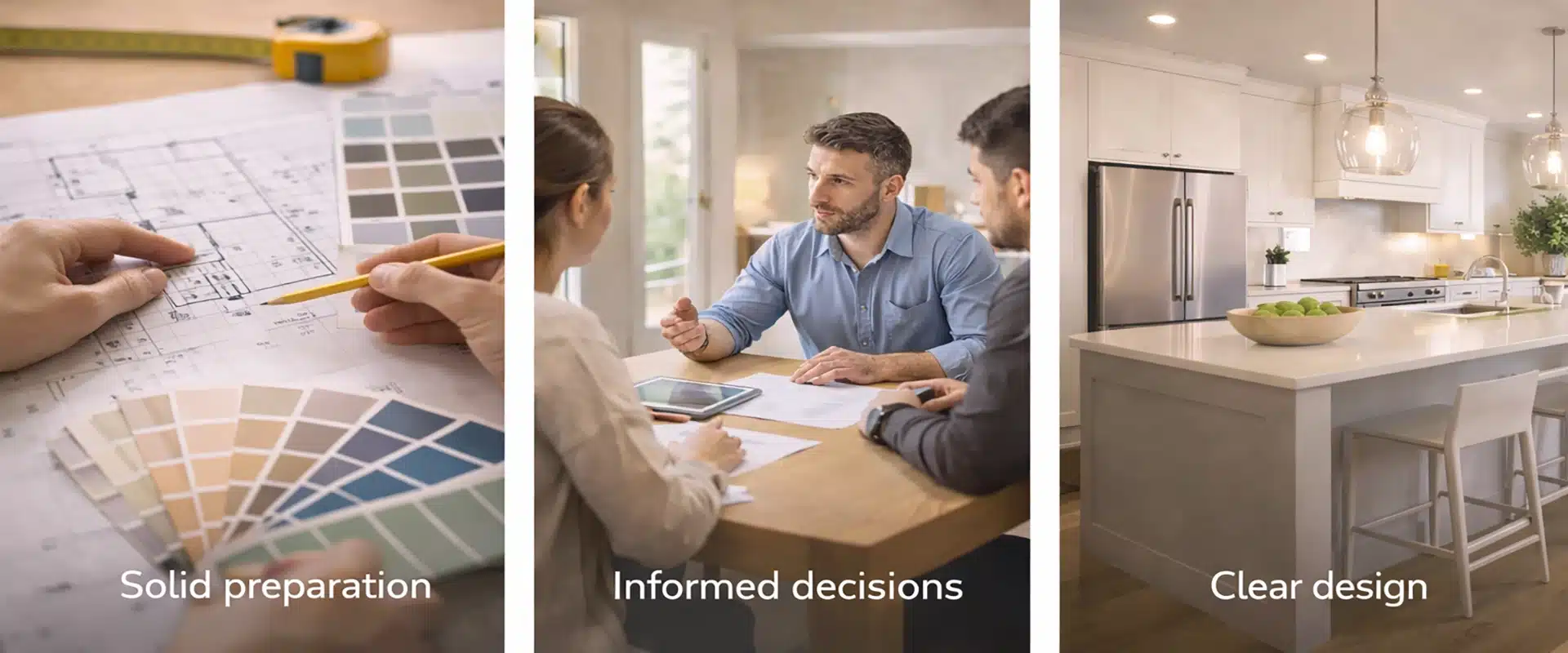
When preparation, decisions, and design are aligned, remodeling stops feeling like a gamble and starts feeling navigable—even when challenges arise.
This understanding changes everything. Remodeling becomes stewardship rather than risk. Confidence replaces vigilance. Progress feels intentional instead of reactive.
That is the system that actually works.