
Willo Bathroom Remodeling for Historic Homes
A bathroom in a Willo home may occupy a modest footprint, but remodeling it can involve nearly every part of the building. Plumbing, drainage, ventilation, electrical work, framing, waterproofing, flooring, cabinetry, lighting, and historic character must all come together within a room that homeowners use every day.
Many original Willo bathrooms were designed before contemporary expectations for storage, privacy, larger showers, layered lighting, and long-term accessibility. Some retain valuable tile, cabinetry, windows, or architectural details. Others have been remodeled in styles that no longer relate to the house or conceal aging systems that require attention.
Homework Remodels provides design-build bathroom remodeling for Willo homeowners who want better daily function without losing the qualities that make their historic homes distinctive. Since 2005, our team has coordinated design, existing-condition investigation, budgeting, engineering when needed, selections, permitting, preservation considerations, and construction for established Central Phoenix homes. The finished bathroom should feel comfortable and reliable, but it should also feel as though it belongs within the larger house.
Begin With the Bathroom’s Daily Demands
A strong bathroom plan begins with the people who will use the room and the problems they need it to solve. A primary bathroom may need privacy for two people, better connection with a closet, more useful storage, or a shower that supports long-term comfort. A hall bathroom may need to serve family members and guests without feeling crowded. A smaller secondary bath may benefit more from a disciplined layout than from additional fixtures.
These routines shape the plan. The location of doors, windows, fixtures, cabinetry, towel storage, lighting, and circulation should work together rather than being selected independently. A larger vanity is not helpful if it restricts the doorway, and an oversized shower may not justify sacrificing needed storage or the proportions of the room.
Our primary Willo historic home remodeling page explains how bathroom decisions relate to the architecture, systems, and long-term plan for the property. The bathroom may remain a focused project, but its design should still respect the home beyond its walls.
Existing Conditions Determine What the Remodel Must Address
Historic bathrooms often contain conditions that are difficult to evaluate from the finished surfaces. Previous repairs may have altered framing, patched plumbing, covered original materials, or added layers of flooring. Water exposure can affect subfloors, wall framing, plaster, and adjacent rooms long before visible damage becomes obvious.
Preconstruction investigation helps establish what can reasonably be known before demolition. The team may evaluate fixture locations, accessible plumbing, floor elevations, wall construction, ventilation routes, electrical capacity, window conditions, and the relationship between the bathroom and the rooms around it. This work cannot reveal every concealed condition, but it creates a more responsible basis for design and budgeting.
When demolition does uncover an unexpected condition, the response should protect the larger home. Repairing deteriorated structure, correcting improper plumbing, or rebuilding a weak substrate is more important than preserving a finish schedule that no longer reflects the reality inside the walls.
A Better Layout Does Not Always Require a Larger Room
Older bathrooms can feel cramped because of door swings, fixture placement, platform tubs, oversized enclosures, or cabinetry that interrupts movement. Reorganizing those elements may improve the room substantially without expanding its footprint.
The design should consider clearances, privacy, sightlines from the bedroom or hallway, access to towels and toiletries, and how one person moves through the room while another uses it. Pocket or outswing doors may be considered where appropriate, but their wall requirements and relationships with switches, plumbing, and structure must be evaluated. Relocating fixtures can improve function, although the benefits must justify changes to drainage, venting, framing, and flooring.
Expansion may be appropriate when adjoining space can be used without weakening another room or disrupting an important feature. The goal is not to make every historic bathroom large. It is to use the available area deliberately so the room feels calm, understandable, and comfortable.
Water Management Is the Foundation of the Finished Bathroom
Tile and plumbing fixtures receive most of the visual attention, but a bathroom’s long-term success depends on work that disappears behind them. Shower waterproofing, drain slope, pan construction, penetrations, movement joints, substrate preparation, and transitions at walls and floors must be planned as a connected system.
Ventilation is part of water management as well. An appropriately selected and ducted exhaust fan helps control humidity, but its route through a historic house can affect framing, ceilings, roofing, and exterior appearance. Relying on an operable window alone may not support the way the bathroom is used throughout the year.
Supply piping, drainage, shutoffs, fixture compatibility, and access for future service should be evaluated before walls are closed. Thoughtful planning protects the tile, cabinetry, finishes, and rooms surrounding the bathroom from preventable moisture problems.
Accessibility Can Feel Like Thoughtful Design
Many Willo homeowners intend to remain in the homes and neighborhood they value. A bathroom remodel creates an opportunity to support future comfort without making the room feel clinical or adding visible features that are not currently needed.
A curbless or low-threshold shower can simplify entry while creating a cleaner visual transition. Practical clearances, a stable place to sit, handheld shower capability, easy-to-operate controls, slip-conscious surfaces, and well-positioned lighting can improve the experience for people of many ages and abilities. Reinforcement can also be installed inside walls so support bars may be added later without reopening finished tile.
These decisions work best when they are incorporated from the beginning. Drainage, floor structure, shower dimensions, glass, niches, benches, controls, and waterproofing all influence whether an accessible shower performs correctly. Homework Remodels’ Universal Design Certified Professional experience helps integrate long-term usability into a bathroom that still feels personal and architecturally appropriate.
Storage Should Reduce Clutter Without Filling Every Wall
Historic bathrooms often lack the cabinetry and linen storage expected today. The answer is not always the largest possible vanity. Storage should reflect what the household keeps in the room and where each item is used.
Drawers can make grooming supplies easier to see and reach. A recessed cabinet may use wall depth efficiently when framing and utilities allow it. Tall cabinetry can hold linens, while a vanity designed around plumbing can capture space that standard cabinet arrangements waste. Niches and ledges can support shower use when their location, slope, waterproofing, and visual alignment are planned carefully.
The cabinetry should remain proportionate to the room. Some open wall area, natural light, and visual breathing room may be worth more than storage that makes the bathroom feel crowded. Hardware, door style, paint, and wood can reference the home’s character without attempting to reproduce an original bathroom that never existed.
Lighting and Ventilation Should Be Coordinated With the Architecture
Bathrooms require clear task lighting, comfortable general illumination, and safe nighttime use. One ceiling fixture rarely serves all three purposes. Vanity lighting should illuminate faces without harsh shadows, while shower and bathing areas need suitable fixtures and controls for wet locations.
Decorative lighting can add warmth, but its scale and placement should relate to mirrors, cabinetry, ceilings, and original details. Recessed fixtures should not be scattered simply to increase brightness. Historic plaster, roof framing, ductwork, and ceiling features may limit locations, making a coordinated lighting plan especially important.
Natural light can strengthen the room when privacy is protected. Existing windows may be retained, repaired, or incorporated into the layout when their condition and location allow. Glass, shades, landscaping, and fixture placement can balance daylight with privacy without automatically sacrificing an architectural opening.
Materials Should Respect the House and the Way the Room Is Used
Historic character does not require every new fixture and finish to be a reproduction. It requires materials to work together in a way that respects the house’s scale, warmth, and architectural language.
Tile pattern, size, texture, grout, trim, stone, cabinetry, metals, and paint should form a coherent composition. Handcrafted or period-informed details can create depth when used with restraint. Contemporary fixtures can also belong when their forms are calm and their proportions support the room rather than competing with it.
Performance matters as much as appearance. Flooring should balance durability, cleaning, and slip resistance. Countertops, cabinet finishes, shower glass, and plumbing fixtures should fit the household’s tolerance for maintenance. Materials exposed to water, cleaning products, sunlight, and daily use should be selected for how they will age, not simply how they look when newly installed.
A Willo Bathroom Restoration Demonstrates Architectural Alignment
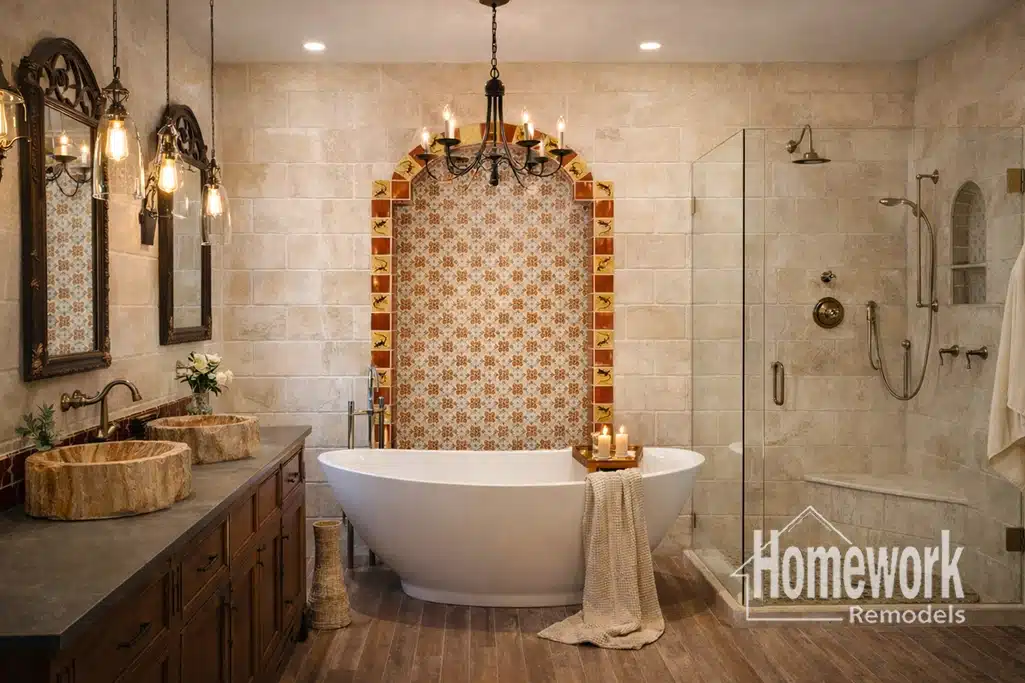
Homework Remodels remodeled the primary bathroom of a 1928 Spanish Colonial home in Willo after an earlier Art Deco renovation had introduced glass block, polished marble, mirrors, and fluorescent lighting that felt disconnected from the rest of the house. The new work corrected underlying ceiling and floor conditions while reestablishing a warmer architectural relationship with the home.
The Willo Spanish Revival bathroom project used travertine, handcrafted Mexican tile accents, a recessed shower pan, a freestanding tub, improved lighting, storage, and updated plumbing. It was the final phase of a multi-year restoration that also included the kitchen and exterior, illustrating how a bathroom can gain modern comfort while contributing to a consistent whole-home direction.
Our 1935 Willo historic-home renovation offers a different lesson. Its primary bathroom was redesigned with a curbless shower and improved circulation as part of larger structural, mechanical, plumbing, electrical, and architectural work. Coordinating the bathroom with the entire house allowed accessibility and performance to be addressed without isolating them from the surrounding renovation.
Decide Whether the Bathroom Should Remain a Focused Project
A standalone bathroom remodel can be an appropriate investment when the room’s needs are well defined and the surrounding suite, plumbing systems, and circulation otherwise function well. This scope allows homeowners to solve comfort, storage, water-management, and accessibility concerns without expanding construction unnecessarily.
Broader planning may be justified when the bathroom depends on reconfiguring bedrooms and closets, correcting substantial floor or structural conditions, replacing plumbing throughout the home, or coordinating several rooms. It may also make sense when the kitchen, mechanical systems, or whole-home finishes need work during the same period.
The distinction should be made before the design becomes fixed. A long-term plan helps the team protect newly completed work and gives the homeowner a clear understanding of which improvements belong in the present project.
Design-Build Planning Connects the Visible and Invisible Work
A historic bathroom compresses design, plumbing, waterproofing, ventilation, electrical work, structure, selections, and preservation decisions into a small space. Separating those responsibilities can allow a beautiful concept to advance without a reliable plan for building it.
Our design-build remodeling process coordinates investigation, design, budgeting, selections, required engineering, permitting, construction planning, and execution under one accountable team. Preconstruction provides the time to test layout decisions, evaluate system implications, establish realistic cost expectations, and resolve important details before demolition.
Homework Remodels is licensed in Arizona and led by professionals with NARI Master Certified Remodeler, Master Certified Kitchen & Bath Remodeler, Universal Design Certified Professional, and Green Certified Professional credentials. Those qualifications support the judgment required to improve a historic bathroom while protecting the home around it.
Ready to Plan Your Willo Bathroom Remodel?
A successful Willo bathroom should manage water reliably, support comfortable daily routines, and remain appropriate to the historic house for years to come. The right project may transform one focused bathroom or become part of a coordinated primary-suite or whole-home plan.
Schedule a consultation with Homework Remodels to discuss your bathroom, your home’s existing conditions, and the planning needed to move from ideas to a buildable project.
Ready to Plan Your Willo Bathroom Remodel?
Begin with a thoughtful conversation about your historic home, your daily needs, and the bathroom improvements that will matter for years to come.