
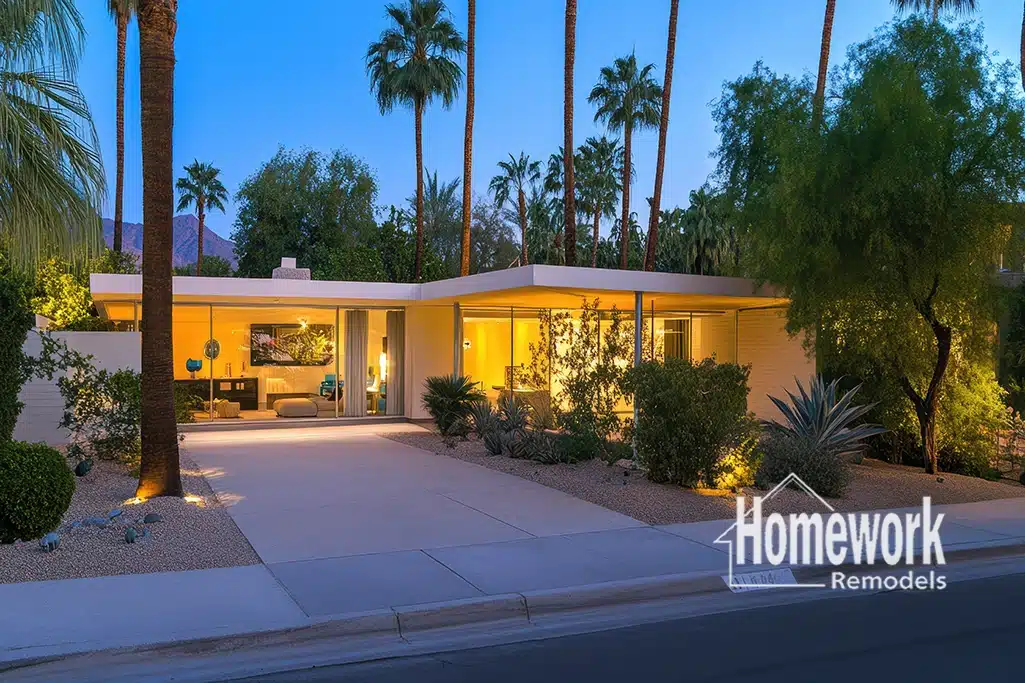
Mid-century modern remodeling planning isn’t simply about choosing finishes that look appropriate to the period. The most consequential decisions involve how the floor plan, structure, roof, windows, mechanical systems, cabinetry, lighting, and outdoor connections work together after the remodel.
Design conflicts occur when you make those decisions independently or in the wrong order. A kitchen layout may look resolved until a structural beam lowers the ceiling, new ductwork crosses a clerestory window, or appliance requirements consume the wall area needed to preserve the room’s original proportions.
The solution is not to freeze a mid-century home in time. It is to establish a coordinated decision sequence that protects the home’s architectural strengths while making it more comfortable, efficient, and useful for the people who live there now.
Why Mid-Century Homes Require Coordinated Planning
Many mid-century homes achieve their character through a small number of carefully related elements: low rooflines, long horizontal views, exposed or visually important structural members, clerestory windows, restrained materials, and direct connections between indoor and outdoor spaces. Because the architecture depends on those relationships, changing one element can alter several others.
A conventional room-by-room approach can miss those connections. Before developing individual kitchen, bathroom, addition, or window designs, homeowners benefit from understanding the broader principles described in our mid-century modern remodeling guide and determining which features give their particular home its identity.
The objective is not to preserve every original component regardless of condition or usefulness. The objective is to distinguish between features that carry the architecture and components that can be changed without weakening the home’s overall composition.
Begin With the Existing Home, Not the Proposed Design
A reliable plan begins with documentation of existing conditions. Original drawings can be helpful when they exist, but field measurements and professional evaluation are still necessary because past alterations, concealed conditions, and construction variations may not appear in the documents.
The investigation should identify structural bearing points, roof framing direction, ceiling and soffit depths, window and door openings, plumbing locations, electrical capacity, HVAC distribution, drainage conditions, and transitions to patios or additions. This information creates a common factual basis for design decisions before attractive concepts become expensive assumptions.
Homes associated with Ralph Haver and other Valley builders may share recognizable ideas without being structurally identical. Our guide to Ralph Haver neighborhoods explains why neighborhood history is useful context, but the actual home must still be evaluated on its own conditions.
Define What the Remodel Must Protect
Once the existing home is understood, the project team and homeowner should identify the architectural priorities that will guide later tradeoffs. These may include maintaining a low roof profile, preserving exposed masonry, protecting a line of clerestory windows, retaining a strong indoor-outdoor axis, or keeping structural rhythm visible across an open living area.
This step prevents preservation from becoming a vague preference that disappears when the first conflict occurs. It also prevents the opposite problem: treating every existing detail as equally important and limiting changes that could substantially improve daily life.
A Practical Decision Order for Mid-Century Remodeling
The exact sequence varies by home and project scope, but major decisions should generally move from broad constraints toward detailed selections. The following order allows each layer of the design to respond to decisions that have already been tested.
- Establish goals and priorities. Define how the home needs to function, which problems must be solved, and which original qualities are most important to retain.
- Document existing conditions. Verify dimensions, structure, systems, openings, site relationships, and known alterations before relying on a proposed layout.
- Set preservation principles. Identify the rooflines, views, materials, proportions, and architectural features that should govern the design.
- Develop the spatial plan. Test circulation, furniture, storage, accessibility, and connections between rooms before finalizing structural changes.
- Coordinate structure and openings. Resolve beams, posts, roof modifications, doors, glazing, and clerestories as one system with appropriate professional input.
- Plan mechanical, electrical, and plumbing systems. Confirm capacities and routes before cabinetry, ceilings, lighting, and finish details are fixed.
- Resolve built-ins and equipment. Coordinate appliances, cabinets, vanities, fixtures, and storage with the architecture and the available system connections.
- Select materials and lighting. Use a restrained palette that supports the home’s proportions and works with the technical requirements already established.
- Reconcile scope, budget, permits, and construction sequence. Make final scope decisions while changes can still be evaluated on paper rather than improvised during construction.
This is not a rigid formula, and some steps must advance together. Its value lies in keeping later selections from controlling earlier architectural decisions that are more difficult and costly to reverse.
Layout and Structure Must Be Tested Together
Opening a kitchen or connecting living spaces may appear to be a floor-plan decision, but it is also a structural and architectural decision. Removing a wall can require a beam, posts, new foundations, roof reinforcement, or changes to ceiling depth that affect the very openness the project was intended to create.
A beam that is resolved late may interrupt a continuous ceiling plane or compete with an original structural rhythm. Before committing to wall removal, the design team should compare structural approaches and their visible consequences, guided by site-specific engineering and permit requirements.
This coordination matters most when a proposed opening sits near large glass areas or clerestories. The goal is not merely to create the widest possible span, but to achieve a proportioned space in which structure, ceiling, light, and circulation remain coherent.
Clerestory Windows Affect More Than Natural Light
Clerestory windows can define the scale of a room, create privacy, and make a low roof appear to float above the walls. They also occupy space that might otherwise be used for headers, ductwork, wiring, upper cabinets, or new structural connections.
Replacing, enlarging, or relocating them therefore cannot be treated as an isolated window decision. Our article on clerestory windows in mid-century modern remodeling examines how to evaluate light, glazing performance, structure, and original proportions together.
A late mechanical or cabinetry decision can easily compromise a well-intended clerestory plan. Confirming routes, equipment clearances, and storage needs early protects both the architectural effect and the practical performance of the room.
Kitchen Planning Can Reveal Whole-Home Conflicts
A mid-century kitchen remodel often becomes the point where the home’s systems and spatial relationships meet. Appliance loads affect electrical planning, plumbing locations influence island feasibility, ventilation affects roof or wall penetrations, and cabinetry competes with windows and open sightlines.
For that reason, don’t design a kitchen as a collection of cabinets placed inside an empty room. A successful mid-century modern kitchen remodel starts with circulation, connections to dining and outdoor areas, architectural proportions, and the routes required for modern equipment.
The design also needs to balance storage with visual restraint. Filling every wall with tall cabinetry may increase capacity while eliminating the horizontal openness, daylight, and breathing room that made the original interior distinctive.
Bathrooms Require Architectural and Technical Restraint
Bathrooms are smaller than kitchens, but their technical density can create equally significant conflicts. Drain locations, ventilation, waterproofing, lighting, electrical clearances, accessibility goals, and storage must fit within a limited footprint without producing a crowded visual result.
A thoughtful mid-century modern bathroom remodel can improve comfort and durability without relying on novelty or theme-based decoration. Simple geometry, carefully placed light, durable materials, and well-integrated storage usually support the architecture more effectively than a collection of period-inspired gestures.
Modern Systems Need Places to Go
Older mid-century homes may have shallow roof or ceiling assemblies, limited service space, undersized electrical capacity, aging plumbing, or HVAC distribution that no longer suits the proposed layout. Modern equipment may be more efficient, but it still requires capacity, access, drainage, ventilation, clearances, and workable distribution routes.
When system planning follows finish design, practical necessities often appear as dropped soffits, awkward chases, exposed devices, or compromises to windows and built-ins. Coordinating systems before ceilings and cabinetry are finalized gives the team more opportunities to integrate them quietly.
This is one reason a focused room remodel may need a whole-home systems review. The review does not automatically expand the construction scope, but it reveals whether the proposed work depends on upgrades elsewhere and helps homeowners make those choices intentionally.
Additions Must Continue the Home’s Logic
An addition can solve space limitations while creating new challenges for roof form, massing, daylight, drainage, circulation, and the relationship between the house and yard. Simply attaching more square footage can overpower the original building or create an interior connection that feels like a passage between unrelated structures.
Early planning should test how the new volume meets the existing roof, where water will move, how original rooms will retain daylight, and whether the addition reinforces the home’s indoor-outdoor organization. The strongest solution may be visually compatible without copying every historic detail.
When changes affect several connected spaces, the planning principles behind mid-century modern whole-home remodeling can help establish one coordinated architectural direction instead of a sequence of disconnected projects.
Energy Improvements Must Respect Proportion and Fabric
Improved glazing, insulation, air sealing, shading, and mechanical equipment can make a mid-century home more comfortable and efficient. However, replacement assemblies may have different frame dimensions, glass characteristics, roof-edge depths, or installation requirements that alter the appearance of important elevations and openings.
Evaluate performance decisions alongside the features they affect. A technically superior component is not automatically the best architectural fit, and an authentic-looking component is not sufficient if it cannot meet the project’s durability, safety, or comfort requirements.
Materials Should Create Continuity, Not a Theme
Material selection comes late in the decision sequence because finishes need to respond to the established architecture, lighting, use, and construction details. Choosing a palette too early can encourage the project to imitate a fashionable image rather than solve the actual home.
Wood, masonry, terrazzo-inspired surfaces, restrained tile, and warm metals can all work in a mid-century setting, but no single material guarantees an appropriate result. Continuity comes from proportion, repetition, transitions, and discipline across the whole composition.
Homeowners should also examine how new materials meet existing ones. A small number of deliberate junctions usually creates a calmer result than using different finishes to announce every remodeled area.
Budget Decisions Belong in the Design Process
Budget is not a final check performed after design is complete. Structural spans, window systems, custom cabinetry, system upgrades, and finish details all influence cost, and they should be evaluated while meaningful alternatives remain available.
A disciplined plan separates architectural priorities from preferences that can change without weakening the project. It also identifies alternates in advance, so a cost adjustment does not trigger a hurried substitution that creates new conflicts elsewhere.
For example, changing an opening size may affect structure, glazing, exterior composition, interior furniture placement, and mechanical routes at the same time. The apparent saving should therefore be measured against the total design consequence, not just the price of one component.
Permitting and Engineering Should Inform the Plan Early
Permit and engineering requirements vary with the home, jurisdiction, and scope of work. Structural changes, enlarged openings, additions, electrical service upgrades, plumbing alterations, and mechanical work may require documentation or review that affects both design and schedule.
Early professional coordination allows these requirements to shape a feasible solution before construction begins. Homeowners should rely on site-specific guidance from qualified design, engineering, trade, and permitting professionals rather than assuming that a detail used in another mid-century home will apply to theirs.
How Design-Build Reduces Unresolved Handoffs
Mid-century projects benefit when architectural ideas, structural implications, system requirements, cost, and construction logistics are evaluated by one coordinated team. A design-build process creates regular checkpoints at which those disciplines can challenge assumptions before the work reaches the field.
This does not eliminate tradeoffs or concealed conditions, but it makes responsibility for resolving them clearer. Our explanation of design-build versus traditional remodeling can help homeowners compare how different project structures handle coordination and accountability.
Questions to Resolve Before Construction
A strong pre-construction plan should allow the homeowner and project team to answer the following questions with evidence rather than assumptions. If an answer remains uncertain, the uncertainty should be identified, investigated, or carried as a clearly defined allowance or contingency.
- Which architectural features are essential to the home’s identity, and how will the proposed work protect them?
- Which walls, beams, roof areas, openings, or foundations require professional structural evaluation?
- Can the existing electrical, plumbing, and HVAC systems support the proposed rooms and equipment?
- Where will new ducts, pipes, wiring, lighting, ventilation, and service access be located?
- How will new windows, doors, cabinets, and built-ins affect daylight, views, circulation, and furniture placement?
- How do proposed additions or exterior changes affect roof form, drainage, shade, and the relationship to the yard?
- Which decisions are fixed priorities, and which alternatives can protect the budget without weakening the architecture?
- What permits, engineering, selections, and approvals must be complete before construction starts?
Resolving these questions does more than reduce surprises. It gives the homeowner a coherent basis for evaluating options when new information appears during design or construction.
Planning Protects Both Character and Daily Life
A successful mid-century remodel should feel as though the home has evolved with care rather than accumulated unrelated upgrades. That result comes from making decisions in a deliberate order and examining how every major change affects structure, systems, light, proportion, materials, and use.
Homeowners beginning a broader project can explore our mid-century modern home remodeling services for an overview of how preservation and modernization can be coordinated. The purpose of planning is not to make the process rigid; it is to create enough clarity that good ideas can be tested before they become costly conflicts.
Planning a Mid-Century Remodel?
Begin with a coordinated evaluation of your home, priorities, and project constraints. Homework Remodels can help you develop a design-build plan that improves daily life while respecting the architecture that makes your home distinctive.